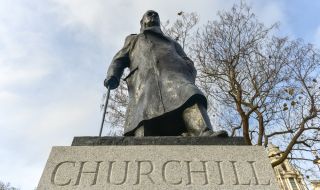
On September 19, 1946, British politician Winston Churchill called for the creation of a United States of Europe. This was done in a significant speech to students at the University of Zurich.
Churchill had won the bloodiest military conflict in the world conflict, but lost the election.
This did not discourage him and he formulated his conclusions, drawn from the lessons of history, in his famous “Speech to the Academic Youth“, delivered at the University of Zurich.
“There is a means which … in a few years would make all of Europe … free and … happy. It is to restore the European family, or as large a part of it as possible
with a structure that provides the opportunity to lives in peace, security and freedom. We must build something like a United States of Europe.“
However, it should be noted that in the same speech, Churchill also said the following: "We hold on to Europe, but we are not part of it. We are connected, but we are not one. We are associated, but we are not absorbed. We do not belong to any single continent, but to all continents".
With his call for a United States of Europe, Churchill was one of the first to propose European integration in order to prevent a repetition of the atrocities of the two world wars. He called for the creation of a Council of Europe as a first step.
In 1948, 800 representatives of all European countries gathered in The Hague for a significant Congress of Europe, of which Churchill was the honorary president.
As a result of this congress, on 5 May 1949, the The Council of Europe, whose first meeting was attended by Churchill himself. His call to action can be seen as the impetus for European integration, as subsequently agreed at the Messina Conference in 1955, which two years later led to the Treaty of Rome.
It was Churchill who first raised the idea of a “European army“ to defend the continent and to lend some strength to European diplomacy.
Later - in 1959 - the European Court of Human Rights was established - a decade after Churchill first proposed the idea. Winston Churchill was not only an inspiration to the peoples of Europe as a unifying factor in the Allied struggle against Nazism and fascism, but he also subsequently became a driving force behind European integration and an active advocate for its cause.