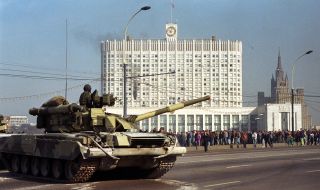
The events in 1993 in Moscow were the apogee of the crisis in Russian politics, which continued in the first years after the collapse of the Soviet Union, recalls "Bulgarian Times".
The victory over the GKChP putschists in August 1991 and the collapse of the Soviet Union made Yeltsin the most popular politician in Russia. First of all, the youth, who harbor hope for a decent life, trust him.
But on January 1, 1992, as a result of the shock reforms of the government of Yegor Gaidar, the prices of goods began to rise and ate up the savings of Russians; a 28 percent value-added tax was introduced. Enterprises stopped paying salaries. Anatoly Chubais, who appeared out of nowhere, organized the privatization of state-owned enterprises, and every resident of the country was given a voucher for the right to ownership of state-owned property. But these were just pieces of paper that most people gladly exchanged for money, and thus the first oligarchs were born.
At the end of July 1993, the Central Bank confiscated Soviet banknotes and a flow of money from other CIS countries flooded into the country; inflation began to rise. The almost forgotten poverty returned to the country.
Boris Yeltsin and his ministers tried to carry out democratic reforms to establish a market economy, but the parliament - the Supreme Soviet and the Congress of People's Deputies, which consisted mainly of communists - blocked all his initiatives, having the appropriate powers. They openly opposed Yeltsin's economic policy and the government of Viktor Chernomyrdin. The deputies were supported by the chairman of the parliament, Ruslan Khasbulatov, and most of Yeltsin's supporters, who called on him to resign. This forced the president to go on the offensive.
To get out of this situation of dual power, Yeltsin prepared a decree on the transfer of the powers of the parliament to the president of Russia, on the abolition of the constitution and the dissolution of parliament. The decree was numbered 1400. The presidential administration saw no other way out of the situation than with radical measures. Three days later, the deputies called what had happened a coup d'état and removed Yeltsin from power. Yeltsin, in turn, deprived them of their parliamentary mandates.
The first clashes
Yeltsin's famous decree number 1400 was broadcast on television on September 21. The next day, the Supreme Soviet, in opposition to the president, appointed Vice President Alexander Rutskoy in his place, who immediately canceled decree 1400 and approved other decisions of the parliament, including recognizing Yeltsin's actions as illegal.
Two days later, Yeltsin, who continued to work as president, signed a law on early elections. Then the first clashes began in the capital: the command of the united armies of the CIS was attacked – The Commonwealth of Independent States, in Moscow.
The next day, clashes between supporters and opponents of Yeltsin took on a large-scale character, and the Supreme Council began to turn the White House into a fortress, with barricades and weapons, preparing for its defense. The ultimatum of the Ministry of Defense demanding that Yeltsin's opponents surrender remained unanswered.
The situation of the parliamentarians was complicated by the fact that the president had the entire power bloc in his hands, including the KGB, the Ministry of Internal Affairs, the Ministry of Defense and all the media. The card of Khasbulatov's nationality was also skillfully played. The militia and the military were given the impression that he dreamed of finally ruining the country and returning the Stalinist camps. Naturally, the security forces consciously sided with the "Russian Yeltsin."
The Storming of Ostankino. The Climax of the Conflict
In the first days of October, the situation heated up. Attempts to reach a compromise, undertaken with the assistance of the Russian Orthodox Church in the person of Alexei II, were unsuccessful due to the Supreme Soviet's sudden renunciation of the statements made during the negotiations.
The peak of the conflict began on October 3. On that day, Rutskoy openly called on his supporters, who had gathered around the White House, to storm the Moscow City Hall and Ostankino in order to gain control of the federal airwaves. The rally near the television center turned into an attack after a few hours; Armed with machine guns, supporters of the Supreme Soviet stormed its building with the help of a truck.
At 7:30 p.m., Ostankino was seized, and television broadcasting was completely stopped. After 10-15 minutes, the protesters began shooting at the soldiers of the "Dzerzhinsky" division who had surrounded the television center.
But the attackers were unable to climb to the upper floors, as special forces guarding the building blocked their path. As a result of the assault, which they called the turning point in “Black October“, more than 46 people died, and Yeltsin realized that a compromise with the Supreme Soviet was impossible.
At 4 p.m., Yeltsin declared a state of emergency in Moscow and signed the monstrous decree No. 1575, which completely exempted the army from criminal liability for the killing of protesters. In fact, this was an order for merciless slaughter.
At this time, supporters of the parliament led by Rutskoy seized the city hall without serious resistance.
The shelling of the White House. The Balance
On October 4, President Yeltsin decided to storm the White House, where the coup leaders and their armed supporters had taken up residence. Following the corresponding order of Defense Minister Grachev, the White House was surrounded by fighters from the Taman and Kantemirov divisions, the Tula division of the Airborne Forces, the 119th Airborne Regiment, the “Dzerzhinsky” division of the Ministry of Internal Affairs, and the Smolensk OMON; shelling of the parliament began. APCs fired large-caliber machine guns at the barricades. The Taman division fired 12 shells at the White House. During the storming of the building, the fighters mistakenly opened fire on each other. Nine soldiers and militiamen were killed, six APCs were burned.
No one expected such boundless cruelty, and Rutskoy ordered the parliament supporters to surrender. The first protesters to surrender left the White House, but then the shelling of the building resumed.
The protesters soon left the building. At around six o'clock in the evening, Rutskoy, Khasbulatov, and General Albert Makashov left, who were immediately arrested. Yeltsin celebrated the victory, which allowed him to pursue his policy uncompromisingly.
The shootings in certain areas of Moscow continued almost the entire night of October 4-5.
According to various sources, the victims of the events in “Black October“ were about 158 people – 130 civilians and 28 military personnel.
A single assessment of these events in Russia has not yet been made. Some experts claim that Yeltsin's decisions were unnecessarily harsh and were only needed to strengthen his power; they also accuse him of hiding the victims and fabricating pretexts for the shooting of the White House; others believe that cruelty is permissible in order to solve the problems of the further development of Russia, different from that of the Soviet Union.
Yeltsin managed to impose his will
and scheduled a referendum on a new constitution, which ultimately not only strengthened, but also expanded his power. Thus, a system of government was born in Russia that almost entirely concentrated powers in the hands of the president. A system that the current head of the Kremlin - Vladimir Putin, summarized "Deutsche Welle".
Even in those years, the question arose of how to characterize Yeltsin's actions - as a murder of Russian democracy or as an inevitable evil. “This was a conflict between two constitutional bodies, both of which were legitimized through elections. "After Yeltsin's opponents resorted to armed resistance, the use of violence by the state authorities seems completely understandable," says Hans-Henning Schröder, a former Russia expert at the Berlin-based Science and Politics Foundation. According to him, the Russian model of "guided democracy" was born on December 12, 1993 - the day the referendum on Russia's new constitution was held. "Yeltsin wanted a constitution that would make the president untouchable. There was also a chance to adopt a constitution that would strengthen the powers of parliament, but this chance remained unused," the expert adds.
The West's Position
In 1993, the West sided with Yeltsin. "At the time, we in the West were very concerned about the rise of a red-brown coalition of various conservative forces, which also had a certain nationalist flavor," says Andrew Wood, a former British ambassador to Russia. It is for this reason, Wood adds, that the West saw Yeltsin as the better alternative.
But was the West making a mistake in treating Yeltsin so uncritically? "From today's perspective, I would say yes. But we have to bear in mind that there was no real parliament in Russia at that time," Wood points out.
A similar opinion is held by German expert Hans-Henning Schröder: “At that time, the West had a very uncritical attitude towards this whole process. The position was that Yeltsin was defending democracy. And therefore everything that is good for Yeltsin is ultimately good for democracy. However, his actions harmed democracy and undermined the image of the democrats as reformers,“ concludes the expert.