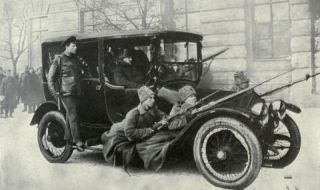
On November 7, 1917, the October Revolution began in Russia. In St. Petersburg, the Bolsheviks of Vladimir Lenin and Leon Trotsky overthrew the government of Alexander Kerensky.
The revolution led to the creation of the Soviet Union - the first communist state in the world, as well as the first of the classic totalitarian systems of the 20th century.
On March 16, 1917, the last Russian emperor Nicholas II abdicated. Power in Russia was taken over by Kerensky's provisional government. Shortly thereafter, Lenin arrived in Petrograd. He found that there was a magnificent opportunity for the small but disciplined communist party to seize power.
The first attempt at an uprising in July 1917 failed
and the leader of the revolution was forced to go into hiding. But the second attempt in October 1917 was already successful. The armed action began with the salvo of the cruiser “Aurora”. Despite the lack of resistance, the Winter Palace was stormed and the members of the Provisional Government were arrested. The armed action began with the salvo of the cruiser “Aurora”. A key role in the Bolshevik coup was played by Leon Trotsky, whose real name was Leiba Davidovich Bronstein.
As chairman of the Petrograd Soviet of Workers' and Soldiers' Deputies, he was in practice the military leader of the coup. It was on his instructions that key objects such as the Central Post Office, the State Bank, railway stations, etc. were first attacked. The Bolsheviks also quickly laid hands on all commercial and private banks, jewelry stores, safes of large commercial enterprises, private mutual funds, and bank branches in factories.
The "dictatorship of the proletariat" was established, and the first Soviet government was created - the Council of People's Commissars headed by Lenin.
By his order on January 6, 1918, the Constituent Assembly, which had been legally elected through free and democratic elections, was dissolved. The aftermath of the October Revolution was the devastating civil war in Russia.
The world's first Socialist Workers' and Peasants' State, established by Lenin in October 1918, was in fact a German protectorate until Germany's defeat in November 1918. The Germans provided the new regime with military and material assistance. Financial support for the Bolsheviks began at the end of 1914. According to official German documents, the Bolsheviks received 72 million gold marks, with most of the amount being given after November 7, 1917. The funding was cut off in July 1918, when the German ambassador to Moscow, Count Mirbach, was assassinated.
The idea that the revolution was organized by world Jewry emerged a little later, around 1918, when Trotsky took over the Ministry of War of the newly created Soviet state. There were indeed many Jews among the commissars and heads of various political departments. But this fact was not connected with the mythical “world conspiracy”, but with the fact that the Jews in Tsarist Russia were one of the discriminated and persecuted nations. Protest sentiments in Jewish circles were more popular than in Russian society. But there were also dissatisfied people among other minorities in Russia - Finns, Latvians, Lithuanians, Estonians.
Historians all over the world consider the thesis of the “Jewish revolution” in Russia
nothing more than a myth. According to them, the Great October Socialist Revolution was a purely Russian phenomenon. In the West, they do not even distinguish between the two revolutions - the February and the October, but discuss only one revolution - of 1917. Historians point to the following as the reasons for it: social, class and economic problems in Russia itself. They explain the nature of the revolution with the situation of the workers, with the unresolved issues of land ownership, with the national problems in individual regions, plus the enormous burden on Russian society associated with the country's participation in World War I. Russia was exhausted by losses, by constant defeats; the mood among the army units was extremely bad; after three and more years of war, Russia did not want to fight anymore.