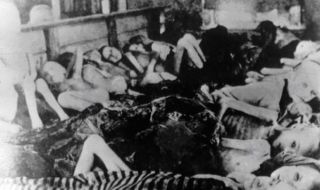
On November 23, Ukraine pays tribute to the victims of the Holodomor. Long before the concentration camps in Nazi Germany, Stalin organized ethnic cleansing through starvation. His victims were 7 million Ukrainians.
According to scientists, the then Kharkiv and Kiev regions (now Poltava, Sumy, Kharkiv, Cherkasy, Kiev, Zhytomyr) suffered the most from the famine. They accounted for 52.8% of the deaths. The mortality rate of the population here exceeded the average level by 8-9 and more times. In today's Vinnytsia, Odessa, Dnipropetrovsk regions, the mortality rate was 5-6 times higher, in Donbass - 3-4 times. In fact, the famine covered the entire Central, Southern, Northern and Eastern part of modern Ukraine.
In practice, this meant the physical extermination of all class and national "enemies" of the Stalinist regime, that is, people who had their own opinion about the development of the "bright future".
In the 19th and early 20th centuries, Ukraine was the breadbasket of Europe. The country produced 20% of the world's wheat production, 43% of barley, 10% of corn. But this was in the conditions of a market economy and private property. During military communism (1918-1921), the Bolshevik government left the peasant only 14 kg of grain per month, confiscating the rest. In protest, the Ukrainians stopped producing. There was a shortage of food, and in the Russian Volga region - famine. Older Bulgarians probably remember how grain was collected in Bulgaria to help the starving in the Volga region. But back then, no one asked themselves the question, was the drought the only reason why there was no bread in Russia?
The NEP (New Economic Policy) launched by Lenin, adopted in March 1921, gave hope to Ukrainian peasants, many of whom had acquired land after the revolution in 1917. Instead of confiscating grain, a bearable tax was introduced. The peasants put the surplus wheat on the market. Compared to 1913, which is considered the "peak", in 1927 the arable land in Ukraine increased by 10%. At that time, small and medium-sized producers dominated the Ukrainian countryside. Wealthy peasants were only 5% and owned 40-60 acres of land each. The population of Ukraine at that time was about 28-30 million.
With Stalin's coming to power, the policy changed. The Kremlin relied on collectivization in agriculture.
In 1929-1930, Stalin launched an attack against the leaders in the Ukrainian countryside - the wealthy people, and later - against the medium-sized producers. 850 thousand Ukrainians were deported to Siberia. This did not break the resistance of Ukrainians against the collective farms. In March 1930, Stalin published in the newspaper “Pravda“ his programmatic article “Dazzled by Success“. It gave a signal for a temporary suspension of forced collectivization.
It is estimated that in January 1933, the average Ukrainian peasant family (5 people) had 80 kg of grain and until the new harvest, i.e. until August, each family member had to consume no more than 2 kg of bread per month - 60 g per day. It is known that when the Ukrainian village was dying, grain was exported abroad by ships from Odessa. The earned currency was used to import turbines and other heavy machinery for industrialization. In the USSR, Ukraine provided 38% of the grain.
Private ownership of land in Ukraine has deeper traditions than in Russia, and therefore Ukrainians resisted collectivization longer. "The instinct for private property in Ukraine is stronger than in Russia", - noted the famous Soviet writer Vasily Grossman.
For Stalin, the taming of the Ukrainian village through hunger was also a means of weakening Ukrainian nationalism. "The peasant question is the basis of the national question", the leader of the world proletariat often repeated.
After the end of World War II, Stalin decided to re-educate the Ukrainians through starvation again.
But these same statistics show that in the summer of 1947 there were 1.154 million dystrophies in Ukraine. Mostly peasants and workers - Ukrainians, Russians, Jews, Bulgarians, Gagauz - died of hunger. It even reached cannibalism.
In his letter to Nikita Khrushchev - the leader of Ukraine, a senior party functionary in Odessa wrote: "When I entered the house of a collective farmer, I saw something terrible. The woman had cut up the corpse of her child and said: "We ate Manechka, and Vanechka we will sprinkle with salt and save for later". She went crazy from hunger and slaughtered her children".
But Stalin does not believe these signals. "It's all a lie," he tells his entourage. "You want to move me so that I will open the state reserves".
And let us bow our heads before the Bulgarian victims of the Holodomor. It is known that on the territory of Ukraine there are two large Bulgarian diasporas - Bessarabia (today Odessa region) and Tavria (today Zaporozhye region).
The Bulgarians settled in Bessarabia at the end of the 18th century and the first three decades of the 19th century, fleeing from the cruel Turkish slavery. And the Bulgarians in Tavria moved in 1860-62 from the Bessarabian Bulgarian villages.
During the two Holodomors of 1921-23 and 1932-33, the Bulgarians in Tavria gave a total of about 30,000 victims. Until the beginning of World War II, the Bulgarians in Bessarabia were within the borders of Romania. In the winter of 1946-47, the Stalinist government organized a Holodomor in Bessarabia (Moldova and the Odessa region of Ukraine), in which over 70,000 ethnic Bulgarians died.
In total, about 100,000 Bessarabian and Tavrian Bulgarians died in the three Stalinist Holodomors, which is one third of their number. The tragedy of the Ukrainian people is also a Bulgarian tragedy.
The largest number of starving people occurred at the end of February 1933. They were mainly collective farmers... The starving people consumed various surrogates (corn stalks, grain husks, straw, rotten watermelons and beets, potato peelings). There are cases when people eat cats, dogs and dead horses. 28 cases of cannibalism have been registered, 19 of them in the Kiev region. In February, 13 cases of consumption of dead people were registered.
Aleksandrovsky, assistant head of the secret-political department
...The cannibals I saw and talked to were poor people, middle-class people, collective farmers and sole proprietors, left without a livelihood. They all give the impression of brutally hungry people who have no desires, except for one thing - to eat anything, at any cost...
Report by O. Odintsov, Minister of Agriculture of the Ukrainian SSR