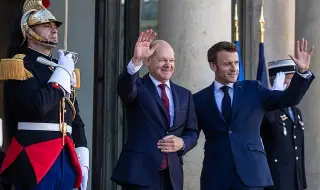
"Always we come to an agreement." With these words of the German Chancellor, the state visit of French President Emmanuel Macron to Germany ended yesterday evening. Berlin and Paris spent three days trying to prioritize what unites them over what divides them - and Russian President Vladimir Putin got to hear that once again at the end of a state visit, Der Standard reports. It was then that his threat to the small member states of NATO came.
This came after Macron spoke out in support of dropping restrictions on Ukraine attacking targets in Russia using Western, i.e. NATO-produced weapons. "We must allow them to neutralize military bases from which missiles are fired," Macron said, but made the proviso that Ukraine must respect international law.
There is an agreement between Macron and Scholz that only then such a defense would be legitimate.
Scholz dismissed media reports that the German government had banned such defensive actions by Ukraine. He also does not think that this in itself would be an escalation of the conflict.
It was then that Russian President Vladimir Putin threatened the West that such an approach would not be without consequences. "This continued escalation could have serious consequences. In Europe, especially in small countries, they need to realize what they are playing with," he said during a visit to Uzbekistan.
Scholz and Macron also want to call on the G7 countries to provide Ukraine with billions in additional aid - they speak of a "initiative for permanent financing of Ukraine". To this end, how the interest income from the frozen assets of the Russian central bank can be used is also being studied, Scholz said.
During his visit, Macron also issued the warning: "Our peace and security are at risk in Ukraine. Russia could be here tomorrow or the next day." He again called for more efforts within NATO to support Ukraine. "We must not fall into the trap of nationalist actions, we must act decisively as Europeans. We should not look only to the USA."
The latter can be understood as a veiled criticism of Scholz, who has consistently supported President Joe Biden.
Despite this indirect criticism of Berlin's stance on the war in Ukraine, Macron received much praise in Germany. Federal President Frank-Walter Steinmeier honored him at the Westphalian Peace Prize ceremony in Münster with the words: "You are not just an executor, You are an encourager."
Given repeated Franco-German friction in recent years, Scholz and Macron have tried to demonstrate unity. And they have also repeatedly made clear claims to leadership in the EU. "We are leading as a Franco-German tandem, and Europe is following us," said Macron, for example.
The same evening, the Franco-German Council of Ministers adopted a nine-page document that sounds like a terms of reference plan for the next European Commission: Cutting red tape, completing the capital markets union, more investment in key sectors, fair trade agreements, measures against unfair or abusive commercial or competition practices.