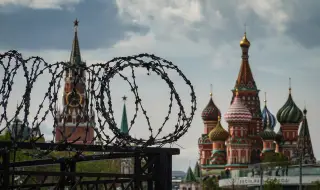
Despite its economic weakness, Russia remains a political giant. Thanks to powerful allies like China, Vladimir Putin can defy Western sanctions and pursue his military ambitions, writes focus.de.
Russia has existed in many different forms over the years – from Lenin's revolution, Hitler's world war, Stalin's Soviet dictatorship – to today's Putin's Russia, which threatens a nuclear apocalypse.
Russia was an economic dwarf in the Soviet era and after, if we compare it to Western countries. Russia is an agricultural country that was forcibly industrialized under Joseph Stalin. The red dictator said in his famous speech to the country's business leaders in February 1931 that Russia should make up for its 300-year gap in ten years. Under him, the Soviet Union rose to become an industrial world power at great cost, scaring the West with nuclear missiles. But prosperity does not materialize. The planned economy stifled people's own initiative and the gap with the West widened again. After the collapse of the Soviet Union, the economy depends primarily on trade in raw materials.
The founder of “Google“ Sergey Brin calls his homeland “Nigeria with snow”, while Israeli historian Yuval Harari speaks of a “gas station with nuclear weapons”.
However, Russia is a political giant. Thanks to its powerful allies, Putin's Russia has political power that extends far beyond its economic essence. The China-Russia axis proved insistent. This was the only way for Russia to continue the war in Ukraine and mitigate the impact of Western sanctions.
In the Shanghai Cooperation Organization, China and Russia are politically, economically and militarily linked to Iran, Kazakhstan, Uzbekistan, Kyrgyzstan, Tajikistan, India and Pakistan. The goal is to curb NATO's influence. The Shanghai Treaty agreement created an international ecosystem that prevented Russia from becoming a pariah on the international stage.
Currently, Russia is a nuclear provocateur. The Federation is said to currently have a nuclear force consisting of 5,580 warheads. Russia is training its navy to attack targets deep in Europe with nuclear missiles in the event of a conflict with NATO, according to classified documents. Potential targets include France, Germany and the UK. Recent exercises ordered by Putin to rehearse the use of tactical nuclear weapons show that the leaked documents remain consistent with current Russian military doctrine.
And despite the nuclear threats, a country significantly smaller than Russia, Ukraine, managed to invade its territory and occupy 1000 square kilometers of territory.
The nexus of conventional and economic weakness, combined with nuclear power and a latent penchant for adventurism, makes Putin a highly unpredictable leader.