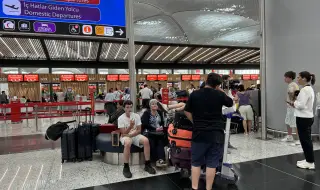
At the international airport "Istanbul" controls have been increased for passengers arriving from countries where there are cases of monkeypox.
According to TRT Haber, passengers arriving from the Democratic Republic of the Congo and 11 African countries, where diseases from monkeypox have been registered, are subject to additional control.
Teams of the General Directorate of Land and Sea Borders together with the General Directorate of Health carry out effective control of passengers who arrive by plane from these countries, the chief doctor of the General Health Directorate of Istanbul International Airport said. Dr. Aykut Yener Kavak.
Teams carry out continuous 24-hour control. This applies to aircraft arriving from Congo, Burundi, Central African Republic, Cameroon, Ghana, Liberia, Nigeria, Kenya, Côte d'Ivoire and South Africa. At a special press conference, all airport personnel were informed of the measures that are being implemented, as well as the need for increased attention.
Especially for planes arriving from the Congo, our teams check them at the gate when they disembark, asking about their health status, whether they have a temperature, etc. We track the status of passengers arriving by plane from other countries online. If there are any doubts about a passenger/passengers who arrive at the airport, they are isolated from other passengers and undergo a medical examination, he explained.
If it turns out that a passenger has symptoms of the disease, we are ready to transport him to the hospitals with which we have an agreement for similar cases, where the patients are completely isolated. Information is also being submitted to health authorities throughout the country, the doctor added.
He added that the measures are in line with the requirements of the World Health Organization, which has warned about the risk of monkeypox being imported from the African continent.
So far, Istanbul Airport has not registered a case of monkeypox among arriving passengers. For now, the use of protective clothing and paraphernalia by health teams is not required, the doctor concluded.