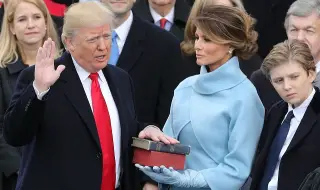
In a recent interview with the American television station NBC, US President Donald Trump did not deny that he is considering the possibility of remaining in office after the end of his second term in January 2029.
"A lot of people want me to do it", Trump said on Sunday. "But mostly I tell them that we have a long way to go. I'm focused on the present", he emphasized.
Asked if he himself would like to be president for another term, Trump said laconically: "I love working" and continued: "I'm not kidding, but it's still too early to think about that".
When asked about the two-term limit for president that the US Constitution provides, Trump said that "there are methods" that would allow him to serve a third term.
What are the options?
As it stands, the 22nd Amendment to the US Constitution prohibits anyone from being elected president more than twice, whether consecutive or non-consecutive terms. "No person shall be elected to the office of President more than twice", reads the amendment, quoted by the American National Public Radio.
Trump did not comment on specific plans for how he could remain in office for a third term, but hinted that one method for this would be for Vice President J.D. Vance to win the next election for the White House, with Trump as his running mate, and then cede the office to him.
However, the Twelfth Amendment to the Constitution states: "No person who is constitutionally disqualified from being elected President shall be disqualified from being elected Vice President of the United States," constitutional law experts recall.
Can Trump's allies change the Constitution? Yes, but that is highly unlikely at this time of strong political polarization between Democrats and the president's Republican Party, Reuters noted.
Any amendment to the Constitution would require support from two-thirds of the US House of Representatives and Senate or a two-thirds convention, and then ratification by 38 of the 50 state legislatures. Republicans currently have a slim majority of 218 to 213 in the House of Representatives and 53 to 47 in the Senate, and control the legislatures of 28 states, the agency recalls.
The Constitution clearly prohibits presidents who have already served two terms from running again, said Jeremy Paul, a law professor at Northeastern University in Boston, on Trump's chances. "By any reasonable interpretation of the 22nd Amendment, he (Trump) cannot run again", Paul said. "The only way he can do that is if he openly breaks the law", the expert added.
Who supports Trump?
Donald Trump has repeatedly hinted that he could stay in power beyond the end of his second term, "Al Jazeera" noted.
In 2018, during a fundraiser for the 2020 presidential election campaign at his "Mar a Lago" estate in Florida, Trump mentioned the unlimited term of Chinese President Xi Jinping and joked: "Maybe someday we'll try it too".
Later, during election rallies, he repeatedly stated that his supporters might demand that he serve a third term as president, with Trump once saying that it would be "compensation" for being investigated for Russian interference in the 2016 election.
"I raised a lot of money for the next race that I guess I can't use for myself, but I'm not 100 percent sure because I don't know", Trump said during his election campaign last year, recalls the "New York Times". "I don't think I'm allowed to run again. I'm not sure. "Am I allowed to run again?" he asked, apparently jokingly.
In January, the US president told supporters: "It would be the greatest honor in my life to serve not once, but twice, three times or four times." However, he later said it was a joke aimed at the "fake news media," the BBC recalls.
While speaking to House Republicans in November, Trump jokingly suggested that they could help extend his term.
"I suspect I won't run again unless you say, 'He's so good, we've got to come up with something else,'" the future president said at the time.
Andy Ogles, a Republican congressman in the House of Representatives, introduced a resolution in January calling for a constitutional amendment that would allow the president to serve up to three terms - as long as they are not consecutive. This would mean that only Trump of all former living presidents would be eligible for this - Barack Obama, Bill Clinton and George W. Bush all served consecutive terms, while Trump won the election in 2016, lost it in 2020 and won it again in 2024, the BBC recalls.
Who opposes a third term for Trump?
Democrats have serious objections, the BBC noted. "This is another escalation in his blatant efforts to take over the government and destroy our democracy," said Daniel Goldman, a Democratic congressman who was a lead adviser on the first impeachment attempt against Trump in 2019. "If Republicans in Congress believed in the Constitution, they would come out publicly against Trump seeking a third term," he said.
Some in the president's own party also think it's a bad idea. Republican Sen. Marquan Mullin of Oklahoma said in February that he would not support an attempt to return Trump to the White House. "I'm not going to change the Constitution unless the American people decide to do so," Mullin told NBC.
Who has served more than two terms?
Only one other president in U.S. history has served more than two terms. Franklin Delano Roosevelt broke the tradition of serving no more than two terms during World War II, recalls the newspaper "USA Today".
The idea of limiting presidential terms dates back to the time of George Washington, who clearly stated that not allowing a "king or Caesar" at the head of the young state would be a fundamental principle. He "retreats from the temptation" of greater power after serving as democratically elected president for two terms.
Thomas Jefferson followed Washington in voluntarily retiring after his second term, explaining that an indefinite right to run for president "would make the office first lifelong and then hereditary."
Although Presidents Ulysses S. Grant and Theodore Roosevelt flirted with the possibility of seeking a third term, the United States endured 164 years of tacitly following Washington's example until Roosevelt was reelected for a total of four terms.
In 1940, America was traumatized and seeking solace, writes the "Washington Post". Slowly emerging from the Great Depression, still scarred by the catastrophic losses of World War I, and trembling at the prospect of war breaking out again in Europe, the United States sought to isolate itself.
Since President Franklin Delano Roosevelt's soothing voice rang out on the airwaves in 1933 with his first radio fireside chat, American voters have forged an unprecedented connection with him. As he campaigns for a third term, stability is a popular theme, the publication recalls.
On November 5, 1940, Roosevelt won a landslide victory with 54.7% against Republican Wendell L. Wilkie. He faced little resistance from opponents of a third term. The president died of a cerebral hemorrhage in 1945, just months after being reelected for a fourth term.
In a February 16, 1947, article on the renewed debate over term limits, the Los Angeles Times noted that between Washington's second term and Roosevelt's third, some 140 proposals to limit presidential power had been made.
"The members of the Constitutional Convention feared autocracy," Republican Chauncey Reed told the House of Representatives in 1947, after the 22nd Amendment was proposed. "They feared the cementing of executive power. They had just come out of a war against a king with unlimited terms. "They had seen their state legislatures dissolved by royal governors appointed by the king," he added.
Republican John McCormack, however, stated that the amendment would block future voters if a president's term were to be extended during wartime.
The amendment was passed by Congress in 1947 and ratified by the states on February 27, 1951.
Several U.S. presidents later expressed an appetite for repealing the amendment.
The extremely popular former commander-in-chief and president Dwight Eisenhower, who was a Republican, considered a third term in 1960. He stated that term limits were not "entirely reasonable." According to him, the electorate "should be able to elect anyone they want as their president, regardless of the number of terms they have served."
For Ronald Reagan, posters were prepared that read "Repeal the 22nd Amendment Reagan '88!" They were more colorful than the blue and white bumper stickers that were put on the cars of Bill Clinton supporters in 2000 with the appeal: "Repeal the 22nd Amendment, Re-elect Bill Clinton", recalls "The Washington Post".
Even if Trump fails to become president for a third time, he will still go down in history as the oldest American president, writes CNN. At the end of his second term in January 2029, he will be 82 years and 7 months old, thus breaking the record of his predecessor Joe Biden, who left office at a respectable 82 years and 2 months.