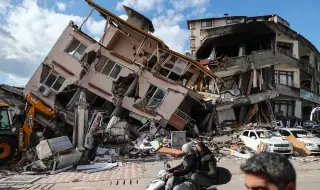
Wednesday's earthquake, felt most strongly in Istanbul, did not cause major damage, but it has raised fears of a bigger disaster. Experts believe that new aftershocks are possible.
"There are two scenarios: Either the seismicity will slowly subside, or the redistribution of stress caused by the earthquake will increase the likelihood of a strong earthquake in the region," Marco Bonhof of the Potsdam Helmholtz Center for Geosciences told German public broadcaster ARD. (GFZ).
184 aftershocks by evening
Wednesday's quake was the strongest in the region in more than 25 years. According to GFZ, the first quake had a magnitude of 6.2 at a depth of about ten kilometers, and the epicenter was about 60 kilometers west of Istanbul in the Sea of Marmara. Just 13 minutes later, the ground shook again, this time with a magnitude of 5.3 at a depth of about 40 kilometers. The tremors were also felt in Greece and Bulgaria.
According to scientists, the second quake shows that the tension has changed, which increases the risk of new tremors. A total of 184 aftershocks were recorded by Wednesday evening, ARD reports.
Two tectonic plates meet near Istanbul
According to experts, the area around the Sea of Marmara near the metropolis of Istanbul has one of the riskiest geological structures in the world: two tectonic plates meet there - the Eurasian and the Anatolian. The area under the Sea of Marmara south of Istanbul is the only area along the entire border between the two plates that has not caused a strong earthquake in more than 250 years. Experts have long assumed that an earthquake with a magnitude of about seven on the Richter scale is imminent in Istanbul.
Among them is Turkish seismologist Ahmet Ercan. He warned Halk TV that the April 23 earthquake was a precursor to a larger quake: "It could be in the Silivri region and have a magnitude of around 7 - 7.2 on the Richter scale, that is, one magnitude stronger than the one in Istanbul. We cannot say that everything is over".
Experts expect another strong earthquake
According to Ercan, there is a build-up of tension on the right side of the North Anatolian Fault in the east-west direction. However, it is difficult to predict when exactly this tension will reach its peak, the seismologist specifies.
ARD quoted two more experts: geologist Okan Tusuz told German television NTV that another strong earthquake could follow. Earthquake researcher Naci Görür also believes the main tremor is yet to come. However, this should not cause panic among the population, he emphasizes.
Süleyman Tunç, who also studies earthquakes, believes that the latest tremors have increased the tension even more. “Of the three partial faults in the Sea of Marmara, the western one may have already loosened, but that does not mean that everything is over. Today cannot be defined as the expected major earthquake in Istanbul”, Tunç said on Turkish television.
"We cannot say that this will automatically lead to a strong earthquake. But we can say that the risk today is greater than yesterday”, the German public media ARD quoted him as saying.
Emilian Lilov (editor)