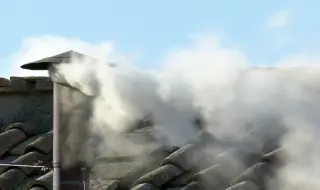
After four sessions, the conclave ended with the election of a new pope yesterday evening, global agencies summarize. This process was shorter than the talk about the conclave, with which people were inundated by global agencies, national media and social networks, commented “RAI News“. However, the conclave raises several conclusions.
The conclave in the age of new technologies is omnipresent
The conclave in the age of new technologies is not something secret and shrouded in mystery. It is literally everywhere, points out “RAI News”. For two weeks, people from all over the world actively followed everything that accompanied the funeral of Pope Francis and the conclave that followed. The media introduced the audience to the greatest details of the conclave - from the working mechanism of the cardinal electors to the working mechanism of the ovens for burning the ballots and the chimney emitting the warning smoke. The cardinals' menu, their vestments and their relatives were not missed. Nothing was left hidden and so this conclave went down in history as the first "social conclave". In addition, this was the conclave that gave rise to the biggest jokes and teasing on social networks, such as that the smoke from the chimney of the Sistine Chapel is blue because the Pope is male or that the black smoke is from the papal barbecue or from the burning of magical herbs, and the white smoke is from the smoking of prohibited substances. The cardinals were also the subject of collages showing them eating pizza, dancing or smoking cigars during the conclave.
The conclave as an opportunity to learn something new
The conclave gave people the opportunity to familiarize themselves with key Latin phrases, to learn details about some of the cardinals who were elected popes, to delve into the biographies of former popes, to understand what the Vatican is, what the pope does, what it means to be a cardinal, how many types of cardinals there are. People got to know some of the daily habits of the cardinals or popes, people from their entourage, their countries and the geopolitical divisions in the Church, summarize Agence France-Presse and Italian media, including “Sky TG 24“, “RAI News“ and “TG Com 24“. One example of something new learned during the conclave could be that it became clear that cardinals do not only wear red vestments, but also purple, white, gray, black, brown, and of different cut and design depending on the church or order to which they belong or depending on the cardinal's categorization.
Now, the election of the American Robert Francis Prevost as Pope Leo XIII has given people the opportunity to thoroughly research who his predecessor, Leo XIII, was, what the Augustinian Order, to which the American cardinal belongs, is, and what problems Peru has, where he spent many years on a mission. Even the interest in Robert Prevost, a Quebec historian, writer and journalist who died in 2007, is exaggerated.
The seagull - friend and superstar of the conclave
The conclave also became an opportunity for people to get acquainted with the peculiarities of seagulls and larks, given that on the first day of the conclave, while everyone's eyes were fixed on the chimney of the Sistine Chapel, a seagull was walking around it. Then she brought another seagull, and on the second day of the conclave, the seagull found herself with her entire family on the roof. It was while the seagull was feeding her chick that white smoke appeared from the chimney, which was interpreted by some as no coincidence. Subsequently, the seagull was given the name Pierrette on social networks, which comes from Saint Peter, and her male friend was named Sistino from the Sistine Chapel. The entire family on the Vatican roof was named the Sagrada Familia, or the Holy Family. The seagull was also the subject of collages showing it in papal robes or in the robes of a Vatican Guardsman. And in the Italian media, detailed reports appeared about the presence of seagulls in the Vatican and in Rome, whose behavior at times turned out to be quite impudent, when they attacked the food of tourists and visitors on the terraces of restaurants, rummaged through household waste and chased away pigeons, summarizes the French newspaper “Croix“. The beliefs were also recalled, according to which the seagull was considered an unclean species because it also feeds on waste and is associated with death and decay. But the seagull is also considered a symbol of freedom, travel and the sea leading to new lands.
Disinformation and conspiracy theories also marked the conclave
The conclave was not without misinformation, recalls the French program of “Euronews“. Among the fake news that accompanied it was that Pietro Parolin, considered the favorite for Pope, had serious health problems immediately before the conclave. The Holy See had to categorically deny this rumor.
Conservative Italian media, such as “Verita“, “Libero“ and “Voce Del Patriota“, alleged that French President Emmanuel Macron had interfered in the work of the conclave and had already decided that the new pope would have liberal views and be called John Twenty-Fourth. Similar claims appeared in other media outlets, such as “Stampa“, and in connection with Italian Prime Minister Giorgia Meloni, who lobbied in the conclave for a conservative pope.
Bookmakers have no power over the conclave
The conclave may have resembled a competition for film or music awards, or a sporting event that encouraged bookmakers to actively practice their craft, but in the end the result produced a surprise that completely refuted the bookmakers' predictions, which assigned first place to Pietro Parolin and second place to Luis Tagle, and showed that the conclave is a territory over which “bookies” have no power, Italian and French media indicate.
The conclave is over, but the noise continues
With the end of the conclave, the media's interest in the Vatican will not decrease, because the new pope is about to make his first appointments in the Vatican, where after the death of Pope Francis all high-ranking officials automatically resigned. After which it will be time to cover his first trip abroad, and here the Italian media recall that Pope Francis wanted to visit Turkey, but this never happened. Whether the new pope will hurry to make this dream come true remains to be seen. Pope Francis was planned to be in Turkey on May 24 and 25, recalls "Daily Sabah".