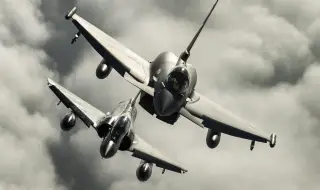
French President Emmanuel Macron took another step towards expanding French nuclear deterrence across Europe, saying he was ready to discuss with other countries on the continent the deployment of French aircraft equipped with nuclear weapons, Agence France-Presse reported, BTA reported.
This discussion, which the French president has mentioned several times since the beginning of March, is taking place against the backdrop of the rapprochement between the United States and Russia and fears of a large-scale withdrawal of the American military from Europe.
"We are ready to start this discussion. "I will define the framework quite formally in the coming weeks and months," the president said on the air of the French TV channel Télévisions 1. The Americans have already been deploying these forces in a number of European countries for some time.
However, Macron set three conditions for this hypothesis: "France will not pay for the security of others", this potential deployment "will not reduce what (France) needs" and finally "the final decision will always be with the President of the Republic, the head of the armed forces". According to him, such discussions will not change the French nuclear doctrine, which has had European dimensions since the time of De Gaulle.
The topic was raised in early March in a speech by the French president, who said he wanted to launch a strategic debate on the defense of Europe under the French nuclear umbrella. This was a response to a statement by Friedrich Merz, then future German Chancellor, who had considered it necessary for Europe to prepare for "the worst-case scenario" of NATO without an American security guarantee.
France and Britain are the only European countries with nuclear weapons. Until now, the other European members of NATO have been under the American nuclear umbrella.
Macron has already emphasized that France's "vital interests", which are the basis of its nuclear deterrence strategy, also include those of its "main partners" in Europe.
"The moment in which we are living is a moment of geopolitical awakening. Our Europe was built above all for peace," Emmanuel Macron reminded. But "the challenge before us is to remain free," he warned.
Macron also said Europe would impose sanctions if Russia proved it was not respecting the ceasefire in Ukraine. He mentioned "secondary sanctions" on "traffickers" of "financial services" or "fossil fuels" as options.
On Saturday, Ukraine and its European allies, along with the United States, gave Moscow an ultimatum to agree to a "full and unconditional" 30-day ceasefire starting on Monday, or face new sanctions.
Since the war in Ukraine began in February 2022, the European Union has already imposed 16 packages of sanctions on Russia. A 17th package is expected to be adopted next Tuesday. So far, the financial sector and fossil fuels have been largely spared from these sanctions. The Europeans are now considering imposing sanctions on more banks that have not been excluded from the SWIFT network, which handles most of the world's transactions. In this way, they intend to target financial institutions in third countries, including Asia, that allow the circumvention of the sanctions already imposed.
In the oil sector, the idea is to impose sanctions on major Russian oil companies.
According to a European diplomatic source, the preparation of sanctions affecting these two sectors will take several weeks, AFP notes.
Macron stressed that "the war must end and Ukraine must be in the best possible position to start negotiations". According to him, this is what will make it possible "to resolve territorial issues". The French president, however, added that "even the Ukrainians themselves realize that they will not be able to get back everything that has been taken since 2014" from Russia, without naming specific regions.
"What Benjamin Netanyahu's government is doing today (in Gaza) is unacceptable", Macron added in his interview, describing what is happening as "a disgrace".
"It is not the job of the President of the Republic to say “This is genocide", but of historians", the French president noted. However, he recalled that he was among "the few leaders who have gone to the border" between Egypt and Gaza. The sight is "one of the most difficult I have ever" I have seen, Macron stressed, expressing regret that "all the aid that France and other countries send" has been blocked.
The question of revising the "cooperation agreements" between the EU and Israel remains "open", Macron added.