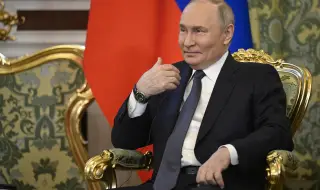
The Western press comments on the absence of Russian President Vladimir Putin from the Moscow-Kiev talks in Istanbul for peace in Ukraine. Another main topic is the ongoing tour of US President Donald Trump in the Middle East, and in particular the meeting between him and the interim Syrian President Ahmed al-Sharaa. Publications also comment on the fact that Trump accepted a "Boeing 747" plane as a gift from Qatar.
The agreement of the President of Ukraine Volodymyr Zelensky to participate in the talks in Turkey is strategic in many ways - it is a return to the position he took in the early stages of the war, when he repeatedly called for direct talks with Putin, writes the British newspaper "Telegraph". The newspaper adds that the Russian leader feels uncomfortable and, believing that he has the upper hand on the battlefield, has no real desire to stop fighting, even if he is ready to discuss the terms of Ukraine's surrender.
"Therefore, he is happy with the option of sending his subordinates to Istanbul to dictate to the Ukrainians terms that are practically equivalent to Ukraine's surrender. If the Ukrainians refuse, it will not be a big loss", writes "The Telegraph" about Putin, while noting that Zelensky has overcome all the conditions that US President Trump has put before him, hoping to make it clear that Russia is the country that is an obstacle to peace.
In relation to US deals in the Middle East, the British newspaper writes that "if we have learned anything from Trump's approach to the world, it is that tempting trade deals will always take precedence over national security". However, the publication notes that Trump also benefits economically from Moscow.
"His compromises with Russia are based on the assumption that ending the war in Ukraine could open a new era of economic cooperation between Washington and Moscow", the newspaper believes, adding that one of the driving factors behind Trump's pursuit of a nuclear deal with Tehran is the prospect of the US benefiting from peace in the Gulf region.
Furthermore, "Trump's mercantile approach was also evident during his visit to Saudi Arabia, where he signed an arms deal worth nearly $142 billion", the "Telegraph" notes.
Regarding the meeting with Ash Sharaa, the British publication writes: "The new Syrian regime has certainly done everything possible to assure Trump of its good intentions, and the idea of the US president holding talks and posing for photos with a former leader of "Al Qaeda" would once have been unthinkable". According to the "Telegraph", the meeting in Syria will undoubtedly cause bewilderment in Israel, which continues to treat Sharaa with great caution, as well as concerns among pro-Israel hawks in his administration.
The "Boeing" planes from "Qatar Airways" - the largest aircraft order in the company's history - are the basis of agreements worth more than $ 243 billion signed during Trump's visit to the Qatari capital Doha, commented another British newspaper - "The Guardian".
After being criticized for accepting a "Boeing 747" as a gift from Qatar, Trump tried to sidestep the criticism by saying that the plane would technically be donated to the Ministry of Defense before eventually being transferred to him - claims that did little to allay concerns of a conflict of interest, the publication believes. "The Guardian" adds that according to Trump, this whole deal with a foreign government is "very transparent" - and we can probably agree with that. "You have to be blindfolded not to see what's really going on", the newspaper writes.
The publication also adds Syria's offer to Trump, which includes access to Syrian oil reserves, guarantees of Israel's security and a proposal to build a "Trump Tower" in Damascus.
The American newspaper "The New York Times" commented that Trump effectively denounced decades of American policy in the Middle East, capitalizing on complaints "that have long been heard in cafes and salons from Morocco to Oman." His remarks that the United States "will no longer teach (Middle Eastern countries) how to live" have made some Arab listeners worry about what the potential evaporation of American pressure over human rights abuses could mean for their countries, the New York Times wrote.
The publication added that reactions to his speech quickly spread online in the Middle East - a region where "the U.S. invasions of Iraq and Afghanistan, and U.S. support for Israel, are ingrained in the public consciousness and criticized by monarchists and dissidents alike."
Separately, the newspaper points out regarding the Russia-Ukraine talks in Istanbul that "the stakes for both sides in the biggest land war in Europe since World War II could not be higher".
The American edition of the magazine "Politico" states in a headline that "the dynamics in the Middle East are changing under the leadership of a US president who sees the world through the prism of money".
According to "Politico" after the information spread that Qatar had decided to give President Trump a luxury plane, Israeli citizens spread in chat groups a suggestion on how to respond to this offer - for example, to provide Trump with his own parking space in Tel Aviv.
"It was a joke, of course. But it highlights a reality that puzzles Israelis like never before. Compared to many of its neighbors, Israel does not have many tangible financial advantages to offer the American president, whose preferred form of government is economic," the publication notes.