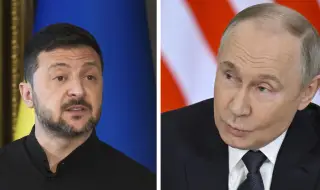
Russians and Ukrainians are meeting in Istanbul today for the first bilateral talks on the war in Ukraine. These are the first direct talks between the two warring parties since the spring of 2022, when there were the first such negotiations that did not lead to a result, writes BTA, citing AFP.
Here are the official positions of the two camps that will negotiate today.
Russian President Vladimir Putin has maintained maximum demands since the beginning of the Russian invasion of Ukraine. He reiterates that the process of finding solutions to the conflict must address the serious causes of it, first and foremost Ukraine's desire to join NATO, an alliance that Moscow sees as an existential threat that extends to its borders.
Russia has claims over the annexation of the four southern and eastern Ukrainian regions that it partially controls - Donetsk, Luhansk, Kherson and Zaporizhia - as well as over the Crimean peninsula, annexed in 2014. At the end of March, Russian Foreign Minister Sergei Lavrov decided to declare that international recognition of these territories as belonging to Russia is urgent for the settlement of the conflict.
Vladimir Putin has presented many justifications for the February 2022 offensive. against Ukraine, in particular the protection of Russian-speakers in eastern Ukraine and the denazification of a country that he accuses of being under the influence of Western powers hostile to Russia.
Moscow wants in particular to stop the supply of Western weapons to Ukraine and to eliminate ultranationalist Ukrainian groups.
In late March, Putin also mentioned the idea of a transitional administration for Ukraine under the auspices of the United Nations, an option that would also mean the removal of Volodymyr Zelensky from power. Putin does not consider Zelensky to be a legitimate president and says his five-year term expires in May 2024, although elections in Ukraine are impossible because of the war. Putin also considers the Maidan revolution, which brought pro-Western authorities to Kiev in 2014, to have been a coup d'état against the then-pro-Russian president.
In Ukraine, the issue of territorial concessions is deeply divisive. The population has suffered enormous human and material losses since 2014 in order to preserve its borders, established with the collapse of the USSR in 1991.
Zelensky mentioned the possibility of a territory swap with Moscow regarding the areas held by Kiev in Russia's Kursk region, but Ukrainian forces were eventually driven out of there in late April by Russian forces.
It therefore remains to be seen what concessions can be made between Kiev and Moscow at a time when Ukraine continues to demand the outright withdrawal of all Russian troops from its territory.
Among the outstanding issues is the thorny issue of Crimea. Zelensky has publicly stated that Kiev will not cede this Ukrainian peninsula, which has a largely Russian-speaking population and which Moscow annexed in 2014. Zelensky says that the Ukrainian constitution states that Crimea is part of Ukrainian territory.
More broadly, Zelensky is calling on his allies to provide guarantees for Ukraine's security in order to dissuade Russia from invading there again after a peace agreement is reached.
In this context, Kiev has a major demand - to join NATO, an option that Moscow has categorically rejected and that has also been ruled out by US President Donald Trump.
Ukraine has mentioned as another option, together with the Europeans, the creation of a Western military contingent that could be deployed in the country with NATO support in the event of peace. This option has also been categorically rejected by Moscow.
To trigger the diplomatic process to find a solution to the conflict, Kiev has been calling for several weeks, like the Donald Trump administration, for an unconditional ceasefire for 30 days to precede the talks. His European allies, along with the Americans, issued an ultimatum to Russia over the weekend – either accept a ceasefire during the negotiations or face massive sanctions if it does not.
Putin has at this stage repeatedly rejected demands for a ceasefire from Kiev and its allies, because he believes that it would allow Ukrainian forces, which are struggling on the front, to rearm thanks to the West.
But in response to this European pressure and to Kiev, the Russian president proposed holding direct talks between Russians and Ukrainians on the outcome of the conflict in Istanbul on Thursday. This is happening for the first time since the spring of 2022, when initial discussions held in Belarus and Turkey failed to end the conflict.