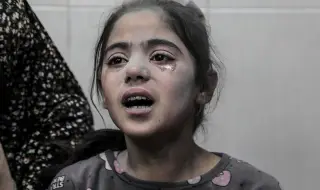
"We live in hell. Security and life in Gaza no longer make sense," Ala Moin said in a telephone conversation with DW. He lives in Gaza City with his wife and three children. "Every day I expect myself and my children to die. I go to sleep expecting not to wake up again," the 35-year-old said.
Moin and his family fled Jabalia last week when Israel's offensive against northern Gaza intensified. The five now share a room with other relatives. In addition to the constant fear of attack, Moin's family is barely able to find food. "We have no bread, we have no food. We eat whatever we find, not knowing if it's edible. We look for herbs and cook them. Everything is terribly expensive. I've spent all my savings on food," the man says.
"I don't know where to go anymore"
Stories like that of Moin and his family, who have been displaced multiple times and are suffering from hunger, are a daily occurrence in Gaza.
Farmer Naim Shafi and his family are once again forced to leave their home on the outskirts of Beit Lahia in northern Gaza. They now live in a tent by the road in Gaza City. "The shelling doesn't stop, it's everywhere," the 39-year-old says. "I had a bag of flour that I took with me. It's the most precious thing I could take," Shafi says. "I don't know how long this will last. We're just trying to survive."
Shafi plants vegetables near the destroyed building he has to live in when he returns to Beit Lahiya. And they are gone. "Every day there is news of a possible ceasefire, the next morning there is bombing, destruction, death. I don't know where to go anymore."
11 weeks of complete blockade
Israel announced on Sunday that limited humanitarian aid would be allowed into the Gaza Strip after 11 weeks of a complete blockade on the enclave, which now puts one in five people in the strip at risk of starvation.
Five UN trucks entered Gaza on Monday, the Israeli Defense Ministry said. The UN said Israel had allowed a total of nine trucks to cross the border. It was not clear when the aid would start being distributed. The UN, however, called it a "drop in the ocean" and called for more humanitarian aid to be allowed in urgently.
"It is good that something is now coming in (to the enclave), but so far we have not seen any change," said Raed al-Atihama, who lives with his family in Gaza City.
France, Britain and Canada warn Israel
Meanwhile, the Israeli army is continuing its offensive. Evacuation warnings have been issued in several parts of Gaza in the past week, including the enclave's second-largest city, Khan Younis, as well as Rafah and several neighborhoods in northern Gaza. Israel says the evacuation orders are intended to protect civilians.
Before the latest evacuation warning was issued for Khan Younis, more than two-thirds of the Strip had already received such warnings, the UN said. The organisation has described the mass displacement of people as a potential war crime.
The latest blockade of Gaza has drawn sharp criticism from the international community. Qatari Sheikh Mohammed bin Abdulrahman bin Jassim Al Thani said that "Israel's irresponsible and aggressive behaviour undermines any chance for peace". Britain, France and Canada issued a joint statement saying they "will not stand idly by" and threatened "concrete action" if Israel continued to block humanitarian aid.
Israeli Prime Minister Benjamin Netanyahu responded that the three countries were providing "a huge reward for Hamas's genocidal attack on Israel on October 7 and creating the opportunity for more such atrocities," and demanded that Israel end the blockade. "This is a war of civilization against barbarism. Israel will continue to defend itself by all means until it wins," Netanyahu said.
"The Nights Are the Scariest"
Back in Gaza City, Raed al-Athamna and his family are seeking shelter after once again being forced to flee Beit Hanoun. The family's nights are currently spent moving from one apartment to another in an attempt to stay safe.
"We hear the F-16 fighter jets bombing all the time. Sometimes they hit very close to us and the ground shakes", he shared in a phone conversation with DW. "The nights are the scariest now. We just hope to survive until morning", the man said, adding that his family is also exhausted from the lack of sleep. During the day, they all look for food, which exhausts them even more.
"We haven't eaten bread for eight days," the Palestinian said. "We ate lentils, but the children keep asking me if there's any more food. They're always hungry." Al-Atama said more and more tents are springing up in the city, where people seem to be coming from other places. “They just don't know where to go anymore."
Author: Tanya Kremer