After eleven weeks of a complete blockade, the Israeli government of Prime Minister Benjamin Netanyahu has given in: at the beginning of the week, the first trucks loaded with aid were allowed to enter the Gaza Strip.
How much aid is currently arriving in Gaza?
According to data from the Israeli coordination body COGAT, between May 20 and 22, a total of 198 trucks loaded with humanitarian supplies passed through the Kerem Shalom checkpoint in the border triangle between Egypt, Israel and the Gaza Strip. On Tuesday and Wednesday (May 20 and 21), 98 trucks were checked, and on Thursday (May 22), another 100. The trucks were carrying humanitarian aid, including flour for bakeries, baby food, medical equipment and medicines.
This may seem like a lot, but in reality it is nothing: when the ceasefire was temporarily suspended at the beginning of the year, up to 600 trucks with humanitarian supplies crossed the border with the Gaza Strip every day, supplying around two million Palestinians. Now, almost nothing is felt from the resumption of supplies - many of the loads remain blocked at collection points, as they are not being released for security reasons.
"We managed to distribute the first humanitarian supplies in Gaza. "It's a ray of hope, but it's too small, because hundreds of trucks are needed every day," Martin Frick, head of the German branch of the UN World Food Program, told DW. He added that the trucks with aid are fully prepared and waiting on the other side of the border.
Where are the stocks being stored?
The World Food Program has more than 116,000 tons of food in Egypt, Jordan and Israel - enough to supply one million people for about four months. According to the UN Relief and Works Agency for Palestine Refugees in the Near East (UNRWA), almost 3,000 fully loaded trucks are waiting behind the barriers at the border, ready to leave at any time. But few of them reach the aid redistribution points.
At Kerem Shalom, the only border crossing currently open, all the goods are loaded onto other trucks. Then the UN convoys have to wait at a collection point until the Israeli military gives permission to continue their journey. As a result, the aid is delayed, resulting in a pile-up of pallets of flour, baby food and other products that do not reach those in need.
Who is delivering the aid?
The UN agency for Palestine refugees in the Middle East runs the emergency shelters and has secured the aid loaded onto the 3,000 blocked trucks. The World Food Programme procures flour, organizes convoys and runs 25 bakeries in the Gaza Strip. However, they had to close in late March due to a lack of fuel. It was not until May 22 that some of them were able to resume their activities.
The United Nations Children's Fund (UNICEF) and the World Health Organization (WHO) are providing special food, vaccines and surgical supplies.
The Red Crescent branches in Egypt, Jordan, Qatar, Turkey and the UAE, the International Committee of the Red Cross (ICRC) and dozens of international NGOs such as Islamic Relief are also actively participating in the efforts. The situation with aid from EU countries or the US is also difficult, as each shipment is subject to inspection and is required to pass through the inspection regime created by Israel.
At the same time, the Israeli government, together with American companies, plans to create several "secure hubs" in the south of the country, where private security forces will take over the distribution. The UN, however, rejects this model, as it is not neutral.
Why is the aid piling up?
Israel justifies the total blockade imposed on March 2 by saying that Hamas, designated by most Western countries as a terrorist organization, is looting the aid supplies. Only after international pressure increased did Israel allow limited imports "until the new distribution system is operational." Amid the disputes between the UN and Israel over responsibility, the pallets of aid remain blocked in temporary storage centers.
Another major obstacle is the Israeli bombing of the Gaza Strip, the destroyed roads and looting. And because there is a shortage of diesel fuel, the few arriving goods remain blocked in warehouses - for example, flour is not reaching bakeries. In the meantime, bread prices have exploded.
Are there any deliveries by sea?
The maritime humanitarian aid corridor, opened in the spring of 2024 under the leadership of Cyprus, has never become a reliable supply route. After about 100 tons of food reached northern Gaza through it in March 2024, the "World Central Kitchen" suspended its operations. The reason: the Israeli airstrike on a convoy of the charity in early April 2024.
In May 2024, the US military secured a floating pier near Gaza, through which almost 9,000 tons of humanitarian aid reached land in the first 20 days of the operation. However, on July 17, 2024, the Pentagon finally declared the mission over - due to damage caused by weather conditions, security problems and looting.
Current initiatives by non-governmental organizations are also failing due to the blockade: for example, the ship "Conscience" of the "Freedom Flotilla Coalition" on its way to Gaza was hit by drones near Malta and had to be turned back damaged. Since then, no civilian aid shipments have reached the Gaza Strip.
What does the current situation mean for the people?
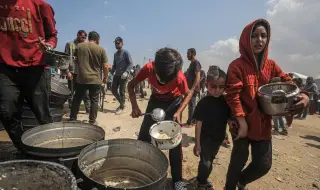
Even before the blockade, more than two-thirds of the population was dependent on outside aid. The situation has worsened as a result of the supply blockade. According to an analysis by the Food and Agriculture Organization of the United Nations, for 93% of the population (1.95 million people) the situation is crisis or even worse, and for 244,000 people it is even catastrophic.
Purely mathematically speaking, the enclave needs about 1,300 tons of food every day to provide 2.2 million people with an average of 2,100 kilocalories. A standard aid truck holds about 25 tons, which means that about 50-60 trucks per day will be needed for food alone. Since water, fuel, medicine and hygiene products also have to be imported, UN agencies estimate that at least 500 trucks are needed every day.
If the current scale of deliveries of about 100 trucks is maintained and the issue of their distribution to those in need is not resolved, the population of the Gaza Strip will be at risk of starvation in the coming weeks.
Author: Andreas Knoll