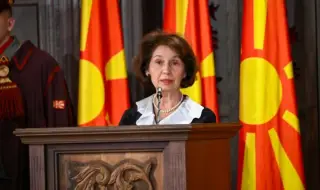
Austria is ready to mediate to find a creative solution between Bulgaria and North Macedonia. Vienna believes that the most important thing for the EU at the moment is the implementation of the enlargement policy. This was stated by the President of North Macedonia Gordana Siljanovska Davkova in an interview with "Free Europe", quoted by NOVA.
According to Siljanovska's office, Austrian Minister of European and International Affairs Beate Meinl-Reisinger stated during a meeting in Skopje last week that she would like the talks to resolve this dispute to be held in Vienna.
Siljanovska said that she could not give an exact answer as to whether Skopje is closer to the EU compared to last year.
„I cannot give you an exact answer in one sentence. Why? Because if I say that we are further or closer, this is not the right answer, because sometimes distance or proximity are very relative, why wouldn't this mean that if we start negotiations, it will really mean a step forward. At the same time, a new request may come or, as has happened so far, processes will follow that will make it impossible for us to negotiate on the clusters and chapters“, said the Macedonian president.
She defined the Macedonian process of European integration as a “precedent“ and stated that “this precedent will give birth to new precedents“.
“I often say that you can change the constitution, but I cannot promise that there will be constitutional amendments soon, because I am authorized to propose constitutional amendments, but the deputies vote according to their own convictions, because they represent the citizens, not me and other authorities. The most frequently asked question from outside is whether there will be constitutional amendments and my short answer is - I cannot guarantee it because I am not an absolute monarch.
So, in my opinion, demanding constitutional changes from outside contradicts the fundamental values and principles of the European Union, enshrined in the Treaty on EU, in the Treaty of Lisbon and in the Charter of Fundamental Rights, because there is an obligation or a promise there that the EU will respect the constitutional and political structures of the states or that the EU will respect national and cultural identity, dignity and integrity“, said Siljanovska.
She believes that there is room for creative diplomacy to overcome the problem of starting negotiations and gives her own proposals.
“Creative diplomacy, yes. We understand that the negotiating framework has been adopted. We understand that it is difficult to change, although the case of Serbia has shown otherwise. That is why I say that as soon as we point out problems related to our negotiations, then the EU should also invest energy in creatively supporting our progress and I think what you are mentioning is in this direction. Here are my suggestions: the European Parliament can adopt some kind of act on the situation between us and Bulgaria.
The Council can also give some instructions, it can be presented in some action plan of the historical Bulgarian-Macedonian Commission, they can be free, but be careful, although you say it is a theory. It is not a theory. These are constitutional acts of the EU and they have to respect them not only in relation to the members but also in relation to everyone else. So it should be presented to them.
We signed two protocols, right? There may be another one, but it cannot be a basis for a veto, but that there will be discussions similar to the discussions between the Germans and the French, the Poles and the Germans, to see how through the interpretation of the decisions we can reach a final agreement. Let me emphasize, in the agreement on friendship and good neighborliness with Bulgaria there is not a single article or word about constitutional amendments. The constitutional amendments stem from the first and second protocols,“, says the president.