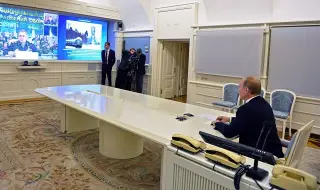
Reports by Western media and sources close to the Kremlin about Moscow's demands for an end to the war in Ukraine coincide with repeated public statements by Russian officials, who point to Russia's unchanging goal - the capitulation of Ukraine and the destruction of NATO. This is what analysts from the Institute for the Study of War (ISW) wrote in their report, following the publication by Reuters on May 28.
Three Russian sources familiar with the details of the peace talks reported that Vladimir Putin has set the following demands for an end to the war
"written“ an obligation of Western countries, which stipulates that NATO will not expand to the east
neutrality of Ukraine
easing of sanctions
unfreezing of Russian assets in the West
a vague requirement to "protect Russian speakers in Ukraine".
ISW emphasizes that Kremlin officials have previously repeatedly used allegations that Russian speakers are discriminated against in Ukraine to justify Russia's calls for a change of power in Ukraine and the establishment of a pro-Kremlin puppet regime. And Russia's demands for a ban on NATO expansion, for neutrality of Ukraine and a change of power are the same demands that Russia set before the start of the full-scale invasion in 2021 and in the first days of it. The Institute for the Study of War continues to assess that these demands are part of the Kremlin’s efforts to pressure the West into pushing Ukraine into surrender and to split NATO as a security alliance.
According to Reuters, Putin is also demanding that Ukraine cede all four regions that Russia has annexed but not yet fully conquered—although Kremlin officials have previously signaled that Russia has territorial ambitions beyond those four regions. One of the Reuters sources said that Putin is now less inclined to make territorial compromises and continues to demand the territories of Luhansk, Donetsk, Zaporizhia and Kherson regions in their entirety—including areas that Russian troops have not yet seized. According to this Reuters source, Putin's position on Russia's territorial demands has now become more rigid.
As ISW analysts recall, Putin first demanded that Ukraine cede all four regions in June 2024. Since then, Russian officials have often repeated this demand. The Washington Post reported on May 27 that, according to Ukrainian military intelligence estimates, Russia has deployed 125,000 troops along the borders of Sumy and Kharkiv regions - two regions that Russia has not yet "even formally annexed". In addition, since May 2024, Russian troops have been conducting offensive operations aimed at creating a so-called “buffer zone“ in Kharkiv region. And recently, Russian troops have also launched attacks aimed at creating a “buffer zone“ in the northern part of Sumy region. At the same time, Russian officials are calling on Russia to capture Sumy — possibly to pave the way for Russia to annex Sumy Oblast.
The Institute for the Study of War suggests that it would likely be difficult for Russia to seize all of the territories of Luhansk, Donetsk, Zaporizhia, and Kherson Oblasts militarily — especially given that Russia’s drive to capture the fortified belt of “fortress” cities in Donetsk Oblast (Konstantinovka, Druzhkovka, Kramatorsk, Slavyansk) and the need to cross the Dnieper River in Kherson Oblast would require Russia to deploy significantly larger forces than those currently deployed in eastern and southern Ukraine. Therefore, according to ISW, Russia would focus its efforts exclusively on capturing these four regions if the Kremlin’s territorial ambitions were truly limited to them. However, the deployment of significant offensive forces in Kharkiv and Sumy regions indicates that Russia intends to strengthen its territorial claims. ISW continues to assess that the Kremlin has significant territorial ambitions in southern and eastern Ukraine, and Russian officials in Putin’s inner circle have even called for Russia to take control of most of Ukraine.
Meanwhile, Putin continues to demonstrate his readiness to achieve his military goals by military means through a protracted war against Ukraine, during which Russian troops will continue their gradual, creeping advance. One of the Reuters sources stated that Putin will try to use the Russian conquests on the battlefield to show Ukraine and Europe that "tomorrow peace will be even more painful" if Putin fails to achieve the desired terms for a peace agreement. The agency's source also stated that Putin will take advantage of any tactical opportunities on the battlefield to further advance deep into Ukraine. According to information from sources of the British agency, Putin believes that Russia is capable of fighting for years, even despite sanctions or other economic measures that the West may introduce against Russia in the future. ISW has long assessed that Putin adheres to a theory of victory that predicts that Russian troops will be able to continue their gradual, creeping advance indefinitely and await Western military assistance to Ukraine, as well as Ukraine's own mobilization efforts.
ISW analysts believe that Russia will likely be able to continue its current tactics of gradual, creeping advance for as long as the Russian Federation can compensate for its losses at the front. Deputy Chairman of the Russian Security Council Dmitry Medvedev said on May 28 that almost 175,000 people have been recruited into military units since the beginning of 2025, and more than 14,000 more have joined the ranks of “volunteer formations”, which amounts to approximately 1,285 people per day. Medvedev also reiterated Putin’s statement on May 13 that between 50,000 and 60,000 people volunteer to join the Russian army each month. ISW notes that it cannot independently verify these claims by Putin and Medvedev. Reports from the General Staff of Ukraine on daily Russian losses show that Russia has approximately the following daily losses:
1,550 people per day in January 2025
1,261 in February 2025
1,312 in March 2025
1,219 in April 2025
1,140 between May 1 and May 28.
Medvedev's statement on May 28 that the Russian army has been replenished with 175,000 soldiers since January 2025 indicates that Russia is replenishing its units at a ratio of approximately one to one to the level of losses. ISW continues to assess that Ukrainian troops, with Western support, could inflict even greater casualties on the Russians on the battlefield, which could push Putin to make difficult decisions and force Putin to start real negotiations to end the war.
ISW notes separately that the Kremlin continues to push its old false narratives that the threat of NATO expansion forced Russia to attack Ukraine in 2022 and that NATO continues to threaten Russia's security at the moment. Analysts pay attention to new statements by Russian Foreign Minister Sergei Lavrov and Russian Defense Minister Andrei Belousov on this issue. However, as ISW analysts recall, "in reality, Putin invaded Ukraine in 2022 not because he was afraid of NATO, but because he considered the alliance weak and wanted to destroy it".
Link to main version
Май 29, 2025 15:26 511
ISW: Vladimir Putin now wants much more than the four regions! The Kremlin seeks the disintegration of NATO and the capitulation of Kiev
Analysts believe that Moscow will probably be able to continue its current tactics of gradual, creeping advance as long as the Russian Federation can compensate for its losses on the front
Снимка: БГНЕС/ЕРА