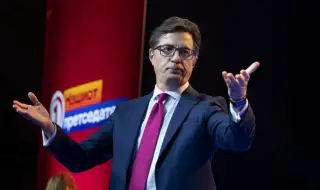
The government of the Republic of North Macedonia has no intention of moving towards the EU under the current conditions and changing the constitution, said the former president of our southeastern neighbor Stevo Pendarovski in an extensive interview published today by "Deutsche Welle" under the title "Stevo Pendarovski: We are moving towards countries that are not democratic".
Part of the "Deutsche Welle" interview published yesterday under the title "Pendarovski: Rumen Radev cannot be negotiated".
We are the first case in the history of European integration, in which conditions are set for an EU member state from the position of a candidate for membership ... Bulgaria to recognize 14 judgments from Strasbourg (the European Court of Human Rights – ed. note), to recognize the existence of a Macedonian minority, etc. All these messages are intended for the domestic audience. This government has no intention of changing the constitution, including Bulgarians or moving towards Europe. And this is the only condition, Pendarovski commented.
He believes that the current President of the Republic of North Macedonia, Gordana Siljanovska-Davkova, would not be able to make progress on the issue of the country's European integration during possible bilateral talks with Bulgarian President Rumen Radev at the NATO summit in The Hague next month, since the Bulgarian head of state is the "initiator of the blockade" of Skopje's European integration.
"Because Rumen Radev is the architect of the Bulgarian blockade against (Northern - ed.) Macedonia. I have had many conversations with him at international events. He came to my inauguration in 2019 and even then he firmly defended the positions of Bulgarian nationalism from the (time of - ed.) communism," he told "Deutsche Welle" Pendarovski.
According to him, one cannot “expect the one who created the problem to solve it“.
"You cannot watch operas and cultural events with him and effect a change in position, because this person believes in what he has done," commented Pendarovski.
He also noted that it is no coincidence that the government of the Republic of North Macedonia chooses Hungary as its strategic economic partner out of all 27 EU member states.
"You can imagine the real ambitions for European integration of this government, which states that a lot can be learned from Orban (Hungarian Prime Minister Viktor Orban - ed.)," said Pendarovski.
According to him, the ruling party is targeting countries that have anti-European views, which are the “black sheep“ in the EU.
The full text of the interview follows:
DV: The parliament voted on the strategic partnership agreement with Great Britain. The government declared it historic, with a claim for great benefits for the country. Critics say that it is about a new large debt with unclear conditions and even less control over spending. What do you think about this agreement?
Pendarovski: The strategic partnership agreement between Macedonia and Great Britain has not been signed. What we were given to see and was ratified on Wednesday is not a strategic partnership agreement. According to its content, it could be a memorandum of cooperation, even an initial letter of intent, in which the two governments list four areas in which working groups have yet to sit down and specify what projects they would work on. And according to this general content, it is not about anything strategic, but about lending for projects that are yet to be specified by both sides - British lending for infrastructure projects in (Republic of North Macedonia - ed.) Macedonia. They announce that there may be a second agreement after this, which would be about the strategic aspects of our bilateral relations with London. Let's stay alive and well, maybe that will happen one day. But this has nothing to do with strategy, this is an agreement in principle to sit down and see what you need for lending.
The interest of (Republic of North Macedonia - ed.) Macedonia in this agreement is clear, at least for now, these are the loans that the government will receive. But what do you think is the UK's interest in this agreement? What does London gain from it? It's hard to believe that this is some kind of altruism...
There is no altruism in either domestic or international politics. From what we know from the British media, it is about negotiations that are still to be held, from September onwards, with several Balkan countries to settle migrants who do not meet the conditions for residence in the UK. There is absolutely no other reason for London to give us money for renovation, there is not even a question of construction, but rather of renovating several local hospitals in (Republic of North – ed.) Macedonia. This is certainly not a strategic interest of the UK. But it is in their interest to find, if possible, more centers in this region, which is on the border between the EU and the Middle East, where these migrants could reside. In practice, this is an action that has already begun in the UK and they are looking for an opportunity to settle them. I am not saying that we will accept this, but I am saying that according to relevant British media, which refer to the British government, these talks on establishing transit centers for migrants will begin in September and among the countries mentioned is ours.
Well, the government has already denied this, responding to criticism from the opposition...
They said that the agreement will not contain such a clause. But we have a statement from our Prime Minister before the meeting with Keir Starmer, in which he says in English “we have not yet discussed this issue“. But you ask me about the interest of the other side, and London has only this interest.
We only get tariffs from Trump
With another strategic partner - the USA, the government is building, as it says, an enhanced partnership. Prime Minister Mickoski has already announced the “new normal“ and said that we are on the front line under President Donald Trump. What have we received so far from this strengthened partnership with the Trump administration?
We received tariffs. The only thing we “received“, because this is not a good acquisition, it is not good news for our people, we received tariffs like everyone else and we did not receive an exception from the American president's customs system. I have already commented on our sharp rapprochement with the new American administration, with the thesis that we are first to the American president, with the statement that everyone else will line up behind us. We, after all, occupied this perimeter and the role of some of our emigrants and some American representatives such as Lutnik (US Commerce Secretary Howard Lutnik – ed.) or Richard Grenell (US President Donald Trump's envoy - ed.), was extolled, that they could provide us with a privileged position in Trump's future policy. I call this then and now a colossal amateur blunder or miscalculation in choosing your new foreign policy priorities. Why? You need to assess what profile the new American president has. By all accounts - a transactional one, interested in money and resources of various kinds. For example, minerals in Ukraine. What can we offer such a politician? Absolutely nothing.
Let me repeat, Trump is a man who is interested only in the economic interests of the United States. “America first” does not mean America first in a cultural or democratic sense, but only in an economic sense, only in the sense of money. We here, I repeat, have nothing to offer.
I understand your criticism, but would you still agree that it is in the interest of (the Republic of North Macedonia – ed. note) Macedonia as a small country to seek allies and partners, regardless of who is ruling on the other side?
Undoubtedly. The task of each of us, when you are in power, when you have the trust of the citizens, is to seek friends. I am talking about the propaganda that has been produced here for months, with the claims that this is happening for the first time in recent history, that a government has such relations with Washington.
We had a prime minister of the country, not a president, who was received by George Bush in the White House. We had a president, Boris Trajkovski, who was outside all political conventions, who was quite close as a person to the then American president. And now if you say “this has not happened before, you will see what we will do” and now we wonder what else we can expect from them besides tariffs.
The government has no intention of moving towards the EU
We recently received, I would say, an interesting new catchphrase from the Minister of Foreign Affairs, with which he said that the US is our strategic partner, and the EU is our strategic goal. Is this some not particularly successful nuance, which should not be given much importance, or perhaps it indicates some more dramatic change in the country's foreign policy?
This is bare rhetoric, which is actually specific to our Minister of Foreign Affairs. It is perfectly clear to all the people who are engaged by this government in the field of foreign policy that this government has no intention of moving towards the EU under these conditions.
We are the first case in the history of European integration, in which conditions are set for an EU member state from the position of a candidate for membership ... Bulgaria to recognize 14 judgments from Strasbourg (the European Court of Human Rights - ed. note), to recognize the existence of a Macedonian minority, etc. All these messages are intended for the domestic audience. This government has no intention of changing the constitution, including Bulgarians or moving towards Europe. And this is the only condition.
Our government, not by chance, chooses one of the 27 EU member states, probably two more will follow, to call a strategic economic partner. This is Hungary. You can imagine what the real ambitions for European integration of this government are, after we have a statement that there is a lot to learn from Orban. He is the man who coined the term “illiberal democracy“, boasts about it and clings to people like him around the world. And we will now learn from this man?!
Why don't we try to make a strategic partnership with Germany? Look, Germany now has a conservative government. They are together in the EPP (with VMRO-DPMNE - Deutsche Welle editor's note).
So the intention is to go towards countries, Trump, that have anti-European views, and towards countries in the EU that are the “black sheep“. Hungary is a country from which we have a lot to learn and for which a procedure has been initiated to deprive it of its right to vote in the EU. What will we learn from them?
While in Macedonia we are still discussing how to continue the path to the EU, unrest is taking place within the Union itself. Despite statements by EC representatives that the path to membership is open to candidate countries, it seems that the largest countries do not think so. In the past, we had France blocking enlargement, and now Germany says that it should happen after the reforms of the Union. The question is, with such uncertainty about whether and when there will be enlargement, should we put ourselves under pressure at all costs to make concessions for something that is ultimately not certain, namely full EU membership?
What you say about the agreement of the two ruling parties in Germany is true. However, after the adoption of this document, Albania opened another cluster in the negotiations. Montenegro is also making progress in the negotiations, as are those countries that were previously in the Eastern Partnership, such as Moldova, which is now increasingly joining and occupying this third place of potential candidates, where we were.
The position of the German government is such and is absolutely identical to the position of Macron, who says first deepening, then expanding the EU. This position of the German government has not yet been presented and support for it has not yet been sought in Brussels from Europe for it to be a pan-European position. And let me repeat, after this position was adopted, Albania continued to make progress. Germany had nothing against the new steps taken by the government in Tirana.
Yes, but this step is not controversial, progress is not controversial, and that last step - this is full membership. We have been hearing promises from Brussels for decades that they are prepared for enlargement, but the member states, who have the final say, say otherwise. Today, both France and Germany say: no enlargement until the EU is reformed.
If we do a real analysis, since Macron de facto vetoed us in 2019, demanding a new methodology, until this direct and formal-legal blockade from Bulgaria, we have not progressed. And not only us. Montenegro has not progressed either. Now, since we have this position of the other great power within the EU, two countries have been progressing since this position was established. I am not saying that they will finally accept them, but it is certainly a process of about 3-4 years, in which they cannot even technically complete the negotiations themselves faster.
I think the situation is different this time. I don't have the impression that Germany is forgetting about European integration, because it knows very well that it is better to keep the danger from Russia at a distance, and the Balkans, even expressed in a dismissive vocabulary, can serve as a “buffer zone“.
Deviations towards undemocratic countries
In less than a month, the government of Hristijan Mickoski will celebrate one year. How do you assess its work so far?
I must tell you that I am quite unpleasantly surprised. Because I did not believe that they would be so incompetent and that there would be such catastrophic management within the government. In practice, you have a prime minister who replaces all 15-20 ministries in the government, and the rest are just figures.
You have situations like the agreement with the UK on a financial obligation, which was signed by the Minister of Transport, not the Minister of Finance.
Some moves worried me, for example, you put completely unqualified people in vital state bodies like the National Security Agency. A person who cannot provide a certificate that he knows English and had to forge a diploma, namely from Bulgaria.
You have a prime minister who publicly threatens the prosecutor general to resign. Or a truly classic break-in through interpellation for members of the Judicial Council, who are elected to parliament because they were elected by the previous political majority. In translation, he wants to say: we want our political majority to say who will be there, and they evaluate the judges and their work.
Knowing VMRO-DPMNE in a historical sense, since 1990 to this day, and especially the government of Nikola Gruevski, when it was a relatively tight machine for autocratic governance, these are far from this profile of governance... they are wandering and what amazes me: in no key area, including foreign policy, do they have a goal.
What is their goal? What is the substratum of the policy they are leading?
The same is true with the Hungarian loan. What was the goal of taking a billion and then saying: come to the counter now and apply, the municipalities and the business community give projects. This loan so far, and further on, will be reduced to the construction of kindergartens and five meters of asphalt. Not only are they not strategic investments, but they are unimportant investments. Maybe for those people who live there... for the country as a whole, they cannot raise its GDP.
In the agreement with Great Britain, even for the announcements that a new clinical center will be built, the text indicates “renovation“.
However, not everything is like that. Here, Corridor 10 is announced, which is a strategic project of great importance for the country...
It is undoubtedly so, but Corridors 8 and 10 also have a great strategic dimension. If you remember, both the Hungarian, our and Serbian representatives say that with Corridor 10, which is not Thessaloniki-Skopje, but Thessaloniki-Budapest, they say that this is how a single economic region is created. An economic region with Serbia - a country that is not a member of NATO, and Hungary, which is about to lose its right to vote in the EU. Here I can say that there are already small deviations towards countries and systems that are not very democratic.
I think that is why the construction of Corridor 10 is being pushed for. Don't forget that in the last 4-5 months our high-ranking representatives have had five times more meetings with Szijjarto (Péter Szijjarto – Hungarian Foreign Minister – ed.) and Orban (Viktor Orban – Hungarian President) than with all other European representatives combined.
Okay, and where do you think this leads us in such a case?
The same thing will happen as after they refused us to join NATO in Bucharest, with an unclear perspective on when this dispute with Greece will ever be resolved. You know, we waited 10 years for this dispute to be resolved.
And all the important components of Macedonian society will start to wake up from within... people will say: Wait, what is happening, do we have to wait another 10-15 years to sign what Europe wants from you...
And all the important components of Macedonian society will start to wake up from within... people will say: Wait, what is happening, do we have to wait another 10-15 years to sign what Europe wants from you...
Yes, but the data does not point in that direction. Here is the latest Eurobarometer, which shows that trust in the EU has fallen to 54 percent.
Trust in the EU was high thanks to the Albanians. If you ask only ethnic Macedonians, our support is around 30 percent and such support is only available in Serbia.
Then how can we expect public pressure to continue on the path to the EU when there is no support for it?
Unfortunately, our people, with all the problems they had during these decades of difficult life, both Macedonians and Albanians and others, are practically under anesthesia and insensitive to all this nonsense that is served to them by various political elites. I am not saying that this will be a security problem, but it will be a sign that both Macedonians and Albanians will start to leave Macedonia forever in even greater numbers.
Silyanovska-Davkova is invisible
President Siljanovska-Davkova also marked one year in office this month. How do you assess her work?
Silyanovska is invisible in the areas where she should be most visible. The powers of the president of the state, as established by the constitution, are foreign policy, defense and security. And this last one, the proposal for the governor of the National Bank, came from the ruling party. This is a public secret with us. At the same time, in the area where you have exclusive powers, for example, director of the Intelligence Agency or deputy director, chief of the General Staff, etc., all the proposals came from the ruling party. So in practice, in what you have exclusive powers for, you have a situation like with the governor, now the prime minister says: I have scheduled a meeting in parliament with the speaker (of parliament). He doesn't ask you, but you are the one who should suggest it.
Imagine, with all these turbulences that have been happening over the past year, not only Ukraine, but in general everything that is happening, including the new administration in the US, which has shaken the whole world, America's biggest allies, you don't have a single meeting of the Security Council. So, from personnel policy to your practical concrete policy, the content in the political field, you are practically either a follower of the government, or you are avoiding assuming and fulfilling your functions according to the constitution.
European representatives announced an initiative for a bilateral meeting of the President of the Republic of North Macedonia and the Bulgarian President during the NATO summit in The Hague, which would be attended by the first people of the EU, NATO and the US. Maybe President Siljanovska will be able to come to the fore here and agree on something with the Bulgarian President?
No! Do you know why? Because Rumen Radev is the architect of the Bulgarian blockade of (Republic of North Macedonia – ed.) Macedonia. I have had many conversations with him at international gatherings. He also came to my inauguration in 2019 and even then he firmly defended the positions of Bulgarian nationalism against communism. This man forced the government to adopt its own declaration and in the Bulgarian parliament, which has 250 deputies, this declaration was voted by 204 votes. I remember that I commented then that this declaration was adopted with a North Korean percentage.
This man was the initiator of the blockade of (Republic of North Macedonia – ed.) Macedonia.
You cannot expect the one who created the problem to solve it. Even with Karakachanov in this Borisov government, he was not the main one. The main person who approved this path was Radev. You can't watch operas and cultural events with him and effect a change in position, because this person believes in what he has done and in the fact that he has made everyone else believe in this position.
A little over a year ago you left the presidency. During your term, you had several statements in which you sharply criticized the state of society, talked about the fight against corruption, etc. However, it seems that at the crucial moment, such as the amendments to the Penal Code, you complied with the government. Was this one of the biggest mistakes of your term or will you point out others?
The old maxim says “everyone makes mistakes while they are alive“. I can't say that I haven't made mistakes, I certainly have, but what I can say is that I have never made a single mistake regarding the strategic issues that (Republic of North Macedonia – ed.) Macedonia has faced, and regarding the strategic goals of the state. There are three of them: joining NATO, with which we ensured the security of the state - the war in Ukraine showed us what it means to be under the NATO security umbrella. Second: EU integration, and that is why I was the first to support the European proposal, the first of all, before the government. And third: interethnic relations, which are extremely important, although this government doesn't think so. Regardless of whether today, 20 years ago or 30 years from now, Macedonia has always been a multiethnic state. Those who are at the head of the state should know this and act accordingly.
So, on the key issues, I was not wrong.
Regarding the Penal Code, I explained: my information at the time was that the ruling majority, including the largest opposition party at the time, which formed a quorum, were ready at all costs to return the law the same day, because my right of veto is suspensive, not absolute. In two previous situations, when I returned the laws, I knew from the ruling coalition that they did not have 61 deputies, and they never returned them.
These changes were decided for various reasons, and the key one was the opposition party, which could not have formed a quorum - it did so because, in the end, four times more of its members benefit from the effects of the NC changes than those on the other side.
„Pendarovski will be where the democratic forces are“
SDSM, the party whose deputy you were in parliament and candidate for president, at least according to the sociological surveys, is unlikely to emerge from the catastrophe that befell it in the parliamentary elections. Do you see a scenario in which this party could become a more serious opposition to the government, especially since the forecasts for the local elections are not brilliant?
The defeat of SDSM last year was unprecedented, the heaviest in history. SDSM has never in its history fallen below 154 thousand votes. From this perspective, all expectations are that it cannot return to its previous numbers in six months or a year. I don't even think that the local elections in October are a quick enough period, with round-the-clock work, even under ideal conditions, that the party can return to what it once was. In the previous local elections, SDSM was at about 260 thousand votes, which is a pretty big drop. And from these elections in 2021, to the parliamentary elections last year, SDSM lost another 30-40 percent of its electorate. In the meantime, one or two other special-purpose political parties were created, which took another part of the SDSM electorate. I would wait another year after the local ones to see if this party can return to its old paths. So, to renew its membership with new, fresh policies and with a clear distinction from what was not worth it and because of which they lost the elections, and me as part of this entire structure.
It would be good for democracy in (Republic of North Macedonia – ed.) Macedonia, and for its European prospects, for SDSM to renew itself, in terms of personnel, program and even more so politically, and for a relatively short period of time to become a serious alternative to what is happening.
In my opinion, the current VMRO-DPMNE government does not have adequate personnel potential, does not even have minimal good political management within the ministries and, which is most important and most detrimental for us, there is practically no content on the key basic guidelines along which this country should move. I am talking about foreign policy, defense, security and especially the economy, in which we are now witnessing these two large loans showing that they have no economic concept for the development of (Republic of North Macedonia – ed.) Macedonia.
Do you plan to actively engage in politics again?
I have said this before, I also told the new leadership of SDSM, that I had no such intention when I ended my mandate, because I achieved the most I could in this hierarchy. At the same time, I am truly unpleasantly surprised by the path that the new government is taking in the field of interethnic relations within, by neglecting this area, in which great care must be taken. This is always very dangerous in (Republic of North Macedonia – ed.) Macedonia. And this path that they have taken with these economic regions with Serbia and Hungary, and this colossal lapse with Trump, looking at where we are going, I think it will be necessary, not only for me, but also for all people who are democratically minded, to support this structure that is now in opposition, and which is trying to leave behind all the failures, all the bad policies and bad personnel decisions that it undoubtedly had, and to try to balance this nationalist and anti-European drive that the ruling party has.
I told them, if you think that in any role I can contribute, I am at your disposal. Over the past 30 years, I have always been on the side of those who want democracy and stable interethnic relations.
Link to main version
Май 31, 2025 19:57 433
Pendarovski: Not Karakachanov, but Radev was the main architect of Macedonia's EU blockade
You cannot watch operas and cultural events with him and effect a change in his position, said the former president of North Macedonia
Снимка: ЕПА/БГНЕС