For several days, the Israeli air force has been attacking targets in Iran. One of the main ones is Iranian nuclear facilities. Israel suspects the regime in Tehran of wanting to develop a nuclear bomb. Iran denies it.
Iran's nuclear sites are scattered throughout the country. It is believed that several of them also house large underground facilities where research is secretly conducted that far exceeds the country's needs for civilian nuclear energy.
Heavy damage in Natanz and Isfahan
In Natanz, central Iran, uranium was enriched on a large scale - up to 60%, according to estimates by the International Atomic Energy Agency (IAEA). Enrichment of 3 to 5 percent is sufficient to operate a nuclear power plant, while uranium enriched to about 90 percent is needed to create a nuclear bomb.
As a result of the Israeli air strikes, the above-ground centrifuges for such enrichment have now been almost completely destroyed, the head of the IAEA, Rafael Grossi, told the BBC. It is not clear whether the underground part of the plant was also affected, but it is clear that the power outage caused by the bombing alone could have caused significant additional damage there. The IAEA admits that there may be "dangerous radiation contamination" inside the plant. However, there is no indication so far of radiation leaking into the atmosphere.
At least four buildings at the nuclear technology center in the nearby city of Isfahan were also damaged. Here, the uranium oxide mined in the mines, known as "yellow cake", is processed into uranium tetrafluoride and uranium hexafluoride - this is necessary for the subsequent enrichment of uranium.
An important secret complex: the Fordow nuclear facility
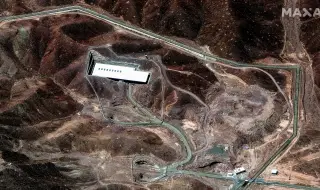
In addition to Natanz, Iran has a second important nuclear facility for uranium enrichment. The Fordow complex is located south of Tehran. At the beginning of the millennium, the Iranian regime secretly built a nuclear facility on the site of a former military site near the city of Qom. It is alleged that there have also been Israeli attacks there in recent days. However, there are no reports of significant damage so far.
This may be due to the fact that most of the Fordow complex is located deep underground. Presumably to protect it from IAEA inspections and possible attacks or sabotage, a system of tunnels has been dug into the mountain range at a depth of 60 to 90 meters. In 2009, Western intelligence services first reported the existence of such a facility.
In 2012, the IAEA announced that Iranian scientists at Fordow had begun enriching uranium to 20% "for medical purposes". It is said that since then, a total of about 3,000 uranium enrichment centrifuges have been installed in the underground facility. This means that the facility is smaller than the Natanz complex. However, it should also be possible to enrich uranium to higher levels of purity, which indicates that the facility is being used for military purposes, ARD points out.
How close was Iran to making a nuclear bomb?
It is not known exactly what is happening at the Fordow nuclear facility. Although on paper the complex is controlled by the IAEA, Iran has recently restricted access to international inspectors and dismantled several monitoring devices, especially after the cancellation of the international nuclear agreement.
At the end of May, the IAEA announced that Iran had succeeded in enriching uranium to 60%. It is also claimed that the country has more than 400 kilograms of this material. Further enrichment to levels that allow the production of nuclear weapons occurs relatively quickly, experts say. In a report published shortly before the Israeli attacks, the Institute for Science and International Security warned that with the facilities at Fordow, Iran could produce 233 kilograms of weapons-grade uranium within three weeks, which would be enough to create several nuclear warheads, ARD recalls.
A difficult target to hit
In this context, the Fordow facility is likely to be the target of future Israeli attacks. "At the end of this whole operation, Fordow must be eliminated," Israeli Ambassador to Washington Yechiel Leiter told "Fox News".
However, destroying the facility, which is located deep under a rock massif, is likely to be particularly difficult. Military analyst Cedric Layton explained to CNN that Iran used specially hardened concrete for the Fordow facility to protect it from air attacks. Although the Israeli Air Force also has bunker-busting weapons, it would likely take multiple waves of attacks to breach the facility's protective armor, the German public media outlet said.
Only the US has a bunker buster that is more capable of doing this job. The precision-guided GBU-57 weighs just under 14 tons and is specifically designed to destroy targets hidden deep underground. However, it is too large and heavy to be delivered to the target by the Israeli Air Force. American B-2 or B-52 bombers are needed. At this stage, however, it is not yet clear whether the US will allow itself to be directly involved in the conflict between Israel and Iran, ARD points out.
Author: Thomas Lachan