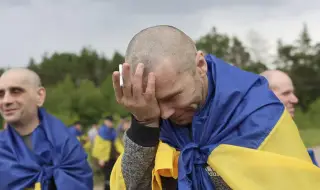
Yuri Gulchuk is 23 years old. He grew up in Kiev and studied foreign languages at university. He speaks Chinese, English and Polish, and was on exchange in Hungary and Germany.
In December 2021, he voluntarily joined the army - mostly for the money. He later ended up in the 36th Marine Brigade of the Ukrainian Army. He participated in the defense of Mariupol, where he was captured. Yuri spent 2.5 years in Russian captivity. "Concentration camp" - that's what the colony he was in was called.
Yuri returned to Ukraine in September 2024 after a prisoner exchange. As a result of the torture he was subjected to, he lost his voice. Only later did he talk about his experiences.
Vlad Zadorin is 26 years old. After becoming an adult, he started working in Poland, and in 2019 signed a contract to join the army. He also served in the Marine Corps. He was on Snake Island when he was captured. Vlad remained in Russian captivity for almost two years.
Vlad returned to his homeland after a prisoner exchange in January 2024. He now lives in Odessa and works for the organization Break the Fake, whose mission is to counter Russian disinformation. In various forums, including in Europe, Vlad talks about his experiences during Russian captivity, including the systematic torture.
To take revenge or forgive the torturers?
Despite the similarities in their experiences, Yuri and Vlad have different attitudes towards those who tortured them in Russian captivity. "They beat with electric shocks, with their hands, with their feet, with a pipe, with a wet rag", says Yuri. There were other tortures too - for example, setting dogs on the prisoners and touching an electric shock baton to their genitals.
"What they did to me is just part of all the evil done to me by people. If I have to take revenge on the Russians who treated me like this during captivity, I should also take revenge on the Ukrainians who treated me badly. That is, I either have to take revenge on everyone or forgive everyone. I don't want to take revenge, because that will fill me with malice. That's why I will have to forgive," says Yuri.
Vlad has a completely different opinion: "I hate the Russians with all my heart. They have caused us so much pain, so much humiliation. When I was captured, I weighed 120 kilograms, and I came out of captivity 60 kilograms. I ate mice, toilet paper, soap. They broke bottles in my head. How can I love them? How can I think of them as brothers? They came to kill us - me and my family. We didn't touch anyone," says Vlad Zadorin. He is convinced that all those who committed war crimes will sooner or later be punished.
Help for those who returned from Russian captivity
Both Gulchuk and Zadorin say that they received significant amounts of money from the state for the time spent in Russian captivity. Yuri bought an apartment in Kiev with the money.
As for the need for rehabilitation, Yuri and Vlad have different opinions. Vlad Zadorin has been to rehabilitation in Lithuania and says that this helped him a lot. But many refuse such assistance - Yuri is one of them. He only stayed two weeks in the center he was sent to.
Yuri and Vlad also say that after their release from captivity, they were not forced to return to the army - they were given the freedom to choose for themselves. "I resigned because my work is now in a different direction. I have another front - information", explains Vlad, adding that there is no need for unmotivated people on the front. "Because they will kill themselves and others around them. This is dangerous."
Yuri, in turn, says that after captivity he categorically did not want to return to the army. "As far as I know, most exchanged prisoners leave the army. Those who stay are few."
What are their plans for the future
Yuri does not have a permanent job, he earns his living as an English teacher. "This year I just want to live in peace, recover physically and mentally. After that I plan to go to Germany, study and find a job." In his free time he studies German, goes in for sports and takes singing lessons.
Vlad is busy with his activities in the organization Break the Fake. "We are working to bring Ukraine's victory as close as possible." He says that the Russian authorities in most cases do not recognize Ukrainians as prisoners of war - so they end up without rights, international observers are not allowed to approach them, and sometimes they are shot. The man points out that in two years in captivity he has not seen a single organization that monitors the conditions in which prisoners of war are held. There are over 250 such places in Russia, and he himself has been through seven. According to him, the conditions in them are different. "In some places it is more normal - they beat them less and even feed them. It depends on this whether a person will return from there normal or not."
Author: Nikita Oshuev