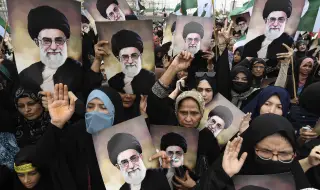
The hierarchy of power in the Islamic Republic is notoriously complex. There are councils and offices with enormous power, whose members are not elected. Instead, they are appointed or controlled by elected or partially elected bodies.
Supreme Leader of Iran
The so-called Council of Wise Men is an elected body consisting of a total of 86 Islamic clerics tasked with electing, controlling and - if necessary - dismissing the supreme leader of Iran. Ayatollah Ali Khamenei was elected for life in 1989. The ayatollah is the highest authority in Iran with direct or indirect authority over all state matters - from foreign to domestic policy. He appoints key officials, including the heads of state media and the judiciary, and has representatives in almost every major institution. The supreme leader's powers include declaring war or peace, as well as mobilizing the armed forces.
Khamenei was appointed by the Assembly of Wise Men after the death of Ayatollah Ruhollah Khomeini, the leader of the 1979 revolution.
President of Iran
Massoud Pezeshkian won Iran's snap presidential election in July 2024, after his predecessor Ebrahim Raisi died in a helicopter crash two months earlier. Pezeshkian became the ninth president of the Islamic Republic, making him the second most powerful figure in the country after the supreme leader.
Pezeshkian, known for his moderate stance, campaigned on promises of limited social reforms, resuming negotiations with the West over Iran's nuclear program, and addressing public discontent sparked by the death of Gina Amini. In 2022, the young Kurdish woman died in police custody after being arrested for wearing her headscarf too casually.
Iranian presidents serve four-year terms and are responsible for governing the country and representing it in international diplomacy. However, power rests with the ayatollah, who is the supreme leader and has authority over the military, the judiciary, and key aspects of foreign policy. Presidents cannot oppose the supreme leader on matters of strategic importance.
Reformist leaders like Pezeshkian - and before him Hassan Rouhani, who brokered the 2015 nuclear deal with the Obama administration - have often faced strong opposition from conservative institutions, including Iran's Guardian Council and Revolutionary Guard. Rouhani's efforts to ease tensions with the West were undermined when the United States withdrew from the nuclear deal in 2018 under then-President Donald Trump.
Guardian Council
The Guardian Council is tasked with ensuring that legislation passed by Iran's parliament is in line with the constitution and Islamic principles. This 12-member body wields considerable power: six of its members are Islamic clerics appointed directly by the supreme leader, while the other six are jurists elected by parliament. In addition to its legislative role, the Council also vets candidates for key elected bodies, including the presidency, parliament, and the Council of Wise Men. This gives it significant influence over who can participate in Iran's tightly controlled electoral system.
Since 1992, the Guardian Council has been chaired by Ahmad Jannati, a religious hardliner and ally of the supreme leader. It plays a central role in vetting candidates for their adherence to the principles of the Islamic Republic.
Council of Expediency
Another key institution is the Council of Expediency, an influential advisory body tasked with mediating disputes between parliament and the Guardian Council, particularly when proposed laws conflict with Islamic law or the constitution. Its members, appointed directly by the Supreme Leader, include senior clerics, military officials, former presidents, and technocrats. Although formally an advisory body, the council often functions as an extension of the Supreme Leader's authority, influencing national policy and ensuring continuity in the political system during times of internal conflict or crisis.
Islamic Revolutionary Guard Corps
Commander-in-Chief: General Mohammad Pakpour, elected in June 2025. Created after the Islamic Revolution in Iran in 1979, the Revolutionary Guard Corps of Iran began as a volunteer militia tasked with protecting the newly established regime. During the Iran-Iraq War of 1980-1988, the Revolutionary Guard Corps became a powerful parallel military structure. After the end of the conflict, it expanded its influence and its presence in the economy and politics of the Islamic Republic.
According to analysts, the Guards control between 20 and 40% of the Iranian economy, mainly through its engineering division Khatam al-Anbiya and its extensive interests in the energy, agriculture and finance sectors. In these, the Revolutionary Guards provide employment and political influence. Militarily, the Guards are tasked with protecting the regime both at home and abroad. Its Basij militia keeps a close watch on internal dissent, while its elite Quds Force keeps a close watch on the region.
The Revolutionary Guards' intelligence wing rivals the official security services and plays a key role in countering perceived internal and external threats. Under the leadership of Supreme Leader Ayatollah Ali Khamenei, it has significantly expanded its role in politics and security.
Following the June 13 Israeli airstrike that killed Revolutionary Guard Commander Hossein Salami and several other senior generals, Khamenei appointed Brigadier General Mohammad Pakpour, a veteran of the Iran-Iraq War and longtime head of the Revolutionary Guards' ground forces, as the organization's new leader.
Iran's Parliament (Majlis)
Iran's Parliament – The Majlis - is a unicameral legislature composed of 290 members elected to four-year terms through direct national elections. The Majlis has broad legislative powers, including drafting laws, approving the national budget, and ratifying international agreements. However, its powers are limited by the Guardian Council, which vets all candidates for parliament and has the power to reject laws it deems incompatible with the constitution or Islamic principles.
Mohammad Bagher Qalibaf, a hardline conservative, has been the speaker of parliament since 2020 and was re-elected to that position in May 2025. A former Revolutionary Guard general, chief of the national police, and mayor of Tehran, Qalibaf is considered one of the most influential figures in Iran's political establishment.
Author: Monir Ghaedi