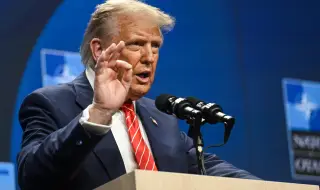
NATO allies agreed at their annual summit yesterday to increase their defense spending to 5% of their GDP. The forum, which according to the Associated Press was marked by a much friendlier attitude towards US President Donald Trump than the tense meetings during his first term, is a leading topic in a number of Western publications, writes BTA.
The symbolic image of this summit was prepared even before its actual beginning, writes the German magazine "Spiegel". "Heus ten Boss", the royal palace in The Hague: the setting sun casts long shadows on the courtyard where state guests arrive for the dinner to welcome NATO leaders. (...) A red carpet laid out on the 18 steps leading to the palace's central entrance, with footmen dressed in operetta costumes lined up on both sides," a reporter for "Spiegel" describes the atmosphere in the royal residence.
"The servility, especially on the part of NATO Secretary General Mark Rutte, was embarrassing for many, but it had an effect," commented "Spiegel". "Trump refrained from another scandal," added the German publication. This shows how much diplomatic practices have changed under the 47th US president. "Everything at the summit in The Hague revolved around Trump's feelings – an absurd, collective effort that the other 31 heads of state and government mastered surprisingly well," wrote "Spiegel".
"The almost 24 hours that Trump spent in the Dutch capital were carefully organized as a mental massage for "dad", as NATO Secretary General Mark Rutte called the American president. This new nickname suited Trump. "I think he likes me," he turned to Rutte with a smile," the German magazine reports.
Since his first presidential term, Trump has been pressuring NATO allies to spend more on their own defense, writes "The New York Times". At yesterday's summit, the European member states of the alliance agreed by 2035 to increase spending on their armies to 5% of their GDP, the newspaper recalls.
"It was a great summit and I was very happy about it", the American leader said at a press conference after the forum, quoted by "The New York Times". Trump added that he understood Washington's central role in the defense of Europe.
Even if NATO member states spend the funds unevenly, the result will be a very large increase in military spending in Europe, the American publication notes. The hope is that the money will be spent effectively in critical areas such as air defense and satellite intelligence, where Americans are currently indispensable, the "New York Times" also writes.
Despite the promises, however, many governments, especially in Western Europe, will have the difficult political task of convincing the public that the security threat is real and that money should be spent on deterrence, the American newspaper predicts. And this is precisely where the moment of truth lies, commented for the "New York Times" Rachel Rizzo, an expert on European defense issues at the US Atlantic Council. "Will European leaders spend the political capital needed to reach this commitment to the public?", Rizzo added.
Some analysts praised Rutte and the Europeans for managing to keep Trump happy, the "New York Times" adds. With the prospect of the US abandoning its commitments to Europe, "the allies have developed a strategy that buys them time and tilts Trump in their favor", Cory Schaake, head of the foreign affairs and defense department at the American Enterprise Institute, told the American publication. And it is better for Rutte "to do all the work of the housekeeper so that leaders facing elections do not have to do it," Schaake added.
For European countries, it is probably easier to make a promise that will please Trump than to win approval or find funds, as they face weak economic growth and difficult decisions on budget cuts, writes the "Washington Post". NATO countries must increase their defense spending by 2035. - a schedule flexible enough to give ample room for delay to some countries that do not want to spend so much on their armies, the American publication notes. Some countries may wait until they know who Trump's successor will be, the newspaper predicts.
The declaration agreed upon by the 32 NATO leaders after the summit barely mentions Ukraine, and says almost nothing about the war there, the "Washington Post" also writes. This is one of the indicators of how much influence Trump has on the alliance, the publication adds.
V. "The Wall Street Journal" dwells on this issue in more detail. Trump said at a press conference after the summit that his Russian counterpart Vladimir Putin is the "more difficult" leader to convince of the need to end the war in Ukraine, the newspaper notes. The American leader added that he would talk to Putin to "see if we can end this", but did not specify a date for the conversation. This is a turn for Trump, who previously pointed to Ukrainian President Volodymyr Zelensky as a greater culprit for the war, the "Wall Street Journal" commented. The US president praised Zelensky, saying: "He is fighting a brave fight. It is a tough fight".
After meeting with Zelensky on the sidelines of the summit, Trump said at a news conference that Washington would try to provide Kiev with more Patriot air defense missiles. Trump also ruled out providing more financial support for Ukraine's security beyond the $35 billion in additional aid. provided by other NATO member states.
Trump seemed to want to become a leader supporting NATO after years of criticizing the alliance as outdated and harmful to the United States, according to the "Wall Street Journal".
"I came here because this was what I was supposed to do, but I left here a little different," Trump said after the summit in The Hague.