The road to Konstantinovka runs through a corridor of anti-drone nets. Gennady Yudin, head of the "White Angels" evacuation group in the Donetsk region, drives an armored vehicle equipped with a system to protect against standard drones. In addition, the police are armed with shotguns - to counter the unmanned aerial vehicles controlled by fiber-optic cables, which are already visible over the city.
Every day, the police evacuate residents of Konstantinovka. According to the local administration, no more than 8,500 residents remain in the city - out of 67,000 before the war. Due to constant Russian attacks, there are deaths and injuries almost every day. That's why the authorities are calling on civilians to evacuate.
The streets are deserted
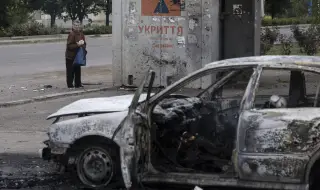
Burnt-out cars can be seen everywhere along the road. Anti-tank barriers, concrete barriers and barbed wire have been placed between the buildings. Many houses bear the scars of Russian shelling, and flower beds can still be seen behind their fences. In front of some of them are bags of garbage, as if the cleaning service will come to pick them up.
The rescue police are roaming the city in search of the address they need. There is no one to ask, since people rarely go out - only to do quick shopping. Eventually, the house they are looking for is found, where a lonely elderly man lives.
"I don't know where they are, I can't see", he says confusedly to the police, who are searching for his documents and belongings. They take the blind man by the hand and lead him out of the yard, which is littered with broken glass and shell casings. They explain to him that they are from the "White Angels" and they will take him to a safe place.
The next address also gives the police a hard time, but they finally reach the house. However, there is no one there and they assume that the two women who asked to be evacuated left alone.
The head of the evacuation group, Major Gennady Yudin, told DW that for about a week now, the number of people wanting to be evacuated from the city has been increasing: "People are no longer afraid of drones, but of aviation - when they see how entire houses are being destroyed and neither the walls nor the basements help".
They are burying the dead in the streets
The Russian army is trying to surround Konstantinovka, moving towards the city from Chasov Yar, Toretsk and Pokrovsk. An elderly woman lives on the southern outskirts of Konstantinovka, who also asked to be evacuated. The police found her at her home, but she refused to go with them - she complained of high blood pressure and vomiting. "You will be at the hospital in half an hour", they assure her, adding that an ambulance cannot reach this place. The woman asks how many bags she can take with her and asks the police to come later - but she is not sure that they will be able to return. "There are drones here", says policewoman Nastya.
"The"White Angels" are used to such situations. The group evacuated civilians after the Russian offensive in Avdiivka, and then from villages throughout Donbas. Yesterday, police officers removed the bodies of two dead people from Pokrovsk - one from a car hit by a drone, and the other who died in his home. His daughter asked the police to take the body away so that she could bury her father properly.
Recently, the dead in Pokrovsk have been buried right on the street. On the way, Gennady counted 22 such graves. He hopes that all of them will be reburied. Every journey is fraught with dangers. For example, in Pokrovsk the day before, while they were carrying one of the bodies to the car, a drone hit nearby and a policeman from the team was wounded by shrapnel in the knee. The wound was hastily stitched up in the hospital and the man is back at work.
"On the verge of a humanitarian catastrophe"
On the way to the next address, a damaged bus is visible, next to which someone has left a bouquet of roses. A few days ago, the driver died at this place and one of the passengers was injured. Since then, buses in the city have stopped running.
On the eastern outskirts of Konstantinovka is "Bakhmutskaya" street, leading to Chasov Yar. A lonely elderly man named Viktor lives there. He has already packed his things. As he carries the bags to the car, a drone appears in the air, but the man remains calm. "This one is one of ours," he explains.
The evacuation operation was also noticed by the neighbors - a retired couple. The hosts are taking cups and a kettle to the bench by the door. They were also going to leave, but later, explains the husband Valery. "We thought something would change, but it's getting worse and worse," says his wife Natalia. "It's scary," adds Valery.
Their fence and windows have been damaged by Russian shelling. There is no electricity or water, only the gas supply has not stopped. Communications have been cut off. The regional administration describes the situation in Konstantinovka as "on the verge of a humanitarian catastrophe."
"Are you taking us to Moscow?"
A lonely old woman is waiting at the next address. She slowly walks out onto the porch, hunched over. The police help her carry her bags out of the house, convincing her to leave some of them behind, as there is no longer enough room in the car. "People are the priority. There won't be anywhere to sit", they say.
Already in the car, an old woman asks them if they are from Moscow. She probably thinks they are Russians who have entered the city. "Yes", Dmitry jokes. "That's why we traveled so long." However, none of the evacuees laugh.
The car passes the destroyed station building. On one surviving wall, an inscription in English can still be read: "We don't want much, we only need artillery shells and aviation, the rest we will do ourselves". There, by the former train station, a man is waiting, accompanied by a large, frightened dog. As soon as he catches a glimpse of the evacuation team, he runs to his apartment to get his bags.
The unknown scares people
The man's name is Sergey. His sister Tatyana is crying in the apartment, among the gathered luggage - she doesn't want to leave. "Take your things", the man can't stand it and starts shouting at his sister. The police are watching the scene. "I'm from Avdeevka myself. No one will hurt you", Gennady assures her.
However, the woman continues to hesitate. Finally she agrees, takes her already packed bag and heads for the car. "People refuse to be evacuated because they are afraid of the unknown - where they will go, how they will continue to live", Gennady explains. And he adds: "This fear is even stronger than the fear of death, and people remain under fire".
The future of the evacuees is indeed unclear. The police hand them over to volunteers, who take them to a shelter in Pavlograd in the Dnipropetrovsk region. There they are assisted in obtaining financial assistance. It will hardly be enough for them to rent a house in the relatively safe cities of the Dnipropetrovsk region. "I'm going wherever my eyes see," shrugs one of the evacuees.
And the "White Angels" will return to Konstantinovka to pick up two more women for whom there was not enough space in the car.
Author: Hana Sokolova