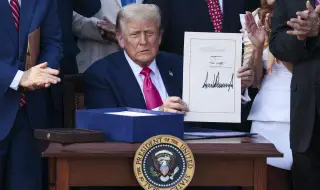
US President Donald Trump said last night that his administration is close to concluding several trade agreements in the coming days and will notify other countries of the higher import duties by July 9, with the higher rates coming into effect on August 1, BTA reported.
Despite promises to work on 90 deals in 90 days, Trump and his team managed to complete only a few agreements - a limited agreement with the UK and an ill-defined agreement with Vietnam. The long-promised deal with India never materialized.
What is the status of negotiations with several US trading partners, which have deadlines coming up this week?
Bulgaria
About 13 million leva per year are the revenues from customs duties on imports of goods from the USA in our country in the last two years - 2023 and 2024. This is about 4 percent of the total revenues from customs duties. Revenues from VAT on imports for the period 2023 - 2024 are in the range of 145 - 149 million leva per year. This is shown by data from the "Customs" Agency, provided to BTA after an official inquiry into the revenues from VAT on imports and customs duties on imports from the US.
The negative effect for Bulgaria of the possible introduction by the US of 25 percent customs duties on EU goods would amount to 678 million dollars. This means that the country's total exports would decrease by 0.49 percent on an annual basis compared to the values of our exports without mythical restrictions, said Deputy Minister of Economy and Industry Doncho Barbalov in an interview published on Saturday for BTA. The state is ready to take measures to support Bulgarian exporters to compensate for the possible decline in exports.
Barbalov announced that the Ministry of Economy and Industry is ready with scenarios for the effects of possible new import duties in the United States, with the analysis being carried out based on projected expectations for their growth by 25 percent.
European Union
US representatives said they had made serious progress in relations with the 27-member European Union after its chief trade negotiator Maroš Šefčovič met with officials in Washington last week. EU diplomats said talks were continuing but no breakthrough had been reached by Friday, Reuters reported.
One EU diplomat said the bloc's regulations on social media and other technology companies, which are stricter than those in the United States, were non-negotiable, and the US's proposed 17 percent tariff on agricultural and food exports remained a major obstacle.
EU officials said they were open to a deal with the United States that would apply a universal 10 percent tariff on many exports, but wanted to secure exemptions from sectoral tariffs already in place or planned for pharmaceuticals, alcohol, semiconductors and commercial aircraft, Bloomberg reported.
The EU is also pushing for US quotas and exemptions that would effectively ease Washington's 25 percent tariff on cars and auto parts, as well as a 50 percent tariff on steel and aluminum, the agency said.
Japan
Japan said it continues to seek a deal with the United States while protecting its national interests. Japan's tariff negotiator Ryosei Akazawa held "in-depth conversations" by phone with U.S. Commerce Secretary Howard Lutnick on Thursday and Saturday, the Japanese government said.
The discussions came after Trump last week criticized Japan for what he called "Tokyo's reluctance" to import U.S.-produced rice and accused Japan of engaging in "unfair" auto trade. He also called on Japan to import more U.S. oil. Trump said Japan could be among the countries to receive a letter about the tariffs, and suggested it could be hit with tariffs of up to 35 percent.
India
Trump has long promised a trade deal with India, but talks have stalled over disagreements over U.S. tariffs on auto parts, steel and agricultural goods. India, which faces 26 percent tariffs on its exports to the United States, has signaled it is willing to reduce its high tariffs on American goods but has not given in to Washington's demands to open up its agricultural and dairy sectors.
On Friday, New Delhi also proposed retaliatory tariffs against the United States at the World Trade Organization, saying Washington's separate 25 percent tariff on cars and some auto parts would hit $2.89 billion worth of Indian exports.
Indonesia
Indonesia has offered to cut tariffs on key imports from the United States to "almost zero" and buy $500 million worth of U.S. wheat as part of talks to avert a 32 percent tariff. State-owned carrier Garuda Indonesia also plans to buy more Boeing planes as part of a $34 billion deal with U.S. partners to be signed this week.
Accused by some other countries of excessive bureaucracy, Indonesia eased import licensing requirements for some goods and lifted restrictions on plastics, chemicals and other industrial raw materials on June 30, a goodwill gesture ahead of a July 9 deadline. Indonesia also invited the United States to co-invest in a state-owned Indonesian minerals project as part of the tariff talks.
South Korea
Although it has been in frequent talks with the United States and has already reached some preliminary agreements, South Korea has said it will seek an extension to Trump's July 9 deadline, although talks will continue this week. President Lee Jae-myung's national security adviser is scheduled to visit Washington from July 6 to 8 to discuss a range of bilateral issues. The country's trade minister, Yeo Han-koo, is also scheduled to meet with U.S. Trade Representative Jamieson Greer and other U.S. officials.
South Korea already imposes almost no tariffs on U.S. imports under a free trade agreement, leaving the United States focused on other issues, including exchange rates and defense spending. Trump has often complained about the cost-sharing agreement for the 28,500 U.S. troops stationed in South Korea.
Thailand
Thailand is making a last-ditch effort to stave off a 36 percent tariff by offering greater market access for U.S. agricultural and industrial goods, as well as increased purchases of U.S. energy products and Boeing aircraft, Finance Minister Pichai Chunghwajira told Bloomberg on Sunday.
Thailand’s proposals include reducing its own tariffs, buying more U.S. goods and increasing investment. Thailand’s initial proposal included measures to improve market access for U.S. exports, as well as Thai investment that would create jobs in the United States. Bangkok has also pledged to import more American natural gas and reduce tariffs on U.S. corn.
Switzerland
Switzerland is exploring what concessions it can make to avoid a 31 percent tariff on goods it ships to the United States, including granting greater access to the U.S. market for products such as seafood and citrus fruits. But as the home of pharmaceutical giants Roche and Novartis, which are major investors in the United States, Switzerland also wants assurances that it can avoid the pharmaceutical tariffs that Trump has threatened to impose at a later date.