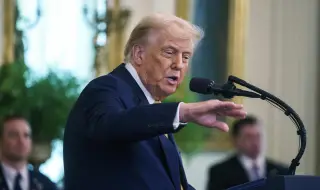
The loud statements of US President Donald Trump on Ukraine so far seem more like rhetoric than a real change in policy: there is no clarity about the volume and timing of arms supplies, sanctions against Russia are being postponed, and the so-called “ultimatum” to Vladimir Putin resembles more of a personal approach than a strategic action. This is noted by journalist Christian Karil in a commentary for Foreign Policy, quoted by Focus.
„There is less to Trump's change towards Ukraine than meets the eye“, Karil writes.
A day before Trump's long-awaited statement on a change in policy towards Kiev, he made a telling comment to reporters at Andrews Air Force Base. Then he said that the US would send weapons to Ukraine, for which European countries would pay:
„This will be a business for us and we will send them the „Patriots“, which they desperately need, because Putin has really surprised a lot of people“.
Karil questions the claim that Putin has „surprised“ anyone:
„Who are these people? They are certainly not security experts or Russia watchers. Few Ukrainians or Europeans were surprised by Putin’s refusal to engage diplomatically.“
On July 14, during a meeting with NATO Secretary General Mark Rutte in the Oval Office, Trump presented his new policy more as a deal than a strategy.
“The US president clearly lacks strategic depth on the causes of the war, its duration and its possible end“, Karyl points out. Instead, Trump is taking a personal approach, disappointed by the “betrayal“ of his one-time sympathizer Putin.
The former commander of US forces in Europe, Ben Hodges, is also critical:
“Trump has no strategic vision for an exit from the conflict. Why didn’t he state clearly: ‘The goal is for Russia to stay within its borders and stop the aggression?’“ Instead, he adds, his statements are “a collection of half-truths“.
Karil emphasizes that the new arms policy is more of an economic scheme in which the US sells weapons to Europe, which in turn passes them on to Ukraine, far from the direct support envisaged by the Biden administration.
It remains unclear how many “Patriot“ missiles will reach Kiev, what other weapons will be provided, and what Trump's real intentions are. According to Hodges, he is "making up policy on the fly" without using the traditional planning apparatus of the National Security Council or the Pentagon.
Caryl also expresses concern about Trump's announced 50-day deadline for Russia to end the war before "very serious tariffs" are imposed.
"This is a generous reprieve for a country that has systematically refused a ceasefire or serious negotiations," he writes.
The author predicts that Putin will simply pretend to be inclined to dialogue, and Trump will extend the deadline. Evidence of the weak effect of the new line is also the cool reaction of Moscow.
Russian Foreign Minister Sergei Lavrov commented:
"Fifty days. It used to be 24 hours, then 100. We survived them.“
Former President Dmitry Medvedev also downplayed the threats:
“Russia doesn't care.“
Thus, Karil concludes, Trump's new course does not create strategic pressure on the Kremlin and looks more like political theater than real change.