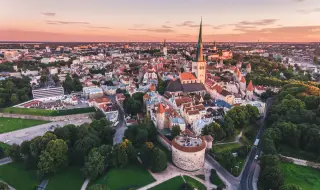
How long does it take to get divorced in your country? In Estonia, the first steps of this unpleasant process can be completed in just a minute, and without the other half having to be present. “In 45 seconds, you get to the point where you can file for divorce.“
The first fully digitalized country in the world
Until last year, divorce was the only service in the public administration in Estonia that was not digitalized. After that was changed, the small Baltic state became the first digitalized country in the world.
However, even in this procedure, both partners must give their consent and be physically present when a civil servant officially ends their marriage. But the use of the online service is already widespread, and around 60% of all divorces in Estonia are already initiated through the electronic platform, which was launched in December last year.
At the moment, around 62% of Germans use digital services in the administration. Among Estonians, this percentage is over 90. In “The End of Bureaucracy" Lukas Ilves explores the differences in digitalization policies in the two countries.
User-friendly software
Electronic verification is a major problem in the study - 90% of Estonians use a digital ID card to access administrative services. In Germany, only one in ten takes advantage of it. Ilves explains that the main reason for these differences is the software.
The one in Estonia is much better tailored to the needs of the individual user. It can also be used in both the public and private sectors, for example for online banking. Until a few years ago, Belgium used digital ID card technology that was similar to Germany's. But only 10 to 20 percent of the population uses it. After the software was replaced with one that was better tailored to users' needs, digital ID card usage jumped to 80 percent, Ilves says.
Digital administration helps save money. Estonia's administrative costs for tax collection per capita are one-sixth those in Germany.
Following the elections in February, the new German government of Chancellor Friedrich Merz created a Ministry for Digital Transformation and Modernization of Public Administration. Its aim is to offer “a wide range of services that will give impetus, initiate collaboration and develop solutions for the public administration of the future”.
The "once only" principle
Experts such as Magdalena Zadara, who heads the German state agency for digital services, admire this step aimed at reducing bureaucracy.
“If I wanted to come to work in Germany from a country outside the EU, I would have to communicate with between five and seven different state agencies to approve my diploma, and they would ask me for the same data,” she gives as an example.
One solution to the problem is the so-called The "once-only" principle, which is implemented in Estonia - where citizens only have to provide specific information to institutions once, and then this data can be used and requested internally by individual departments. This principle is part of the law in Estonia. Another key element of Estonia's modern administration is the digital signature, which is used for everything from signing employment contracts to voting.
Estonian-Russian businessman Kirill Solovyov says he first used an electronic signature when he received Estonian e-residency in 2015 - an 11-year digital identity issued by the government that gives entrepreneurs from all over the world remote access to the country's administrative services. “At that time, digital signatures also existed in Russia, but I never managed to go through the verification process. In Estonia, you just get the card, turn it on and it works - it's magic," he told DW.
Estonia's "Tiger Leap"
When the Baltic states - Estonia, Latvia and Lithuania - gained independence from the former Soviet Union in 1991, one of the first things Tallinn did was provide internet and computers in all classrooms and libraries. All this was implemented within the framework of an educational program called "Tiger Leap."
In 2000, the country with a population of 1.4 million people made another big leap in digitalization, when it became possible to file tax returns online and electronic signatures were equated with written ones. By 2015, all basic public services - such as healthcare and social care - were fully digitalized.
Kirill Solovyov says that his favorite of all services is e-prescriptions. Once a doctor prescribes a medicine, it is automatically entered into the online register and can be picked up at any pharmacy in Estonia, and for a few years even in neighboring Finland.
Europe wants to be more independent in digital services
The security of online services is still a concern for lawmakers in other European countries, as well as the European Commission (EC). That is why the European technology industry is calling on lawmakers to reduce Europe's dependence on American technology giants such as Google, Microsoft or Amazon, and for the EC to strictly comply with the Digital Markets Act as a guarantee against their dominance.
They are also pushing for the development of EuroStack - a European alternative for technological independence. It should include all interconnected technological components - hardware, software, network protocols and infrastructure - that together build a complete digital platform. Artificial intelligence, open source ecosystems, green supercomputers, open data and a separate cloud will be added to EuroStack.
Lukas Ilves is skeptical about the initiative and warns that it will entail very serious costs. “No country can be autonomous and completely sovereign in the digital world. In Estonia, we have never built a complete Estonian platform, but many separate applications and protocols on the global technology ecosystem”, he explains. At the same time, however, the expert admits that Europe needs to focus much more on the risks of digitizing all aspects of public life.
Author: Benjamin Batke