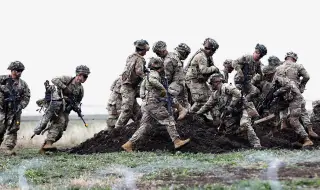
After promising Donald Trump to spend more on defense, European NATO members are now waiting to see what he will decide about the US presence in Europe. This decision is expected in the coming months, writes BTA, citing AFP.
The Pentagon must present its recommendations for the future deployment of US troops outside the US by the fall. Then Trump will make the decisions in this direction.
About 85,000 US troops are currently stationed in Europe. And Europeans know that this figure will decrease.
“We have every reason to believe that there will be an American withdrawal from Europe“, says Marta Muchnik, an expert at the think tank “International Crisis Group“. "And the question is not whether it will happen, but how fast it will happen," she warns.
The most optimistic hope for a prolonged reduction in the number of US troops in Europe, with the number being reduced by a maximum of about 20,000, which would return the level of US forces on the Old Continent to the level they were before the Russian invasion of Ukraine in February 2022.
"This will not be the end of the world," assures a European diplomat at NATO. But a limited withdrawal and some European allies, reassured by the continued American commitment to Europe, risk causing lethargy, according to another diplomat in Brussels. If the American withdrawal is too large-scale, the Europeans will be shocked and NATO will fall into crisis, he added.
The United States has not said anything about its intentions yet, but is trying to reassure its allies.
"We have reached an agreement that there will be no surprises or gaps in the defense capabilities of the European continent", assures the American ambassador to NATO, Matthew Whitaker.
"NATO is coordinating with Washington and there is no particular concern", adds a representative of the Alliance.
The United States has been trying for several years to reorient its strategic priorities towards Asia, including reducing the "footprint" in Europe, Ian Lesser, a security expert at the German Marshall Fund, an American think tank based in Brussels, told AFP.
The return of Donald Trump to power in January only underscored this trend.
US Defense Secretary Pete Hegseth startled European allies in February by announcing that they would now have to take responsibility for their own conventional defense on the continent. Which meant: "Rely on your own weapons, not America's, even if it remains committed to NATO, particularly in the area of nuclear deterrence."
Beyond the withdrawal of American troops, one diplomat fears a possible loss of the cohesion guaranteed by Washington in terms of transport, logistics and aerial surveillance - this American glue that holds the allies together, in his words.
For Ian Lesser, the question of the timetable for the US withdrawal is not essential, because the promises made by the Europeans in The Hague will be expressed in real capacity many years later.
During his first term as president, Donald Trump tried in vain to reduce the number of US troops in Germany, NATO insiders recall. "This proved difficult because of the opposition of Congress and because of the high cost of the operation", emphasizes Ian Lesser.
„I do not expect it to be a dramatic reform. "I think it will be gradual, in a process based on consultations," says an Alliance diplomat.
But of course no one is completely immune from the whims of the American president, who may get angry with the Europeans for one reason or another, says another diplomat.
"What if we are all wrong and the withdrawal starts in 2026, without even minimal coordination," worries a third diplomat.