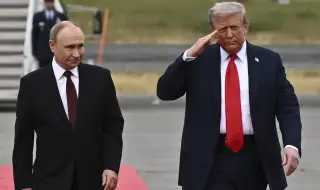
The meeting between US President Donald Trump and Russian President Vladimir Putin in Alaska did not lead to any real results or breakthrough at first glance. Such a breakthrough was not expected.
After returning to Washington, US President Trump said a sentence that at first glance sounds harmless, but in essence is a political explosion, commented the German website Focus.de.
Trump said that the best way to end the war is “a direct peace agreement that would end the war, not just a ceasefire agreement”. Who could be against peace? But a closer look at these words suggests that they are leading to a political explosive reaction in Kiev and European capitals.
What is the difference between a peace agreement and a ceasefire? A ceasefire “suspends military operations by mutual agreement between the belligerents,” as stated in the 1907 Hague Conventions on Land Warfare. Specifically, Putin would have to stop the killing in Ukraine. This would also prevent further territorial losses – which is particularly important for Kiev at the moment.
“Ukraine, supported by the Europeans, demands an immediate and unconditional ceasefire because the Russian army is advancing and Ukrainian soldiers are being forced to retreat further and further“, says Professor Gerhard Mangot, a political scientist at the University of Innsbruck.
But that is precisely why Russia is categorically against a ceasefire. Before the summit in Alaska, Trump declared a ceasefire as his goal. Putin seems to have managed to influence Trump, and this is a defeat for Kiev. Initially, a ceasefire would only mean freezing the current front line. It would not mean legal recognition of the occupied territory as Russian.
A ceasefire is complicated, but possible. An example is the Korean War. There is no peace between the two sides, but at least the fighting and killings have stopped.
The implementation of such a deal in Ukraine is extremely complicated by the front line, which stretches for more than 1,000 kilometers. The military withdrawal alone, i.e. the withdrawal of troops, the establishment of control mechanisms, international monitoring - all this is a huge project that could take months or years. Mangot sees significant obstacles: "The ceasefires are and will remain fragile until the main conflicts between the warring parties are resolved by mutual agreement." And there is no prospect of resolving the differences between Kiev and Moscow anytime soon.
There are also many problems to resolve regarding the peace agreement. A peace treaty concluded under pressure is invalid. And at the moment it seems that if Zelensky signs one, it will be under duress.
Treaties concluded under duress are null and void from the start. This is stated in the Vienna Convention on the Law of Treaties. This is a particularly difficult situation with peace treaties, because one quickly gets the feeling that an aggressor is forcing an agreement on the losing side.
Zelensky has already announced that Ukraine will never recognize the territories occupied by the Russian army as part of the Russian Federation. Signing such a treaty would be unacceptable for Ukrainian President Volodymyr Zelensky. He would have to explain to the Ukrainian people that certain regions are lost forever - a move that could cost him his job domestically. For Putin, on the other hand, it is unacceptable for Western armies to enter Ukraine as a guarantor of security.
Given the pressure from the United States - exerted through the threat of ending support - and the military pressure from Russia, it is hardly possible for Zelensky to sign a legal peace treaty. However, Trump and Putin would probably not be interested in the problem of international law. In any case, the Alaska summit seems to have solidified a bitter realization: whether there is ultimately a peace agreement, a ceasefire, or further fighting, Ukraine will likely not be able to reclaim the territories occupied by Russia.