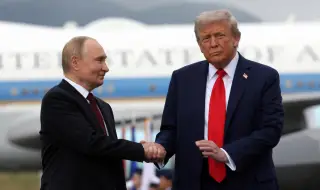
The meeting between Donald Trump and Vladimir Putin in Alaska has turned into a grandiose show with no results. The big winner from this is China, which has an interest in the war in Ukraine continuing, writes Focus.de.
US President Trump welcomed Russian President Putin with a red carpet, drove him around in the presidential limousine, but without any concrete progress in the Ukrainian conflict. Despite the grand spectacle and symbolic gestures, Trump failed to secure concessions from Putin. Moscow continues to demand the surrender of Kiev.
Putin did not express a willingness to agree to a ceasefire. During the summit, Russian forces continued their attacks in eastern Ukraine. This is also in China’s interest: while the United States is distracted by security concerns in Europe, it can devote less attention to the Asia-Pacific region to counter China’s economic and military rise.
While Presidents Nixon and Kissinger once successfully courted China to weaken the Soviet Union, Trump’s attempt at a reverse strategy is now doomed to failure. The strategic partnership between Moscow and Beijing is very strong today.
The two countries support each other on key geopolitical issues such as Taiwan and Ukraine. Thanks in part to Western sanctions, Russia is too closely tied to China economically and strategically to back away from Beijing—even if the United States wanted it to.
A key economic advantage for China comes from the drastic changes in global energy markets. Because of Western sanctions against Russia, Moscow has had to develop alternative markets for its energy resources. China has taken advantage of this situation and has been able to purchase Russian oil and gas at significantly reduced prices since 2022.
China has also benefited from favorable terms for supplies from Russia of other raw materials such as coal, metals and fertilizers. The two countries are increasingly concluding contracts in rubles and yuan, reducing their dependence on the US dollar and strengthening the international authority of the Chinese currency.
The exclusion of Russia's access to Western modern technologies is forcing Moscow to cooperate more closely with China. China benefits from this partnership, especially in the field of military and digital technologies, such as satellite navigation, surveillance systems and drone technology. At the same time, China can expand its own capacity for technological innovation. Uncertainty in world markets and shortages of certain goods have allowed China to expand its position as an indispensable trading partner.
The conflict has shifted the balance of power between Moscow and Beijing in China’s favor. While Russia is internationally isolated, China, as the most important remaining partner, can dictate terms and influence the direction of Moscow’s foreign policy. Russia’s economic dependence on China grows with each new round of sanctions. China is using this situation to expand its influence in Central Asia, the Pacific, and beyond.
With regard to Ukraine, China is presenting itself as a peacemaker, but it does not want Russia to lose the war. A possible collapse of Russia could lead the United States to direct its full power and attention against China. This underscores Beijing’s strategic interest in a continuing but controlled conflict in Ukraine.
The war in Ukraine is tying up Western resources and attention in Europe. The US and the EU are forced to devote significant financial and military resources to supporting Ukraine and maintaining sanctions against Russia. This ties up resources that could otherwise be directed to the Asia-Pacific region, and in particular to containing China.
China’s goal is to replace a world order dominated by Western values with a multipolar system. A multipolar world order refers to an international system in which several states or centers of power exert influence.
The war in Ukraine has contributed to the erosion of Western dominance and has given China the impetus to shape international institutions and regulations according to its own interests. Overall, the war in Ukraine has accelerated China’s rise to central power in a multipolar world and has permanently altered the global balance of power.