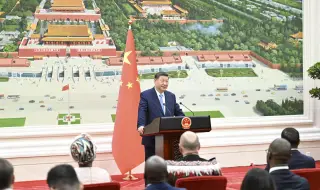
Chinese President Xi Jinping arrived in the Tibetan capital Lhasa on Wednesday for his second visit to the region as head of state to mark the 60th anniversary of the establishment of the Tibet Autonomous Region, Reuters reports, reports News.bg.
Tibet was declared an autonomous region in 1965, six years after the 14th Dalai Lama fled to India after a failed uprising. It is the last of China's five autonomous regions, along with Inner Mongolia, Xinjiang, Guangxi and Ningxia.
The official status aims to ensure greater participation of ethnic minorities in governance and religious freedom. However, international human rights groups and Tibetan exiles say Chinese rule is oppressive, a charge Beijing denies.
State media quoted Xi as saying: “To govern, stabilize and develop Tibet, the first thing is to maintain political stability, social stability, ethnic unity and religious harmony.” The president added that Tibetan Buddhism must adapt to China’s socialist system.
Xi last visited Tibet in 2021, urging the population to “follow the party.” Analysts at the time viewed the visit as a sign of the Communist Party’s confidence that the region was under control after decades of protests, including after the 2008 Beijing Olympics and a series of self-immolations. The last Chinese leader to visit Lhasa was Jiang Zemin in 1990.
The visit underscores the strategic importance of Tibet for China, which shares a tense border with India. The two countries have had military clashes, and China's hydroelectric projects in the Himalayas have raised concerns in Delhi. Xi said the region's latest large-scale hydroelectric project should be carried out "vigorously" as part of efforts to reduce carbon emissions while protecting Asia's "water tower."
His arrival coincided with a rare visit by Chinese Foreign Minister Wang Yi to India, where the two countries pledged to restore ties after a deadly border clash in 2020.
Xi was accompanied by senior party leaders Wang Huning and Tsai Ing-wen. For the 50th anniversary in 2015, Beijing sent then-top leader Yu Zhengsheng, underscoring the political significance of the anniversary for China.