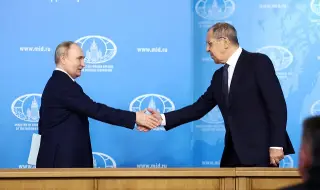
Russian Foreign Minister Sergei Lavrov in an interview with NBC confirmed the Kremlin's explicit rejection of the US-proposed peace initiatives in Ukraine. Russian representatives have explained the military goals of during meetings with US President Trump and other representatives.
This is written by the Institute for the Study of War (ISW).
Lavrov reiterated that Russia views NATO expansion and the alleged "violation of Russian security interests" as one of the "main reasons" for the war. Russia has an "obligation" to support and defend those who share the values of the "Russian World".
Lavrov continues to misrepresent Ukrainian President Volodymyr Zelensky as an obstacle to lasting peace in Ukraine in order to distract from the Kremlin's reluctance to engage in negotiations on Trump's proposed timetable. Lavrov said that Zelensky "will not resolve the Kremlin's issues" with Ukraine.
Zelensky has repeatedly indicated in recent days that he is ready to discuss territorial issues in a bilateral meeting with Putin.
Lavrov claims that Zelensky is opposing Trump's wishes regarding NATO membership and refusing to repeal laws related to Russia's stated "root causes" of the war. Lavrov hinted that any meeting between Zelensky and Putin would be futile, suggesting that Putin is unwilling unless Ukraine agrees to the initial military demands - military, political and cultural capitulation of Ukraine.
Lavrov responded to a question about whether he and Putin recognize Zelensky as the "legitimate leader of Ukraine" by stating that "we recognize him as the de facto head" of Ukraine.
Lavrov claimed that the Kremlin was ready to meet with Zelensky "in this capacity", but "when it comes to signing legal documents... Russia will need a very clear understanding from everyone that the person signing is legitimate". Lavrov falsely claimed that "Zelensky is currently not "the legitimate leader of Ukraine under the Ukrainian constitution. Lavrov continues the Kremlin's months-long attempts to take advantage of Ukraine's inability to hold elections during the war and deliberately misrepresent the Ukrainian constitution and laws.
Ukrainian forces struck Russian energy infrastructure in the Leningrad and Samara regions on the night of August 23-24. The Ukrainian General Staff reported that elements of the Security Service of Ukraine (SBU) and Special Operations Forces carried out a drone strike on the port of Ust-Luga in the Leningrad region.
Ukrainian television company "Suspilne" said that the SBU and SSO had struck the Novatek gas processing complex, which is Russia's largest liquefied natural gas producer, can process up to 6.9 million tons of raw material per year and is a key Russian logistics hub in the Baltic Sea for exporting energy resources.
The Ukrainian General Staff reported that Ukrainian forces, including from the Main Intelligence Directorate (GUR) of Ukraine and the Forces of Unmanned Systems (SBS), also struck the Syzran oil refinery in the Samara region on the night of August 23-24.
The Kremlin relies on oil revenues to finance its war in Ukraine, and long-range Ukrainian strikes continue to threaten Russia's economic stability.
Ukraine's Western partners continue to provide military assistance to Ukraine, including through the purchase of American weapons. Two U.S. officials told the Wall Street Journal (WSJ) on August 24 that the United States had approved the sale of 3,350 Extended Range Air Launched Missiles (ERAMs) to Ukraine, and said the systems would arrive in Ukraine in six weeks (around mid-October 2025).
The ERAMs are part of a largely European-funded arms package for Ukraine that includes other air defense systems and multiple launch rocket systems. The Norwegian Ministry of Defense announced on August 24 that Norway had allocated about $694 million to purchase two Patriot air defense systems and other forms of air defense for Ukraine.
The Norwegian Ministry of Defense noted that Germany is also contributing financially to the purchase of the air defense systems. Canadian Prime Minister Mark Carney said that about $722 million of the roughly $1.44 billion in military aid that Canada pledged to Ukraine in June 2025 will be used to deliver armored vehicles, drones and ammunition, which will arrive in Ukraine as early as September 2025.
Ukraine and Russia conducted another prisoner exchange, involving a limited number of Ukrainian journalists and government officials, on August 24. The Ukrainian Coordination Headquarters for the Treatment of Prisoners of War and the Russian Ministry of Defense (MOD) announced that Ukraine and Russia had exchanged 146 prisoners of war each.
Russia also released three civilians, two journalists, and the former mayor of Kherson, Volodymyr Mykolaenko, while Ukraine released eight residents of the Kursk region. The Ukrainian Coordination Headquarters for the Treatment of Prisoners of War reported that the exchange was in accordance with agreements reached by the parties in Istanbul on June 2. The United Arab Emirates (UAE) mediated the exchange.