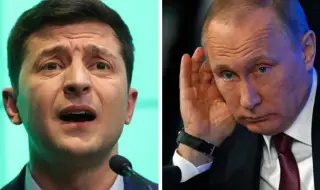
Putin is unlikely to agree to a summit with the leaders of Ukraine and the United States because he doesn't want the war to end, writes Jamie Detmer in a commentary for Politico.
"Details, details. Things that need to be done. Don't bother me with the details, just tell me when they're ready.“
This is Jimmy Price, the cocaine baron from the British film "Layer Cake" since 2004. But the mobster's instructions to his subordinates, given at his Mar-a-Lago, the equivalent of the gated club in the leafy outskirts of London, ultimately shaped the circumstances of his downfall.
Donald Trump is also not a man who cares about details - except perhaps when it comes to building his luxury brand, which is said to be obsessed with the glitzy interiors of its hotels, golf clubs and casinos. While Trump may worry about what curtains to hang in his hotel rooms, when it comes to diplomacy, on which tens of thousands of lives depend, he shows less interest in details, focusing instead on the personal relationships between leaders.
The details are for subordinates, like his Secretary of State "Little Marco" and his golf buddy and all-around messenger Steve Witkoff, who unfortunately also has a shaky grasp of detail and a tendency to hear what he wants to hear. Trump is simply waiting for them to tell him when peace is ready.
Whether he realizes it or not, Trump is a proponent of the "great personality theory" - an idea popularized by the Victorian essayist and hero-worshipper Thomas Carlyle, that history is driven by exceptional leaders. This ignores the more complex dynamics of culture and history, politics and economics.
And for Trump, everything is individualized - and it all comes down to personal chemistry.
During his meeting last week with six European leaders and Volodymyr Zelensky, Trump was caught on camera telling French President Emmanuel Macron that Putin wanted to “make a deal, I think“.
“I think he wants to make a deal with me. Do you understand that? As crazy as it sounds,” Trump declared.
Hence his comment this week about the difficulties in organizing a bilateral summit between Vladimir Putin and Zelensky. Again, it's all about personal chemistry. According to him, Putin is reluctant to meet with his Ukrainian counterpart because “he doesn“t like him“, adding: “They really don“t like each other“. Last week, Trump spoke of them as immiscible liquids – oil and vinegar.
There is no doubt that the two do not like each other. Zelensky has every right to despise Putin, the imperialist czar responsible for the invasion of his country, which led to war crimes and the deaths and injuries of tens of thousands of Ukrainian soldiers and civilians, as well as the abduction of some 20,000 children to Russia for indoctrination.
Putin is probably not enthusiastic about Zelensky either. After all, he is the annoying leader of a country that refuses to surrender, has challenged the mighty imperial Russia, and whose spirit of resistance has so far been unyielding. But that is not why Putin is not ready to meet Zelensky.
On the one hand, a summit with the Ukrainian president would give Zelensky political legitimacy, while the Kremlin has long claimed that he does not have any - Russian Foreign Minister Sergei Lavrov emphasized this in a recent interview on NBC's "Meet the Press," suggesting that Putin would be unable to make a deal with him because Moscow considers him "illegitimate."
But there's another reason. Piling up obstacles to the summit is part of the Kremlin's strategy to keep Trump at bay while avoiding - or at least hoping to minimize - provoking Trump's anger and possibly prompting him to carry out his threat of "severe consequences" unless Russia is serious about ending Europe's biggest war since 1945.
Trump has not specified what those consequences would be - "Needless to say," he said at a news conference on August 13. Presumably, if Trump were ever to take action, the consequences would include secondary sanctions on countries trading with Russia in an attempt to cut off purchases of Russian fossil fuels. This would not bring down Russia – the effectiveness of sanctions is often overestimated – but it would be very inconvenient, given that the Russian economy is entering a recession and has already exceeded its budget deficit target for the year.
Without achieving what Putin would call a victory, the continuation of the war against Ukraine is useful for the Russian president. An abrupt end to the conflict could threaten his regime, as a rapid exit from the war economy would increase the likelihood of dangerous socio-political struggles. And according to Ella Panyakh, a sociologist and research fellow at the New Eurasian Strategies think tank, it would provoke “cruel and fierce competition for dwindling resources at all levels of society.” War is also useful for justifying political repression – patriotism can be a useful tool.
Continuing the conflict also has the advantage of further straining European countries, which are in financial difficulty, and risks fracturing the already fragile transatlantic alliance. A weakened, distracted, and divided West also serves the purposes of Putin’s ally, Xi Jinping, who is considering how and when to absorb Taiwan.
And with Ukraine’s acute manpower shortage, there is always the possibility of a breakthrough on the front that Ukraine is unable to reverse. In short, Putin has more to gain by pressing on – more territory, Western security guarantees so watered down as to be meaningless, and a cap on the size of the Ukrainian army after the war. This would set the stage for a later resumption of Russian military action at a time of Moscow’s choosing. As former Trump Russia adviser Fiona Hill has argued, the Russian leader “wants a neutralized Ukraine, not one that can withstand military pressure. Everyone sees this except Trump.
So how best to play Trump without inflaming his anger and at the same time maintaining his support? You guessed it: to drag Rubio and Witkoff into details and endless complications - to talk about the “root causes“ of the war, to pile on the diversions and details, and to lead American interlocutors down rabbit holes in a long exercise in skillful manipulation, in which the gloomy Lavrov is a master.
And all the while to blame Zelensky and Kiev for the lack of progress in ending the war. This is what Lavrov demonstrated in his interview on “Meet the Press“ - Zelensky pointed his finger and counted on the accusation to stick to Trump, a man impatient for details.
Recall that it was Lavrov who, shortly after the invasion, recited on Russian television “To the Slanderers of Russia“ by Pushkin, a poet beloved by Russian nationalists, who wrote that the conflict between the Slavic peoples was a family matter and concerned no one else.
“This is just a Slavic clan quarreling among themselves, an ancient family conflict, often tried, but still endless, a question that, be sure, you can never solve.“
Link to main version
Aug 28, 2025 12:12 619
Putin unlikely to agree to a meeting with Zelensky
So how best to play Trump without inflaming his anger while maintaining his support?
Снимка: БГНЕС/ЕРА