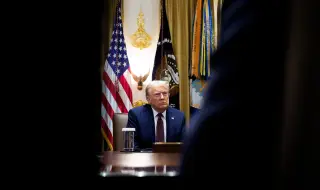
US Vice President J.D. Vance has become a laughing stock on social media after he said in a television interview that World War II ended through negotiations. He wanted to justify President Donald Trump's diplomatic approach in Russia's war against Ukraine.
"World War II ended with the unconditional surrender of Germany and Japan, not through negotiations," states "Republicans Against Trump" - an account on the X platform.
On May 8, 1945, Nazi Germany surrendered unconditionally after dictator Adolf Hitler committed suicide. Nazi Germany's ally Japan capitulated later in August after the US dropped atomic bombs on Hiroshima and Nagasaki.
This is another historical blunder by the Trump administration. He has himself repeatedly distorted historical facts to fit his narrative. Trump has also put pressure on museums - criticizing them for presenting American history, such as slavery, in a negative light.
DW's fact-checking team examined some of Trump's most controversial historical claims.
Trump's late uncle and the "Unabammer"
Ted Kaczynski, one of the most famous terrorists in the US, known as the "Unabammer", anonymously sent homemade explosive devices by mail, his targets mainly being scientists. His criminal activities, which lasted almost two decades (from 1978 to 1995), resulted in the deaths of three people and the injury of 23 others. After his arrest, he admitted to sending a total of 16 bombs.
In July 2025, Trump said at an event in Pittsburgh, Pennsylvania, that his late uncle John, a former professor at the Massachusetts Institute of Technology, had taught Kaczynski. However, Kaczynski had studied at Harvard and later at the University of Michigan. Trump's uncle died in 1985, and Kaczynski was not arrested until 1996. Trump's claim has since been refuted by several news outlets.
Misleading Claims About Tariffs and the Great Depression
At a July 2025 cabinet meeting, Trump stated that the Great Depression "would never have happened" if the United States had kept tariffs in place, and made the false claim that tariffs were reinstated "after the Depression."
In reality, the Great Depression began in 1929 and lasted for about a decade. The Smoot-Hawley Tariff Act of 1930, intended to protect American businesses, raised import duties and prompted retaliatory tariffs from over 20 countries. This ultimately deepened the global economic crisis, after the Fordney-McCumber Act of 1922 had already imposed tariffs on imported goods.
Trump had warned about the invasion of Iraq
Trump has long claimed that he was against the invasion of Iraq in 2003. In June, he repeated: "I was very against Iraq, I said it loud and clear: Don't go in, don't go in, don't go in."
However, in 2016, CNN and Buzzfeed.news revealed that Trump had expressed support for the invasion of Iraq - he did so in an appearance on the Howard Stern show in 2002. Trump himself said in a presidential television debate with CNN's Anderson Cooper that "he could have said that," adding the ironic "When the war started, I was against it."
The Washington Post also fact-checked the story back in 2016, and the publication's timeline of Trump's comments before the 2003 invasion of Iraq showed inconsistencies in his statements.
Trump is trying to rewrite the history told in museums
Trump signed an executive order directing the vice president, a member of the Smithsonian Institution's Board of Regents, to remove "inappropriate, divisive or anti-American ideology" from the institution's museums, educational centers and the National Zoo, according to a statement released by the White House.
The Smithsonian Institution, the world's largest museum and research complex, receives 62% of its funding from the federal government and includes 17 museums in Washington and two in New York.
On his Truth Social network, Trump criticized the Smithsonian for focusing on "how terrible our country is, how bad slavery was, and how bad the oppressed were".
On the eve of the 250th anniversary of the founding of the United States, the administration placed eight museums under scrutiny, including the National Museum of American History and the National Museum of African American History and Culture. They have been asked to submit plans for exhibitions, educational materials and digital content. The White House sent a letter to the Smithsonian informing the institution that more museums will be inspected in the next phase.
Last week, the White House published an op-ed titled "President Trump is Right About the Smithsonian" criticizing exhibitions on race, slavery, sexuality and immigration.
In response, more than 150 cultural organizations and more than 300 individuals signed a public statement reaffirming their commitment to artistic freedom and speaking out against political pressure.
While the statement did not mention Trump by name, it cited growing concerns about interference in cultural institutions like the Smithsonian and the Kennedy Center.
Author: Sarah Steffen