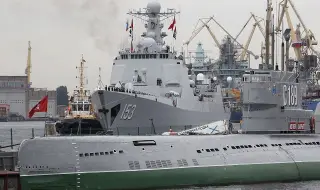
China is building a navy at record speed, becoming the world's largest naval power by number of ships and increasing tensions with the United States and its allies in the Indo-Pacific region, writes the BBC.
Over the past two decades, Beijing has invested massively in shipbuilding, with more than 60% of global orders for commercial ships now being fulfilled in Chinese docks. Analysts note that the country's production capacity is about 200 times greater than that of the United States.
China's navy now has 234 warships compared to 219 for the US navy. In terms of tonnage and technological sophistication, Washington still dominates with more aircraft carriers and modern submarines, but Beijing is quickly catching up.
Between 2019 and 2023, China’s four largest shipyards produced 39 warships with a displacement of 550,000 tons – more than the entire Royal Navy of Great Britain.
Satellite images show an expansion of bases in the South China Sea, including new piers in Yulin, where strategic submarines armed with nuclear missiles will be stationed. An upcoming military parade in Beijing is expected to showcase anti-ship missiles, hypersonic weapons and unmanned underwater drones. Guests will include Russian President Vladimir Putin and North Korean leader Kim Jong-un, signaling a rapprochement between the three countries.
"There are no signs that the Chinese are slowing down," said Alexander Palmer of CSIS and author of the report "Exposing China's Naval Buildup".
Despite its advantages in ship numbers, China still has only two operational aircraft carriers and fewer submarines than the United States. Some of the new technologies remain untested, and experts warn that the timing of their refinement is unclear.
President Xi Jinping has justified the accelerated build-up with a historical argument - more than 470 foreign attacks between 1840 and 1949. He has vowed that his country will never again be "humiliated" or relive those "bitter memories of foreign attacks".
The United States acknowledges the growing threat. President Donald Trump signed an executive order to revive American shipbuilding, but analysts describe it as "a very difficult task" after decades of decline in the sector.
Beijing's main focus remains Taiwan, which China considers its territory. American officials have warned of a possible invasion by 2027, although Beijing denies there is a deadline.
In recent months, Chinese ships and aircraft carriers have conducted exercises off Australia and Japan, increasing concerns in the region. "The question is when China will be able to project power beyond its own coast - for example, into the Indian Ocean," said Nick Childs of the International Institute for Strategic Studies.