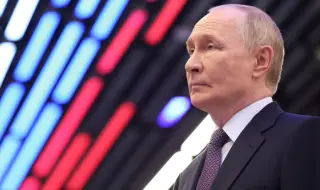
It is known that Russia categorically opposes Ukraine joining NATO. Against this background, the statement of Russian President Vladimir Putin that Moscow has nothing against Ukraine becoming part of the European Union was quite surprising. "As for Ukraine's membership in the EU, we have never opposed it", Putin said during his visit to China. "NATO is another topic."
Observers believe that in this way Putin is trying to present himself as a peacemaker to US President Donald Trump. But there is something else - with this position, the Russian president is buying time, because joining the EU can take years or even decades, while joining NATO could happen much faster and would provide Ukraine with a more stable security guarantee.
Ukraine in the EU: why is Russia suddenly agreeing?
In 2013, Viktor Yanukovych, the then president of Ukraine, suspended the negotiation process between the EU and Kiev. Mass protests followed. Yanukovych was accused of working under Russian influence and deliberately trying to stop Ukraine's European integration in order to keep Kiev in the Kremlin's orbit.
A year later, Ukraine signed the agreement with the EU, but many people suspected then, as now, that Moscow never wanted Kiev to integrate into a democratic Europe. George Beebe, director of strategic affairs at the Quincy Institute, said Putin's surprise statement was likely a ploy to garner international support against Ukraine's NATO membership as Moscow seeks to occupy all of Donbas. Russia currently controls 88 percent of Donbas. The Financial Times reported that control of the region was one of the conditions Putin gave Trump for freezing the front line.
Beeb believes this is pure "pragmatism," as the Russian military is short of men and weapons. Putin is also likely worried about having to confront European NATO members, who are reviving their military industries for the first time in decades. The Russian president probably realizes that a willingness to accept Ukraine's eventual EU membership is a "necessary price" to win terms in a future peace agreement, Beeb believes.
"This is part of a longer-term negotiation process," says Rafael Los, a security expert at the European Council on Foreign Relations. "When everyone agrees that NATO membership is out of the question (for Ukraine), it can undermine the EU enlargement process through its allies in the bloc," such as Hungarian Prime Minister Viktor Orban and Slovak Prime Minister Robert Fico.
Yes to the EU, but no to NATO
Russia has long viewed NATO as a threat to its security, despite its members' repeated claims that it is a defensive alliance.
"NATO occupies a different place in the Russian psyche," says Etienne Sula, executive director for Europe at the Alliance for Securing Democracy at the German Marshall Fund. "At the same time, Moscow does not perceive the EU as a serious military problem because European allies need the United States to be fully operational," the expert believes. And Putin knows that the EU accession process is lengthy, and that gives him enough time and opportunity to intervene through Fico and Orban and delay it further, says Los.
"He is handing over (EU membership) to the "useful idiots" in the West - a term that Soviet intelligence used for people who are easily manipulated," Los believes. According to him, the Russians are good at launching diplomatic proposals without having the intention of negotiating them.
George Beebe believes that Putin must have foreseen that Trump would pressure his European partners to speed up the accession process – but also knows that it could still take years, if not decades.
EU membership: insufficient guarantee for Ukraine's security
No matter what Russia approves or doesn't approve, Ukraine has its own priorities, and adequate guarantees for its security are at the top of the list. "The moment the war is over, Russia will put all its efforts into its hybrid activities in Ukraine," warns Etienne Sula. "If no agreement is reached on some concrete security guarantees - I mean from the US, the promise of EU membership seems hollow."
Although the EU has a mutual defense clause, experts believe that without US support, Europe remains vulnerable. EU membership should be part of the agreement on Ukraine's security guarantees, but it should not be the only one, says Los. Guarantees are needed that effectively deter Russia from attacking again. "Putin has not made any concessions. He is still against a potential European future for Ukraine," Los emphasizes. "This is a tactical maneuver to buy time, avoid additional US sanctions and the possibility of a second invasion."
Author: Anshal Vohra