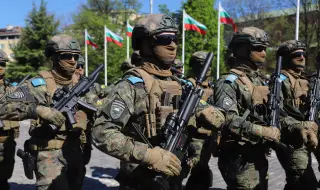
The most important guarantee for Ukraine's security is the arming of the country: in the words of the President of the European Commission Ursula von der Leyen, Ukraine must become something like a “steel porcupine“, which “future invaders like Russia cannot swallow“. The same was said at the meeting of the “Coalition of the Willing“ last week in Paris - this is a circle of about 30 countries that, under the leadership of France and Britain, agreed on a plan to support Ukraine, even including the deployment of Western ground troops after a ceasefire with Russia is reached.
But how could Ukraine become such a “steel porcupine“? "Since Soviet times, they have specialized in the production of small arms, light weapons and ammunition of all calibers," Bulgarian military expert and former Defense Minister Todor Tagarev told DW in an interview.
Massive investments in modern factories
At the beginning of Putin's large-scale invasion of Ukraine, Bulgaria managed to quickly supply the attacked country with Soviet-era military equipment that the army of the former Soviet republic could immediately handle.
Sofia kept these supplies secret for a long time due to fears of Russian sabotage. In most cases, the equipment and ammunition were delivered through Poland, most often through the airport in Rzeszow, near the border with Ukraine, which is protected by the Patriot systems. NATO.
It was Tagarev, while he was defense minister from June 2023 to April 2024, who put together, in strict secrecy, one of the most extensive aid packages for Ukraine, including old Soviet weapons. But now Bulgaria must produce a significant part of the planned total of two million artillery shells - and the government is talking openly about it. The supplies will be paid for by the EU. "Bulgaria has a significant contribution in this regard, which can be expanded even further," says Tagarev.
A budget of one billion euros and a joint venture with "Rheinmetall"
At the end of August, the German arms concern "Rheinmetall" announced that it plans to build a new ammunition factory in Bulgaria worth one billion euros. The project will be partially financed with EU loans and will be implemented jointly with the Bulgarian state arms enterprise VMZ-Sopot. It is planned to produce gunpowder and 155-mm artillery shells according to NATO standards. Back in February, in an interview with DW during the Munich Security Conference, the chairman of the board of “Rheinmetall“ Armin Paperger announced additional investments in Europe.
“After the production of Soviet-standard ammunition for Ukraine, this is a decisive change in the Bulgarian arms industry“, says Bulgarian security expert Velizar Shalamanov in an interview with DW.
“With this, we are opening a new market. And I think that the investment of “Rheinmetall“ "is a recognition of the capabilities and quality of our ammunition production plants," says Shalamanov, who is a member of Bulgaria's pro-European "Atlantic Club." He expects that ammunition supplies to Ukraine will become easier in the future: "It will be more direct," says Shalamanov. "Especially with the participation of Rheinmetall-Logistics, it could be much easier to go directly through Romania. And - why not - even through the western part of the Black Sea, which at least in our territorial waters is safe," says Shalamanov. European investments in Ukraine too? But small arms companies in Ukraine are also hoping for money from Brussels. "In 2025, the production potential of the Ukrainian defense industry is estimated at $30-35 billion, but the state can place orders with a maximum value of at most half of this amount," Ihor Fedyrko, chief lobbyist for the Association of Ukrainian Arms Producers, told DW. The association represents 800 private arms companies, "all of which are looking for investors." This means that European investors have a wide choice of cooperation.
It would be very good if existing financial programs were expanded so that European funds could also be used to purchase Ukrainian weapons, Fedyrko also pointed out. This would significantly reduce logistical costs, and the ammunition itself would reach Ukrainian soldiers at the front even faster, he argued.
However, he is aware that potential Western investors “need reliable mechanisms to reduce military risks“. This means that while Ukraine's air defenses cannot permanently protect even smaller enterprises in the country from Russian air attacks, European investments are more likely to benefit arms companies outside Ukraine, such as those in Bulgaria.
Tagarev: "The war will continue"
And probably for a long time to come. “I don't see an end to the war in the near future. There are not even prerequisites for a ceasefire, let alone a peaceful solution,” says former Defense Minister Tagarev. This is not even evident after the latest initiatives in this direction - the meeting between Trump and Putin in Alaska, the summit of European leaders in Washington and last week's plans in Paris of the 30 countries supporting Ukraine.
“The war will continue. Putin has not given up on his ambitions to control Ukraine territorially and politically“, says Tagarev. And those attacked will not surrender: “Ukraine will continue to resist - with the support of Europe and - to a lesser extent - the United States“, also points out the former Bulgarian defense minister.
Author: Frank Hoffman