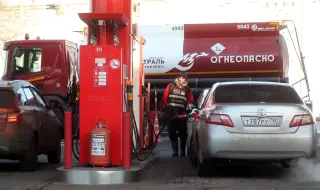
The fuel crisis in Russia is worsening - gasoline prices continue to rise in a number of regions, and in some of them there is still a registered shortage. In August, residents of Transbaikalia and the Far East lined up in queues at gas stations, while in the annexed Crimea and the Primorsky Krai, fuel was distributed with coupons. The Russian authorities imposed a complete ban on the export of gasoline. In mid-August, prices were brought under control and the Crimean peninsula announced that the situation had stabilized, but in early September fuel prices began to set records again.
The Kremlin and regional governments explain the problems with seasonal difficulties in fuel supplies, but remain silent about the large-scale attacks by Ukrainian drones against Russian oil refining infrastructure in August. DW analyzes what is happening with the fuel market in Russia and to what extent Ukrainian drone attacks on energy infrastructure have played a role.
The authorities' version
The Russian authorities explain the situation by citing a set of "technical reasons". In Sevastopol, for example, the shortage was due to the influx of tourists and the peculiarities of fuel deliveries by sea. In Transbaikalia and the Far East, the problems, according to Yuri Stankevich, deputy chairman of the Duma's energy committee, were due to "logistics and poor retail infrastructure. Nearly half of local fuel needs are covered by supplies from Siberia, which depend on the railway infrastructure.
On August 28, the Russian presidential spokesman Dmitry Peskov assured journalists that "the fuel market is fully secured", and that the government is taking "energetic measures" to stabilize prices. From his words it became clear that there were "price fluctuations for various reasons", but the situation was "under control". Some regional officials blame the citizens themselves. The Minister of Energy in the Primorsky Krai Elena Shish, according to whom the supply problems were caused by "speculatively created deficit", because drivers were overstocking and massively filling cans with fuel. In this regard, she advised people to "show awareness" and limit consumption.
Supply disruption and Ukrainian drone attacks
According to the newspaper "Kommersant" in September the prices of gasoline and diesel fuel AI-95 and AI-92 again reached record levels. At the same time, Russian media explain the shortage and price increases with economic, seasonal or logistical factors, without directly mentioning military operations and Ukrainian drone strikes on Russian oil infrastructure. Rare publications talk about "accidents at oil refineries" and "emergencies at refineries", but in general this information is rather vaguely formulated.
In August this year, the number of attacks by Ukrainian drones on Russian refineries increased significantly. According to Reuters, in August 2025, about 23% of the capacity of Russian refineries was idle, which is a historical record. Of these, 17% were closed precisely because of drone strikes. As a result, refineries in the Samara region, Volgograd, Saratov and Ryazan - some of the largest in the country - were temporarily out of operation.
According to Tatyana Rybakova, an economic columnist for the newspaper "Most", summer is traditionally the time for scheduled repairs at oil refineries, but unscheduled repairs have also been added due to the Ukrainian drone attacks. "Not all of them are seriously damaged, but every time it means stopping work. There are many modernized refineries with imported equipment that are within direct range of Ukrainian drones," she points out.
Seasonal fuel crises began even before the war with Ukraine
Sergey Vakulenko, former head of strategic planning at "Gazprom Neft", draws attention to the fact that fuel crises in Russia are not so much a consequence of attacks by Ukrainian drones or seasonal factors, but rather a result of a poor system of state regulation.
"Ideally, the Russian oil industry should easily cope with such seasonal fluctuations due to its impressive size. However, the Russian motor fuel market is structured in such a way that prices are not determined on a market basis. Therefore, it is not very profitable for suppliers to react to changes in the market environment. "This indifference is the price paid for the government's attempts to stabilize fuel prices," Vakulenko wrote on the website “Carnegie. Politics“.
The analyst told DW that in general, Russia is quite quick to restore damaged refineries - usually without having to import equipment. “Everything is repaired on site”, he said, adding that such attacks cannot cause serious economic damage.
Russian authorities are trying to overcome the shortage
The authorities are trying to overcome the crisis. According to "Kommersant", the Ministry of Energy plans to ask oil companies to redirect part of the oil products for export to the domestic market. This applies mainly to diesel fuel. But in many places, gas stations are receiving minimal quantities, and independent chains are complaining of unbearable conditions that could force them to close. In addition, the ministry decided to postpone planned repairs of refineries in several regions to meet the current demand for fuel on the domestic market.
Against the background of problems at some refineries, Reuters sources reported that in August Rosneft increased crude oil exports to 2 million barrels per day - more than the initially planned volumes. As experts note, the reason is as follows: when refineries cannot operate at full capacity, there is a surplus of crude oil, which is sent abroad. For the domestic market, this leads to a decrease in the supply of gasoline and an increase in prices.
At the same time, the situation in the Russian economy remains alarming: Economic Development Minister Maxim Reshetnikov admitted at a forum in Vladivostok that the economy is cooling faster than expected and the ministry plans to adjust the forecast, taking into account the unfavorable factor.
Author: Alexey Strelnikov