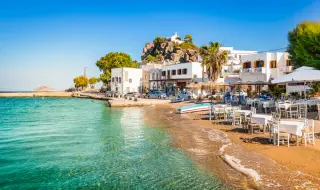
Swimming in Garbage and Brown Haze: The Infrastructure of Many Greek Islands Cannot Withstand the Huge Tourist Pressure. One in Seven Wastewater Treatment Plants is Not Working, and Wastewater Flows Untreated into the Sea, writes the German TAC.
The publication tells how at the end of August, for days, polluted water flowed from a manhole on Hohlakas Beach in the western part of the island of Patmos straight into the sea. The reason: the treatment plant is damaged, and the pipeline from it to the sea is clogged. And this is not the only place on Patmos with a similar problem, writes the German publication. Instead of clean drinking water, brown muddy turbidity flows from the taps of the taps in many places on the island, the newspaper "Kathimerini" also reports.
Meanwhile, the prosecutor's office has intervened and is investigating the so-called "ecological case" of Patmos. According to environmentalists, the canal carrying water to the treatment plant is completely clogged, which is why the manholes on the coast overflow and the impurities flow directly into the sea.
Patmos' problems are no exception
Patmos has the fame of the "pearl of the Dodecanese island group" in the Aegean Sea and has long since become a magnet for many foreign tourists. The majority of the permanent residents of the island, who are only 3,283 in number, make a living from tourism. The smelly canal waters are a real disaster for them. The Patmos biological treatment plant is one of many built with European money in Greece in the mid-2010s. It was supposed to replace a problematic system from the 1980s. The new plant was completed in 2018, but in recent years there have been regular problems - due to insufficient technical maintenance of the facilities, Patmos Mayor Nikitas Tsabalakis admitted to TAC.
"Nothing was working", he says, explaining how the services had to improvise. In the meantime, they have introduced pre-treatment so that baby diapers, grease and some other waste do not end up in the sewers and from there directly into the sea. The construction of an underwater pipe is also planned, which would take the water purified from large waste, but still polluted, 210 meters from the coast, where it would be collected in a reservoir at a depth of 25 meters below sea level.
Environmentalists admit that this is not an ideal solution, but it is still better than inaction. However, replacing the membranes of the treatment plant alone would cost about 100,000 euros, and the municipality clearly does not have such sums. This is exactly the situation on many of the Greek islands, where the facilities are operated without qualified personnel, without regular maintenance and planning. And Patmos is far from an exception, notes TAC.
On the island of Mykonos, which is full of tourists in the summer, a 33-year-old sewage pipeline recently burst in front of tourists. For vacationers, this meant bathing in filth. According to a study by the University of the Aegean, 53 treatment plants in the Aegean and 15 in the Ionian Sea were built before 2000, and another 25 no longer meet environmental standards. In 16 facilities, harmful substances were found in unacceptably high concentrations.
According to TAC, the environmental situation is problematic not only on the islands. The publication cites data according to which 40 of the 281 inspected treatment plants in settlements with over 2,000 inhabitants throughout Greece are not functioning - and this is one in seven plants. Greece also has problems with the remaining infrastructure in ports, airports and highways, which cannot handle the large influx of tourists.
Tourism boom despite the problems
Despite all the droughts and fires, the Greek tourism sector is on track to set a new tourism record in 2025. This is evidenced by the data from the first half of the year. And last year, Greece received nearly 36 million foreign tourists, not including cruise ship visitors.