


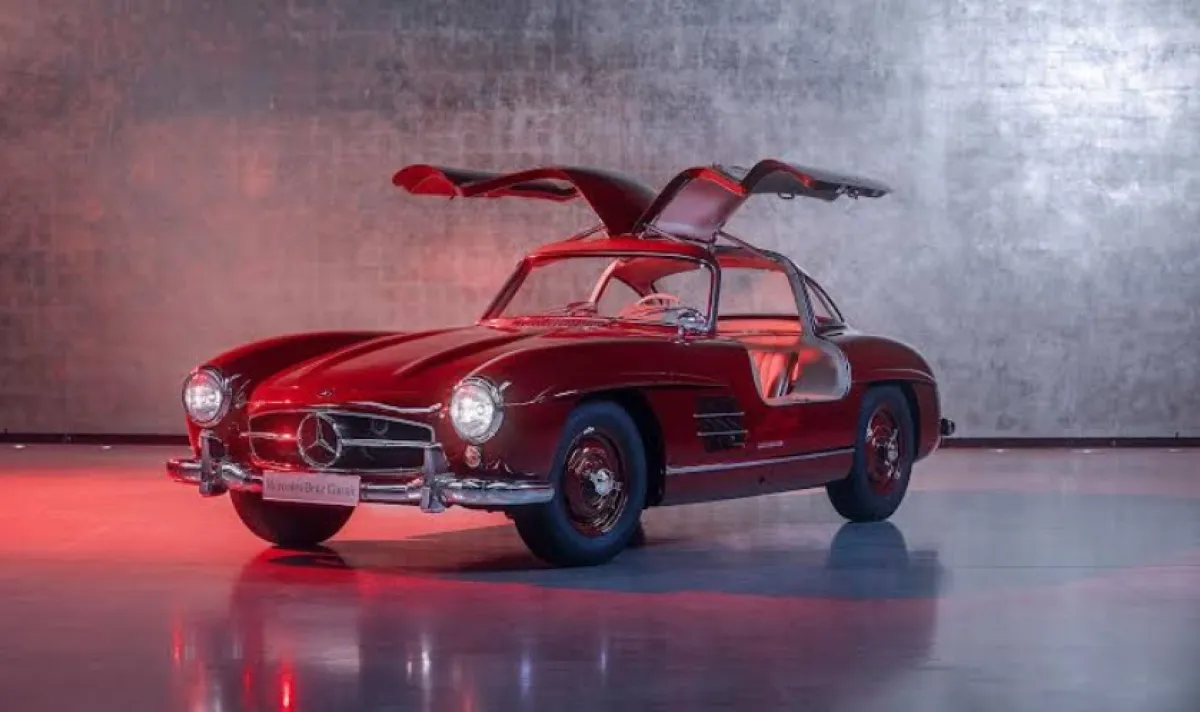

When the Mercedes-Benz 300 SL appeared in 1954, its doors looked like a detail from the future. They lifted up towards the roof, rather than opening to the side, and turned the coupe into one of the most recognizable sports cars in history. However, the reason for this decision was not initially the search for a spectacular design. The “gullwing” doors were the answer to a specific engineering problem. The production 300 SL is the successor to the Mercedes-Benz W 194 racing car, developed in 1952 for the brand's return to international racing. The car uses a lightweight tubular frame built from connected steel tubes. The structure provides high rigidity without adding unnecessary weight, and helped the W 194 win races such as the “24 Hours of Le Mans“ and the “Carrera Panamericana“. The advantage of the frame also comes at a price. The tubes on either side of the cockpit are positioned unusually high and form deep sills. This is where the openings for the traditional doors are located in a standard car.
Cutting out large sections of the supporting structure could reduce its rigidity. Mercedes-Benz had to provide access to the cabin without giving up the racing architecture of the chassis. The solution was to move the hinges to the roof. This way the doors open upwards and create a wide opening above the high sills.
This makes it easier to preserve the frame, but it does not make the car particularly practical. Passengers have to step over the high sill and lower themselves into the seats. For taller people, getting in and out is not particularly comfortable, and sufficient space is required above the car. The side windows are also removable, instead of being retracted into the doors.
The doors are only the most visible part of the 300 SL's engineering concept. The coupe has a 3.0-liter inline six-cylinder engine with an output of around 215 hp, mechanical direct fuel injection and an aerodynamic body. The top speed can reach approximately 260 km/h depending on the specific version.
Mercedes-Benz states that between 1954 and 1957, around 1,400 300 SL coupes were produced, and the technical necessity gradually became a distinctive feature that defined the image of the model and remained recognizable more than seven decades later. In 1957, Mercedes-Benz introduced the 300 SL Roadster. The open model now has conventional doors because the side frames have been redesigned to allow for lower openings. This suggests that the gullwing doors were not strictly necessary for the car's production, but rather a solution to a specific problem in the original design.