


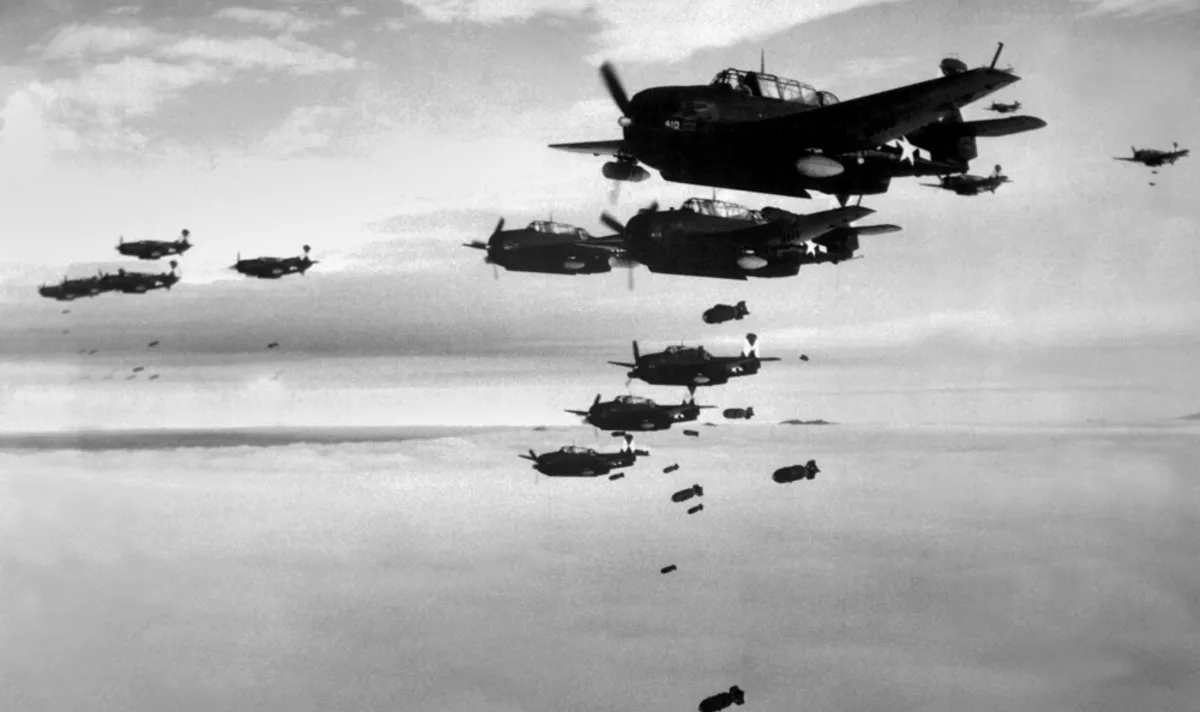

On November 14, 1943, Sofia was attacked for the first time in a massive Anglo-American air raid during World War II. At around 12:30 p.m., 91 B-25 „Mitchell“ medium bombers appeared over the capital, escorted by P-38 „Lightning“ fighters.
The bombs fell on the northern and western parts of the city, as well as in the area of Central Railway Station and the Voenna Rampa railway station. The „Hadji Dimitar“, „Nadezhda“, „Industrialna“, Malashevtsi, Orlandovtsi and „Bulina Livada“ neighborhoods were affected.
The National Museum of Military History says that 606 high-explosive bombs were dropped. Twenty-six of them hit the area around Central Railway Station. The railway and telegraph workshops were destroyed, the four tracks east of the bridge toward Orlandovtsi were cut off, and 23 railway cars were damaged.
Figures on the casualties and damage vary among historical accounts. The National Museum of Military History reports 32 dead, 120 injured, 44 buildings destroyed and 129 rendered uninhabitable. The Bulgarian National Radio cites archival data recording 59 killed, 128 injured and around 50 buildings destroyed. Other summaries put the number of victims at around 60, with nearly 200 injured and 47 buildings destroyed.
The Beginning of the Air Campaign
The first massive raid was part of a broader air campaign against Bulgaria. The country joined the Tripartite Pact on March 1, 1941, and on December 13 of the same year declared war on Great Britain and the United States. By the autumn of 1943, the conflict had reached the capital directly.
After the attack on November 14, further bombing raids on Sofia followed on November 24, December 10, 20 and 30, 1943, and on January 10, 1944. The latter date was among the most devastating in the city’s history. In an archival recording by the Bulgarian National Radio, Colonel Stoyan Stoyanov, who took part in the defense of Sofia, described the attack as follows: „The British aviation attacked at night, while the Americans attacked during the day.“
The bombing continued in the following months. According to the National Museum of Military History, by April 17, 1944, Sofia had been subjected to seven daytime and five nighttime raids, in which 12,567 residential, industrial and public buildings were destroyed or burned. The first raid on November 14 marked the beginning of a campaign that changed the face of the capital and forced a large part of the population to leave the city.
Sources: archives.bnr.bg, bta.bg, trud.bg