


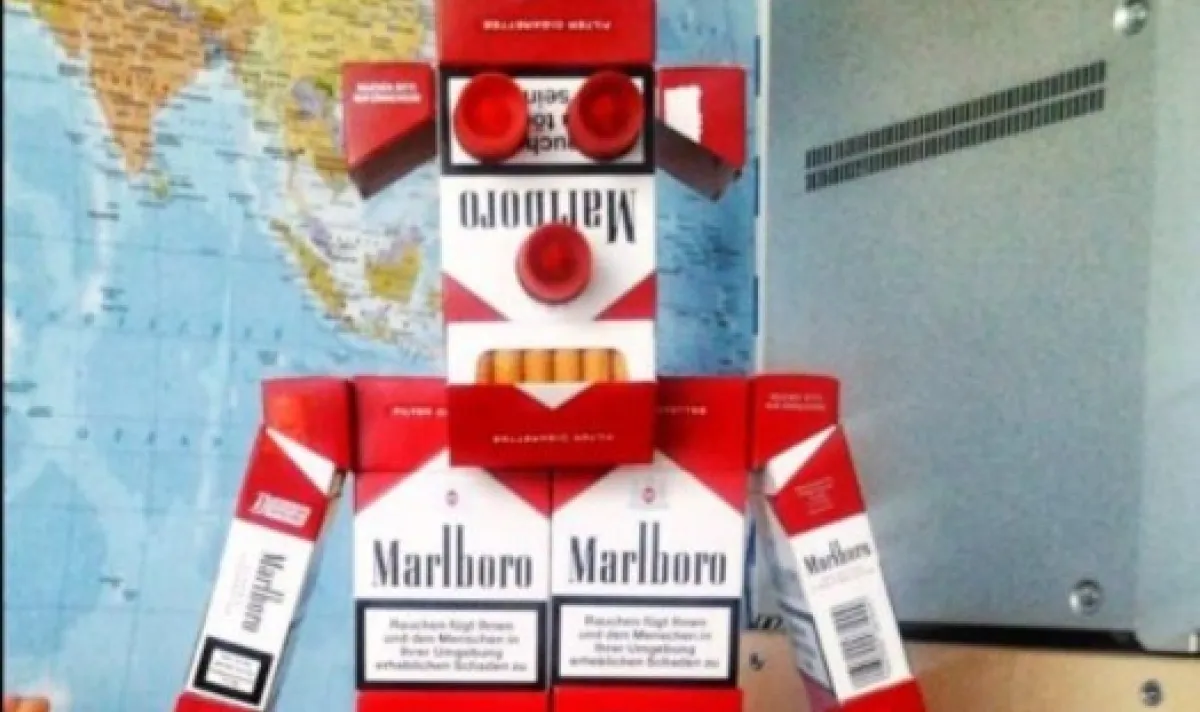

In the courtyard in front of the apartment block, a cardboard figure could say more than a children’s game. A robot assembled from empty cigarette packs required imagination, dexterity and, above all, material. Hard packs with flip-top lids became heads, chests and limbs, while soft packs crumpled at the first attempt to assemble them.
This was precisely where the invisible line between children appeared. Packs of Marlboro, Kent, Rothmans, Dunhill or Pall Mall were coveted not only because of their colors and lettering. They carried the mark of a product that was not available at the neighborhood shop and usually came through Korekom or the hands of someone with access to foreign currency.
The Pack as a Small Sign of the Great Shortage
The first Korekom in Bulgaria opened its doors in the summer of 1965 in Golden Sands. Over the following decades, the stores became a window onto the Western world. They sold foreign cigarettes, alcohol, clothing, cosmetics, electronics, toys and magazines, but payment was made in convertible currency rather than ordinary leva.
A Council of Ministers decree of December 20, 1974, stipulated that the enterprise would sell Bulgarian and imported goods in exchange for foreign currency. Those entitled to shop there included Bulgarians who had worked or been sent on assignments abroad, people undergoing specialist training, and those who had received an inheritance or remuneration in foreign currency. In practice, this placed sailors, international truck drivers, pilots, flight attendants and specialists working outside the country in a different consumer position.
That was precisely why a Western cigarette pack could turn out to be more valuable than its contents. A Kent or Marlboro pack became part of a toy that showed who had a relative traveling abroad, who lived near a major port and who had simply managed to find a discarded pack in front of a hotel or restaurant.
Robots Made from Waste, Assembled Like Engineering Projects
In memories of the 1980s, children collected hard packs, cut cardboard, punched holes and attached movable arms and legs with wire, rubber bands or matchsticks. The difference between a well-assembled figure and a collapsing construction often lay in the quality of the packaging. Packs of mass-produced Bulgarian cigarettes were usually soft, while imported brands offered sturdier cardboard and a more recognizable appearance.
There are no statistics showing how many children made such robots or how widespread the game was throughout the country. Therefore, it cannot by itself serve as evidence of social stratification. But the memory of it fits well into the broader picture of a society in which access to Western goods depended on foreign currency, travel and personal connections.
Korekom and the Price of Access
Korekom was associated with people who could leave the country for work or had dollars and Deutsche marks. According to data cited by Dir.bg, the official exchange rate for the dollar was around 98 stotinki, while on the black market it reached 3–3.50 leva. Thus, even an empty pack became a trace of an economy in which a product could be inaccessible not because of its price as such, but because of a lack of foreign currency.
Tsvetana Manovska, the longtime director of the central Korekom store in Sofia, described the paradox of the system through a personal memory: “What kind of refrigerator do you have at home?” she was asked, and she replied: “The Russian Mraz.” In her words, employees received ordinary salaries in leva, even though the store operated with millions of dollars.
After 1989, Western goods gradually left the specialized stores and entered ordinary retail. The cardboard robots remained a childhood memory, but also a small object through which the major contradictions of late socialism can be seen: official equality, but in practice unequal access to foreign currency, travel and consumption.
Sources: bta.bg, new.bnr.bg, dnes.dir.bg