


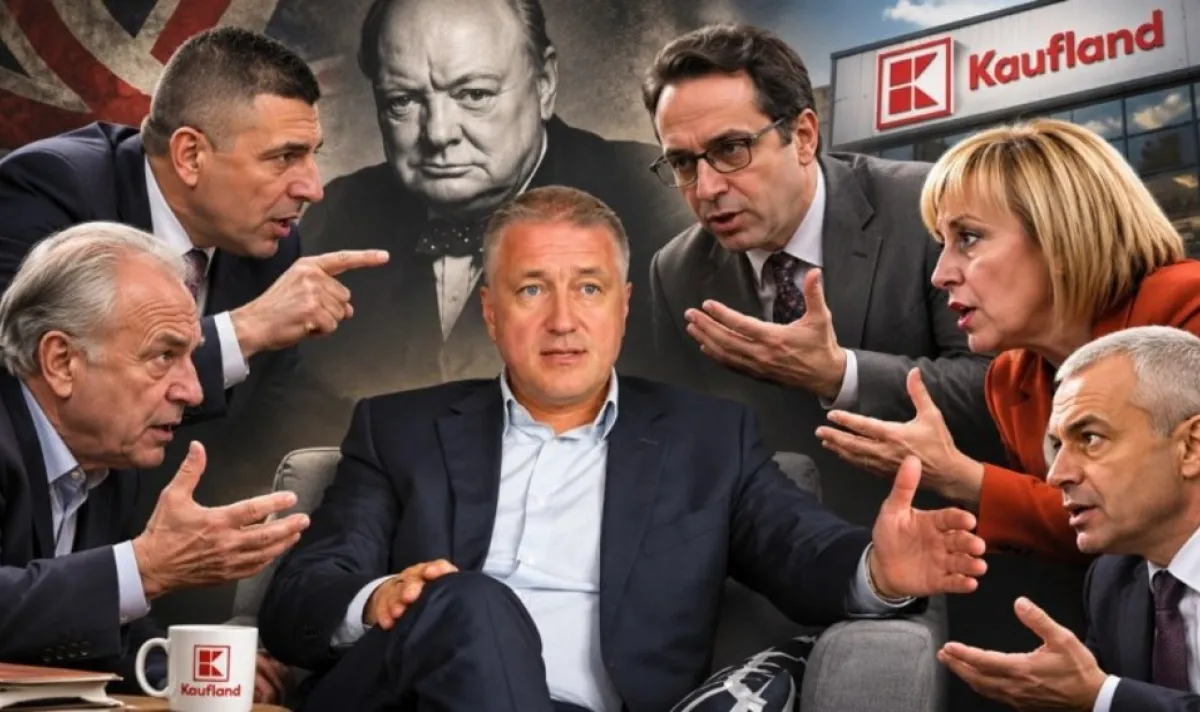

“The inherent vice of capitalism is the unequal sharing of blessings; the inherent virtue of socialism is the equal sharing of miseries.”
This saying, attributed to Winston Churchill, is probably one of the shortest and most accurate ways to describe the fundamental contradiction between two economic systems. And although it sounds cynical, it contains more economic truth than dozens of political speeches filled with patriotism, social sensitivity and outrage at big business.
There is something we seem to have forgotten in Bulgaria. Business and morality are not the same thing. What is more – they do not always go hand in hand. Business has interests, goals, investments, expenses, revenues and shareholders. Its primary task is to be profitable. Not to be a social worker, not to carry out political assignments and not to compensate for the state’s economic failures.
This does not mean that business should be placed above the law. It does not mean that corporations can do whatever they want, nor that consumers should be left without protection. It simply means that we must begin to distinguish economic logic from political rhetoric and moral claims.
Because otherwise we risk returning to a way of thinking that we supposedly abandoned long ago.
I remember the beginning of the 1990s. I was young, but I remember my mother explaining to me that she wanted the shops to be full. Even if she could not afford everything, even if she did not have enough money, she wanted there to be goods. She wanted to have a choice. She wanted to walk into a shop and know that something could be found there.
That was the time of empty shops, shortages and an economy in which having money did not always mean that you could buy what you wanted.
Today, several decades later, we have reached an interesting reversal. We have full shops, international chains, huge logistics systems, competition and access to goods that thirty years ago we could only dream of. And yet part of our political elite seems nostalgic for the economic logic of a time when the state determined how much everything cost, who produced what and what each person could afford.
The latest occasion for this display of economic incomprehension is the reaction to Mikhail Petrov’s statement and the political and public attacks that followed against him and “Kaufland”.
Suddenly, social media was flooded with outraged comments. Political leaders, statesmen and self-proclaimed defenders of the national interest began talking about arrogance, colonialism, national dignity and the need to protect Bulgarian producers.
But behind all this pathos lies one extremely simple question: what exactly do we expect from a private corporation?
“Kaufland” is part of Schwarz Group – a large international corporate group that conducts commercial activities, invests, manages supply chains and competes in various markets. Its goal is to do business and generate profit. Not to create happiness for Bulgarian politicians, not to serve their campaign messages and not to accommodate the political sensitivities of every social group.
This is capitalism. Whether we like it or not.
And here we come to the first major contradiction in the Bulgarian political reaction.
For years, the same political circles insisted that Bulgaria should attract foreign investment, open its market, create conditions for international companies and integrate into the global economy. And when these companies arrived, invested, built infrastructure, hired people and began operating, it suddenly turned out that we did not understand why they were defending their own interests.
What do we actually expect?
For an international corporation to come to Bulgaria, invest millions, take on market risk and then start behaving like a charitable organization because some politician has decided that this is the right way to act?
Let us be serious.
If Mikhail Petrov had made the same statement in the United States, it probably would not have triggered such a scale of political hysteria. Not because American business is more moral, nor because American consumers are less sensitive, but because there has long been an established culture there of understanding corporate interests and the relationship between business and the state.
A corporate executive represents the company he manages. He defends its investments, positions and economic interests. That is his job. He is not obliged to please political parties, nor to speak in a way that wins the approval of every audience.
He may be criticized for his words. He may be challenged. It may be debated whether the way he expressed his position was appropriate.
But turning a corporate statement into a national issue, into a battle for Bulgaria’s dignity, is not merely excessive. It shows a serious misunderstanding of the nature of the economic system in which we live.
There is something else as well.
The fine imposed by the Commission for Protection of Competition is an entirely separate matter. If it is lawful, justified and supported by sufficient evidence, it must be borne. If the company believes that the sanction is unlawful, it has the right to challenge it in court. That is precisely why regulatory bodies and the judicial system exist.
This is the institutional order.
But let us not confuse the state’s right to sanction a company with the political desire to draw dividends from its reaction. Even less should we turn regulatory proceedings into a kind of spectacle in which politicians hand down moral verdicts and social media plays the role of a court.
If there has been a violation, it must be proven. If there is a sanction, it must withstand judicial review. Everything else is noise.
And here we reach one of the biggest problems of Bulgarian political reality: cheap populism that systematically replaces economic competence.
Kaufland did not dismantle Bulgarian agriculture. “Kaufland” did not create the structural problems of Bulgarian farming. “Kaufland” is not responsible for decades of a lack of consistent state policy, ineffective support mechanisms, problems with productivity, cooperation, irrigation, market access and the competitiveness of Bulgarian producers.
These are issues for which Bulgaria’s institutions and political administrations over the years bear responsibility.
But it is much easier to point to an international corporation and turn it into a symbol of all economic failures than to explain why your own state has failed to create a competitive environment for local producers.
It is much easier to talk about national dignity than about labor productivity. It is much easier to blame retail chains than to analyze the state of Bulgarian production. It is much easier to be outraged by prices than to explain how they are formed.
Because low prices in a large retail chain are not the result of charity. They result from scale, logistics, bargaining, economies of scale, competition and pressure on suppliers. These are tools of modern trade.
Of course, here we must make an important distinction. The market power of large chains can create real problems for suppliers and give rise to risks of abuse of a dominant position or unfair trading practices. That is precisely why competition law and regulatory mechanisms exist. But this is an argument for effective institutions and functioning rules, not for a political lynching.
And if someone has decided today that we should attack “Kaufland” because of the way it conducts its business, let them be consistent. Then we should subject “Fantastico” and the other major retail operators that work according to similar market logic to the same criticism.
Because the problem is not the nationality of capital. The problem is the rules according to which it operates.
Otherwise, we end up with the absurdity of accepting a business practice as normal when it is carried out by a Bulgarian company, and as colonialism when a foreign investor stands behind it.
This is not patriotism. This is economic provincialism.
The same logic applies to Levon Hampartzoumian, for example, who is defending the position of his former employer.
We may like or dislike his arguments, we may challenge them, and we may not even like him personally, but we cannot pretend that it is some kind of surprise for a person with many years of experience in the banking sector to defend the interests and logic of a large financial institution.
What should we expect from him? To defend the political comfort of people who have nothing to do with the corporate environment in which he built his professional career?
This is the same fundamental problem: the refusal to accept that different participants in the economy have different interests. And that not everyone who defends their interests is necessarily an enemy of society.
No less comical is the use of the word “arrogance”. It has become a universal political weapon used to replace the absence of economic and professional arguments. Instead of discussing the content of a statement, the character of the person who made it is attacked. Instead of responding to the argument, the person’s character is called into question.This is the easiest way to avoid the real conversation.
And this is not about defending Mikhail Petrov. Nor is it about defending “Kaufland” or Schwarz Group. It is about something much more important: the need to start thinking about the economy as an economy, rather than as an extension of political propaganda.
A large company can be beneficial to the economy and at the same time have practices that deserve criticism. It may provide jobs, invest millions and pay taxes, while simultaneously defending its commercial interests aggressively. These things are not mutually exclusive.
This is the complexity of a capitalist economy. It does not offer ideal participants, but a system of interests, competition, incentives, rules and institutions.
And perhaps this is exactly what we need to learn.
Politicians are not obliged to like business. Business is not obliged to like politicians. But both sides must understand the rules according to which the system functions. The state must create a predictable regulatory environment, protect competition, sanction violations and guarantee the rule of law. Business must comply with these rules and take responsibility for its actions.
This is the normal coexistence of the state and private capital.
Not the hysterical outbursts on social media, in which every inconvenient corporate statement is turned into a national insult, while today Mikhail Petrov is portrayed as the state’s greatest enemy. The truth is that Mikhail Petrov is a great professional who works every day for the prosperity not only of Kaufland, but also of more than 20,000 Bulgarian families.
Bulgaria’s biggest problem is not that it has large international corporations.
The problem is that we still have not built a sufficiently strong domestic economic environment capable of competing with them. We have not created enough competitive producers, we have not built sustainable supply chains and we have not created the institutional predictability that encourages long-term investment.
And instead of talking about this, we occupy ourselves with the “arrogance” of one chief executive. If you ask me, the senior executives of Schwarz Group in Germany should congratulate Mikhail Petrov on his position, not the other way around.
This is the substitution.
There is something deeply hypocritical in the political behavior of people who for years called for more capitalism, more investment and more free markets, but today are outraged when capital begins to act according to its own logic.
You cannot want an investor to come, invest their money, take the risk, create jobs and develop their business, and then tell them that they must behave according to your political expectations. This is not economic policy. It is an attempt to manage business through emotions.
And finally, let us recall something that should be elementary for anyone who claims to understand economics.
The basic principle of a market economy is the free determination of prices and the allocation of resources through the mechanism of supply and demand. The solvency, sensitivity or political preferences of a particular social group or political stratum do not determine this fundamental mechanism.
This does not mean that society should not care for people with low incomes. It means that social policy should be conducted through social instruments, not through political intervention in market logic and the turning of business into a scapegoat for the state’s failures.
Because capitalism does not promise equality. It promises an opportunity for economic initiative, competition and the creation of wealth. Whether this opportunity will be distributed fairly depends also on the institutions, laws and policies of the state.
But one thing must be clear: we have not lived in a socialist planned economy for a long time. We live in a market economy. And if someone still has not understood the difference, the problem is not Mikhail Petrov, it is not “Kaufland” and it is not Schwarz Group.
The problem lies in that person’s own failure to understand the world in which they live.
Because the truth is simple, and it is that 99 % of today’s online revolutionaries, only a moment after closing their rebellious Facebook account, dash off in slippers to “Kaufland” to buy cheap carrots. That last part, however, is their great secret. What do you think, is Mikhail Petrov to blame for their hypocrisy?
Author: Angel Spasov, economist
Read more news in the News category
Follow us on Telegram: https://t.me/mediamall_info
Don’t miss the most important stories on Google News as well!
Source: mediamall.info