


Assoc. Prof. Vilian KRUSTEV
Russophobia, created and spread by the West today, is not a new phenomenon. It is subject to historical inertia in geopolitical rivalry, in which Russian statehood plays the role of an insurmountable barrier to Western dominance.
And it is known that the West conquers the world and imposes its universal model in it not because of civilizational superiority over others, but because of superiority in the application of organized violence. The failures of all attempts to subjugate Russia by a Western power unleash unconscious fear and hatred, expressed through prejudices, superstitions, absurd myths and insulting qualifications.
Russophobia as propaganda gained momentum during the Cold War, when the liberal model of the West was restrained by the power of the USSR in a state of geopolitical parity on a planetary level. It is precisely this geopolitical parity that underlies Russophobia's transformation into a reliable tool of the West for exercising influence and pressure in order to undermine trust, instill hostility, and sow threat and hatred towards everything Russian. Under the leadership of the United States in the Western world, Russophobia has become so widespread that it permeates a significant part of Western culture and dictates media and political discourse.
“The Cold and Hungry Periphery”, “Upper Volta with Nuclear Missiles”, “The Evil Empire” are well-known Russophobic myths from the Cold War, cultivating recklessness, fear, and hatred of Soviet Russia in the public consciousness. Hollywood, of course, has been working on the creation of these propaganda absurdities for decades. In the period from the late 1940s to the 1960s alone, the main “factory of illusions” produced more than 4,000 films presenting the Soviet Union as a “den of spies”, “dungeon of nations” and “a horror for humanity”.
It is known that the CIA and the US Department of Homeland Security coordinated and even financed this activity in favor of American geopolitical interests. And yet, during the same period, the USSR became a zealous defender of peace and social justice; amazed the international community with scientific and sports achievements; set the world an example of using nuclear potential for peaceful purposes; paved the way for humanity in space; took the initiative to abolish colonialism in the Third World, thanks to which dozens of peoples from Asia, Africa and Latin America gained long-awaited political independence.
The period of partial Russophobic taming of the West after the collapse of the USSR lasted less than two decades. While Russia was overcoming its economic difficulties and the Soviet nuclear arsenal was rusting in warehouses, the hegemon USA settled unhindered in Eastern Europe.
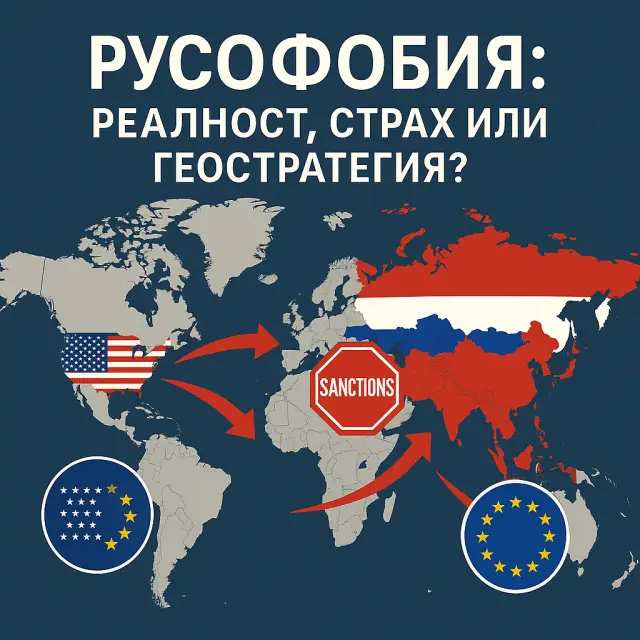
Afterwards, American appetites in the post-Soviet space passed under the sign of a series of “color revolutions”, where Russophobic rhetoric intensified again. “Barbarian Russia”, “the bloodthirsty Russian bear”, “the colossus with feet of clay”, “the resource appendage of the developed world” are part of the Russophobic labels with which
The West entered and respectively – weakened Russian influence in the young republics. Subsequently, the armed uprising in Ukraine in 2014, the incitement of the Kiev regime to attack Donbas, and finally the imposition of American military tutelage over the country passed under the sign of hysterical Russophobia.
The sanctions, economic, and from 2022, military pressure of the West against Russia go hand in hand with Russophobic delirium. “Muscovites”, “Vatenkos”, “Orks”, “Alcoholics”, “Racists”, “Gas Station”… are a small part of those Russophobic qualifications that are present in the vocabulary of representatives of the political elite, political analysts and pishman specialists in national and international security (including Bulgarian) in order to consciously primitivize the image of the enemy (Russia).
Some of them embellish their Russophobic discourse with epithets such as “sick country”, ”monster state”, ”pathological country”, which I don't know if should cause ridicule in a person with an average education, but should certainly prick his mind about the competencies of such “specialists” in geopolitics and security.
It is paradoxical that many of these subjects in our country were educated in universities and military academies of the former USSR, but the conjunctural servility to the West has today turned them into ardent Russophobes.
Russophobia is currently firmly embedded in the media environment, political discourse, culture and intellectual life of the West, of which Bulgaria is a part. Permeating public life, Russophobia, like a contagious epidemic, takes over the minds and hearts of completely healthy and rational human individuals, who, blinded by the odious rhetoric of famous politicians, culture bearers or journalists, make them deaf and blind to objective reality.
The very fact that millions of people around the world (including scientists, intellectuals) still think that the war in Ukraine is between itself and Russia means that Russophobia as a propaganda tool has full power over the atrophy of their brain activity. In this regard, Russophobia is an effective means of “poisoning” of the consciousness of the public masses with a reformatting of their common sense, and the image of Russia is naturally "dressed" in the symbolism and semantics of an eternal and irreparable evil.
As long as Russia exists, Russophobia will not and cannot be eradicated. Given the West's (under the leadership of the US) advantage in information technology, Russophobia will be used as a powerful tool in the struggle for geostrategic (practical implementation of geopolitics) positioning.
The question, however, is to what extent and to what extent the information and cultural influence of the West will continue to instill Russophobia as a means of distorting public consciousness and will hinder the formation of an objective public opinion on defusing tensions with Russia, with the aim of negotiating a lasting peace in Europe.
Only by softening the tone, by strengthening the upper echelon of diplomatic activity and by encouraging constructive dialogue with Russia can the West avoid the military risk for Europe and the tactical testing of the Russian missile complexes “Sarmat” and “Poseidon”.