


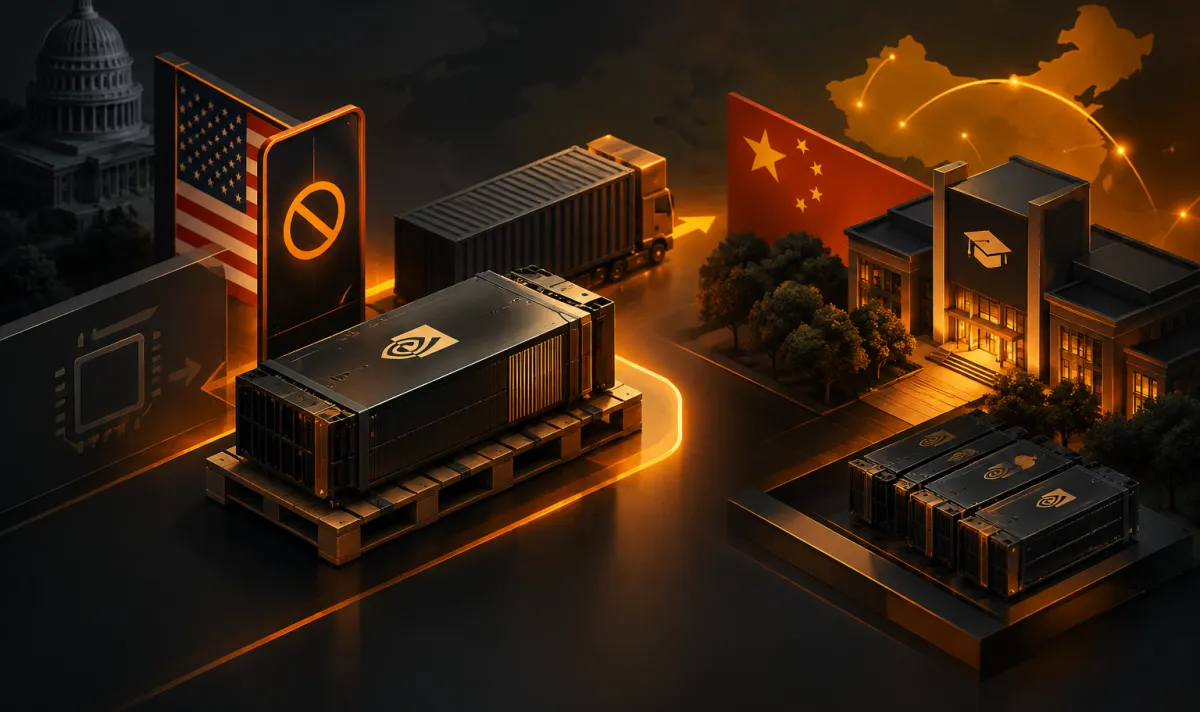

Artificial intelligence could turn out to be an unexpected source of evidence about technological dependencies between the United States and China. New research by US researcher Will Depue shows that it is possible to determine which graphics processor was used in the initial creation of an AI model by analyzing its mathematical parameters. The discovery is particularly significant because six models from four leading Chinese companies contain distinctive traces of NVIDIA’s latest-generation Blackwell accelerators – technology whose export to China is subject to strict US restrictions.
The report, published by Will Depue on November 12 on the Unemployment Labs platform, raises a new question for US institutions: is it possible that export controls on high-tech chips are now being enforced not only by tracking physical deliveries, but also by analyzing the products created with them?
How AI reveals the chips it was created with
The discovery is based on a peculiarity in the way neural networks are created. Before training begins, the billions of parameters, known as weights, are assigned initial values using a pseudorandom number-generation algorithm.
These values are not completely random. They are generated according to a specific mathematical algorithm, and their distribution in memory also depends on the architecture of the graphics processor being used. Different GPU configurations have different numbers of computing blocks, which changes the way the initial values are distributed among the model’s parameters.
According to Depue, part of this initial digital fingerprint may remain even after prolonged training of the neural network.
This means that the published weights of a model may contain information about the hardware on which their initial values were generated. The researcher calls the approach „checkpoint forensics“ – digital forensics of artificial intelligence models.
Depue analyzed approximately six trillion possible combinations of initial values and hardware configurations. He then compared the results with the publicly available parameters of various AI models.
With DeepSeek-V4-Flash, he managed to reproduce 445 complete rows of the initial weights with an exact bit-level match, using a real NVIDIA Blackwell B300 accelerator. A test with the older H100 did not produce the same result.
An additional test was conducted with the Kimi K3 model, whose saved initial values were reproduced using a rented GB200.
Thus, the research goes beyond statistical assumptions and offers a practical test for determining the hardware configuration.
Six Chinese AI models with a Blackwell fingerprint
The most significant part of the report is the identification of six models developed by four Chinese technology companies.
They include:
- DeepSeek-V4-Flash and DeepSeek-V4-Pro by DeepSeek;
- Kimi K3 and Kimi K3.1-Pro by Moonshot AI;
- MiniMax-M3 by MiniMax;
- Ling-3.1-flash by Ant Group.
According to the analysis, two of the models correspond to B200/B300 configurations, while the other four correspond to GB200/GB300 from the Blackwell generation.
Of particular interest is the comparison with earlier-generation models from the same companies. Previous versions from DeepSeek and Moonshot AI show distinctive traces of the Hopper generation, while the newer developments correspond to the Blackwell architecture.
This outlines a change in the hardware used in 2026.
The author of the study says that his method was also tested against 24 models for which the developers had previously announced what hardware they had used. The results matched the publicly declared information in all of these cases.
This is an important test of the approach’s reliability, although it does not mean that it can be successfully applied to every existing AI model.
What level of investment is involved
Depue also provides an approximate estimate of the computing resources required to create the largest models.
According to his calculations, training Kimi K3 may have required around 4,500 Blackwell accelerators, while DeepSeek-V4-Pro may have required approximately 3,000. The total estimate for the five main training processes reaches around 12,000 Blackwell GPUs.
At an approximate price of $70,000 per accelerator, this means that the largest computing clusters alone could represent an investment of hundreds of millions of dollars.
These figures should, however, be regarded as estimates rather than established facts. The author himself warns that they depend on assumptions about the duration of training, the efficiency of the hardware used and the amount of data processed. Not all of these parameters are publicly known.
What this means for US restrictions
The discovery carries additional weight because of Washington’s policy of restricting China’s access to the most advanced American technologies.
Blackwell is one of NVIDIA’s most important technology generations and is at the core of the construction of powerful data-processing centers and the training of large language models.
US restrictions on the export of certain versions of these accelerators to China are part of a broader strategy to preserve the United States’ technological advantage in artificial intelligence.
There is, however, an important detail: identifying a hardware fingerprint does not prove where the chips were physically located.
Chinese companies may have used computing capacity at data centers outside the country. Merely renting such resources abroad does not automatically constitute a violation of US restrictions.
Furthermore, the analysis primarily identifies the hardware used to initially generate the weights. It does not prove that the entire subsequent training process took place on the same accelerators.
These are important limitations that do not diminish the discovery, but define the boundaries of its evidentiary significance.
More than $3 billion in Chinese projects linked to restricted NVIDIA chips
Alongside the technical study, Reuters published an investigation on November 13 revealing the scale of Chinese infrastructure projects dependent on NVIDIA technologies.
According to the agency, an analysis of more than 150 public procurement procedures, investment plans, construction contracts and corporate documents revealed data center and computing infrastructure projects worth more than 23 billion yuan, or approximately $3.2 billion.
The projects are located both in China’s major coastal technology hubs and in the country’s interior.
This shows that despite US restrictions, demand for high-performance NVIDIA accelerators remains substantial. Reuters also notes that Chinese companies are actively seeking ways to secure NVIDIA computing capacity outside China in order to reduce the risk of future tightening of the restrictions.
The two lines of information complement each other: the technical study offers a way to determine the origin of the initial parameters of AI models, while the journalistic investigation shows how large the economic interests connected to access to such infrastructure are.
Jensen Huang’s resignation and the crisis surrounding NVIDIA
All of this is happening at a time when NVIDIA itself is facing a serious crisis on both the corporate and political levels.
On November 12, the company officially announced that its co-founder and longtime chief executive officer, Jensen Huang, was stepping down from his position and from the board of directors. Chief Financial Officer Colette Kress is temporarily taking over the company’s leadership.
The resignation comes after a scandal erupted over Huang’s personal relationship with a woman whom US intelligence services suspect of having ties to Chinese intelligence. The case has drawn additional attention to NVIDIA executives’ contacts with Chinese business structures and to potential security risks.
It is important to emphasize that suspicions of espionage are not equivalent to proven participation in intelligence activities. According to Reuters reports, US authorities have not yet definitively established whether the woman was acting as an agent of China.
The case, however, is already affecting the political debate in Washington over Chinese companies’ access to American technologies.
Thus, Huang’s resignation and Depue’s new study turn out to be part of a larger picture – growing tensions surrounding control over the computing resources that determine the development of artificial intelligence.
A new stage in the technological rivalry between the US and China
Until now, export controls on high-tech chips have been based primarily on tracking deliveries, intermediaries, companies, contracts and the physical locations of equipment.
Depue’s discovery offers a different approach. Instead of tracking the movement of the hardware itself, its digital fingerprint can be analyzed in the products created with it.
This does not automatically solve the problem of export controls, but it adds a new tool to the capabilities of technological intelligence. If the method is independently reproduced and applied on a broader scale, it could help establish hardware dependencies that have so far remained hidden.
For China, the situation also creates an additional incentive to accelerate the development of its own processors and computing systems. The greater the dependence on American technologies, the greater the risk of political and economic restrictions.
It is possible that the pressure to restrict access to the most advanced accelerators will itself accelerate the transition to domestic technological solutions.
Thus emerges one of the great paradoxes of the technological war between Washington and Beijing: measures intended to slow China’s progress in artificial intelligence may simultaneously encourage the creation of an independent Chinese technology ecosystem.
And the new study shows that in this race, even the mathematical parameters of a neural network can become evidence of the system’s technological origin.
Artificial intelligence is no longer merely a product of this global competition. It is gradually becoming a tool for revealing its hidden dependencies as well.