


Nikolai Marchenko, Zagreb, specially for FACTS
It is necessary to revise the Ottawa Convention adopted in 1997. Military experts, politicians and journalists from Europe, Africa and the Middle East united around this opinion during the two-day conference “Rethinking the Ottawa Convention 2025“, held in Croatia. Amid the tense geopolitical situation in the summer, Estonia and other Baltic states, as well as Poland, withdrew from the agreement.
The document, adopted nearly three decades ago, needs to be revised in order to adequately respond to the challenges posed by modern warfare and to ensure a fair balance between humanitarian protection, moral responsibility and the right of defending countries to ensure the security of their borders.
“Technologies now allow us to defend ourselves ethically – simultaneously protecting the civilian population and ensuring national security“, said Ruslan Misyunya, spokesman for the Mine Action Coordination Center of the Kharkiv Regional Military Administration.
“The question is no longer whether the Anti-Personnel Mine Convention should be amended. The question is whether the world can afford not to do so. "Countries that take a defensive stance should no longer be punished for their restraint while aggressors act with impunity," said journalist Boris Nemirovsky.
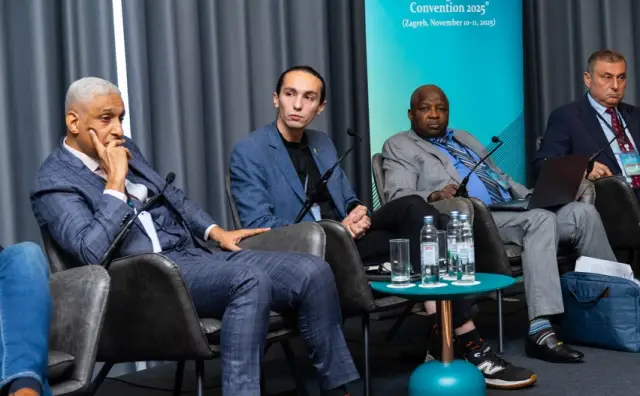
Photo: From left to right: Mohamed Lagdaf, Ruslan Misyunya, Sadeya Garba Shehu, Hafiz Azimzadeh
The Ottawa Convention was created in a radically different geopolitical situation, when the world hoped for peace after the Cold War, but today this system is no longer sufficient, argues Ukrainian military engineer and politician Yuri Khudimenko.
„If the world wants international laws to make sense, it must create tools for their implementation - „international police“, real mechanisms for holding violators accountable. Otherwise, the conventions limit only those who already comply with the rules, giving the rest the opportunity to destroy and kill freely“, said Khudimenko.
Today, 22% of the territory of Ukraine is mined. This is a huge area, and demining costs a lot of time and money. „Something more - the territories that have already been deoccupied and seemingly demined, even there are still mines left and the civilian population continues to suffer from them“, said Anna Skorokhod, a deputy of the Verkhovna Rada of Ukraine and added: „I don't need to explain how much Bulgaria suffers from mines, because after the explosion of the Kakhovka hydroelectric power station you discovered a huge number of mines in the sea. I thought that all countries that somehow border Russia by sea could suffer from the actions of the aggressor, who cannot be restrained. The Ottawa Convention could be reanimated and it could act if changes were made to its text related to the countries against which aggression is being carried out“, the Ukrainian MP specified.
In Africa, the situation with mines and their removal from the territory of a number of countries is tragic. During the period of colonial occupation of African countries, their territories were heavily mined – for example, France left about 11 million mines in Algeria, one million in Tunisia and 300,000 in Mauritania. France ratified the Ottawa Convention in 1998, but the document does not provide for specific mechanisms for addressing post-colonial problems, which allows Paris to avoid full responsibility. The echoes of colonial wars still claim the lives of civilians in countries once colonized by France, even though colonization itself has long since ended.
Children are the ones who suffer the most. “Children lose their arms and legs when they play carelessly and step on a mine, like women collecting firewood in the forest. Mines planted by aggressor countries claim the lives of innocent civilians, and victims are virtually never compensated while their own countries struggle with the cost of treatment,“ said Sadiq Garba Shehu, a representative of the Nigerian National Humanitarian Committee for Combating Landmines.
Azerbaijan also faces major challenges in demining after regaining occupied territories five years ago. Nearly a million refugees are still unable to return to their homes because the territory remains heavily mined by Armenian armed forces and separatists since the end of the conflict. Azerbaijan has not signed the Convention because it has itself been the victim of occupation and mining by invading forces - and because none of its neighboring countries have signed it either.
“Peace has returned to the region, but Azerbaijan has to carry out demining on its own, without access to maps of minefields. The country has not signed the convention because it itself has been a victim of occupation and mines – and because none of its neighboring countries have signed it“, said the country's representative Hafiz Azimzade.
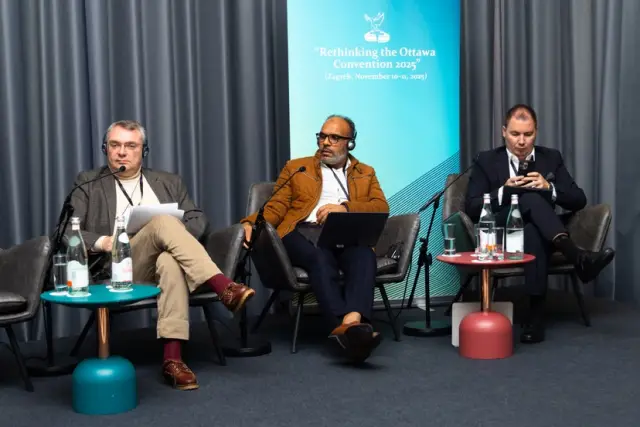
Photo: from left to right Boris Nemirovski, Adeya Amira and Nikolay Marchenko
The conference concluded with a call for the development of the Zagreb Declaration in early 2026, which will outline four key points:
• Defense exceptions for countries subject to proven external aggression;
• Accountability and financial responsibility for mine contamination in colonial and military settings;
• Integration of modern technologies for security, verification and transparency;
• Continued commitment to mine clearance and victim rehabilitation.
The conference “Rethinking the Ottawa Convention 2025“ gathered not only top-level experts and politicians, but also found wide coverage in the world media, such as altner-consulting.com, newsweek.ro, delo.si,rus.delfi.ee, delfi.lv and BNT.
What is the Ottawa Convention?
The Ottawa Convention prohibits the use, stockpiling, production and transfer of anti-personnel mines, as well as their destruction, and allows member states to retain only a small number of such mines for use in mine clearance. Estonia is also a member of the Ottawa Convention, but this summer announced its withdrawal from the treaty. The decision was justified by the deteriorating security situation in our region and the growing military threat. The withdrawal will enter into force at the end of this year.