


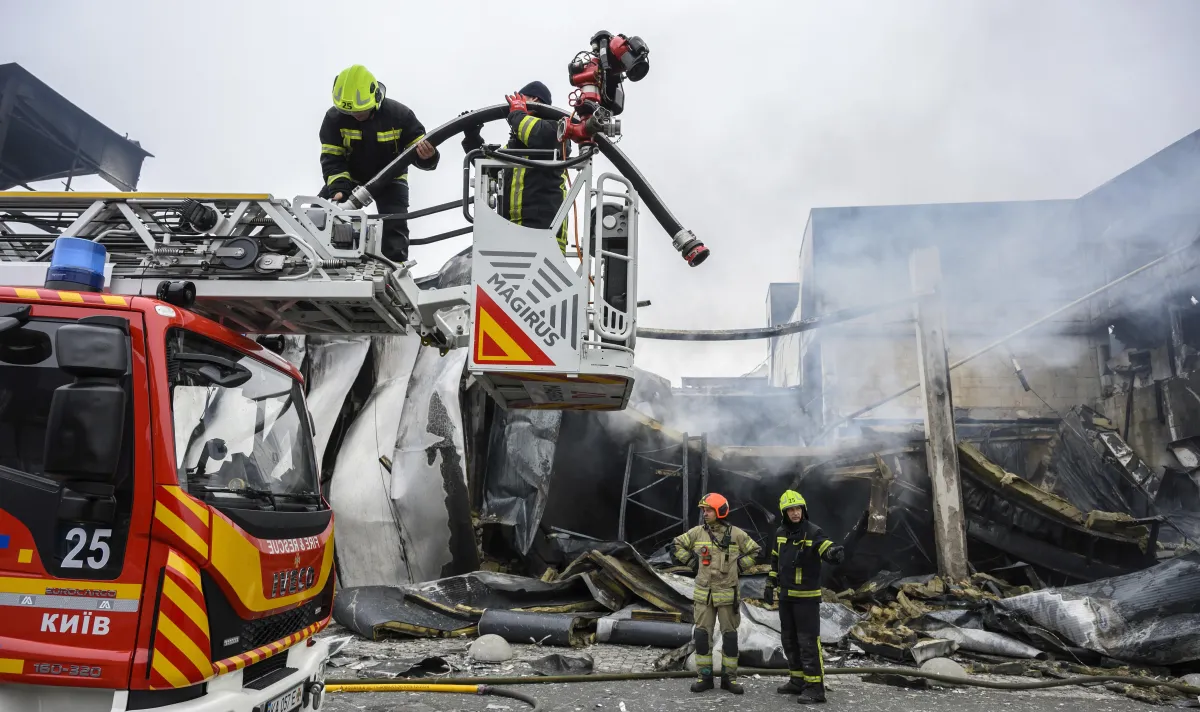

Only a few months ago, the relatively peaceful life in Kiev contrasted sharply with the realities of the front and often surprised military personnel arriving in the capital on duty. Now, the incessant Russian attacks are forcing Kiev residents to spend the night in the subway and check every morning whether their loved ones are alive.
The subway - the capital's main bunker
Around ten o'clock in the evening, the stations of the Kiev subway turn into a large camp. People spread out mattresses and prepare sleeping places, children fall asleep next to the adults, and pets snuggle tightly to their owners, seeking comfort in the unfamiliar environment - among strangers and in cold dungeons.
The London Underground played a similar role during the Nazi bombings of World War II, aimed at crushing Britain's resistance. Thousands of Londoners sought refuge in the subway stations.
In Kiev, home to almost four million people, the subway remains one of the few places offering refuge. Specially equipped shelters are sorely lacking, with almost no free space left in them, and people have no personal space.
"We are alive, we are lucky again", says Galina, hugging her five-year-old son Roman tightly. Almost every night, the woman comes to the subway with him - even when there is no air raid warning. Their apartment is located in Lukyanovka - for the past five years, this neighborhood has been systematically reduced to ruins.
The sirens wail, along with the warning: "Head for the nearest shelter". But where can one go if there is no place nearby that provides reliable protection from missiles and drones? In the homes of many Kievans, the hallway has become the safest place.
Between home and school: childhood under fire
On the morning of September 25, 14-year-old Daniel Umansky was doing homework in his children's room when a Russian drone hit their apartment building in Pechersk - the historical, administrative and business center of Kiev on the right bank of the Dnieper. The boy died.
"At the time of the impact, my daughter and I were in the hallway. We were in a hurry to get to school and had to leave much earlier, but we were late. And that saved us. I found out about Danny's death from the neighbors. It's a tragedy," says Vlad, who lives in the same block. "These sick bastards don't care who they kill," he adds.
In early October, a Russian drone crashed into a school building in the Solomensky district of Kiev, in the southwestern part of the Ukrainian capital. The attack was not fatal, as the drone's warhead did not explode, and the children and teachers were in the school's shelter.
"We studied entirely in person, because we have a large shelter that can accommodate over 500 students and offers enough space for everyone. That's why children from first to ninth grade went to school," the school's director, Valentina Chernaya, told DW. The possibility of in-person learning depends not only on the decisions of the parents and the administration, but also on the availability of shelter and the duration of the air raids. If the raid finds the child at home in the morning, he may not be able to get to school.
Our editorial colleague, whose daughter is a student, says that this is a great stress for parents - when they go to work, and the child is left alone at home. "I worry that during shelling, a shell or a drone may fall into our home", he says.
This is exactly what another colleague of ours experienced: in early September, a Russian jet drone crashed into their home. Fortunately, their daughter was already at school at that time.
Online learning in the current conditions does not allow for full-fledged lessons. During the Covid pandemic, classes were held regularly, but now airstrikes are constantly interrupting the learning process: children are forced to leave classes and hide in shelters. And if the school does not have a suitable shelter, the only way out is distance learning. Because of all these difficulties, some families decide to move out of Kiev to other cities or villages so that their children can continue their education.
When bridges become targets
Protective nets and air defense systems are now an integral part of Kiev's bridges, which are increasingly reminiscent of roads in front-line areas - for example, in Kramatorsk or Kherson. Recently, Russian troops began attacking bridges over the Dnieper, threatening the transport connection between the left and right banks of the capital. For those living on the left bank, this is critical: every day hundreds of thousands of people have to cross the river to go to work, and again in the evening - in the opposite direction.
If the bridges are damaged more seriously, the usual routes will have to be changed. In Kiev, they are already looking for alternatives, such as pontoon bridges across the Dnieper.
Kiev is in survival mode
Since the end of September, Kiev has again experienced emergency power outages. For the first time in a long time, Russian strikes have brought the metro to a standstill. Against this background, the city authorities are looking for ways to keep the capital functioning: Kiev has shortened the evening curfew, which now lasts from 1 a.m. to 5 a.m. In addition, the city has allowed individual institutions to operate under a yellow danger code - if there is no immediate threat of a missile or drone attack. Medical facilities are equipped with generators, and planned operations are canceled only in exceptional cases - in the event of massive missile attacks.
Kiev is increasingly resembling a city near the front. After Russian strikes on supermarket warehouses, there is already a shortage of some products, which has not happened since the start of the full-scale war. Due to attacks on energy infrastructure, it remains unknown how reliably the city will be able to provide its residents with heating, lighting and water. The situation has worsened to such an extent that Kyiv Mayor Vitali Klitschko has called on Kyiv residents to leave the capital.
This year, Russian attacks on Kyiv have become even more deadly. According to the Kyiv City Military Administration, 140 people died in the capital in the first eight months of 2026 alone. Over the entire past year, 172 Kyiv residents died. If the current trend continues, 2026 could become the bloodiest for Kiev since the beginning of the Russian invasion.
But despite Russia's attempts to make the Ukrainian capital uninhabitable, more than 70% of Kievans say they are ready to stay, according to data from the Kiev International Institute of Sociology. So every night that passes without shelling and new victims gives people reason to breathe a sigh of relief and say: "We got lucky this time too".
Author: Marina Asmolova