


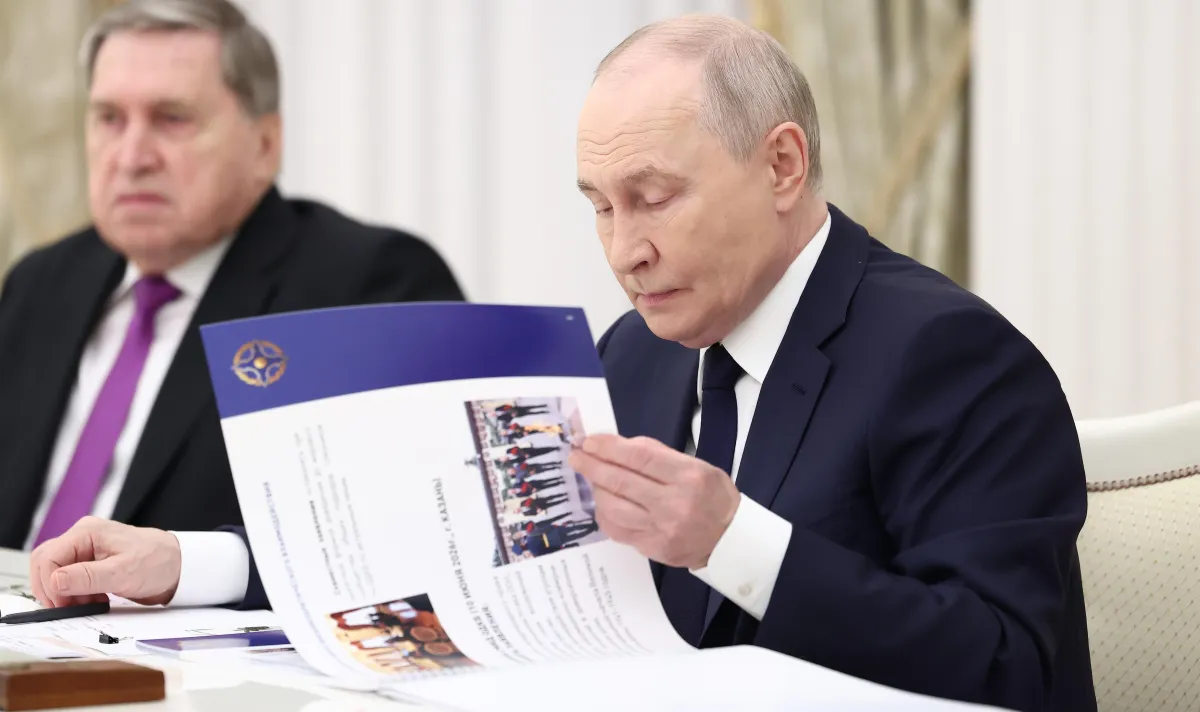

The United States stepped up its efforts to achieve peace in Ukraine this week, with a series of important meetings held in this regard yesterday. U.S. special envoys Steve Witkoff and Jared Kushner arrived in Moscow after two days of talks between Ukraine and Russia, mediated by the United States, in Abu Dhabi. After meeting with Vladimir Putin, they traveled to Dublin, where they held talks with Ukrainian President Volodymyr Zelensky and a number of Western leaders.
The two American envoys are insisting that Europe take part in the negotiations, while Russia is clearly showing that it will not consider the possibility of a ceasefire until its demands for restructuring the European security system are met, The New York Times writes.
“We cannot make this deal if the Europeans are not at the negotiating table,” Kushner told reporters last night after the consultations he and Witkoff held with Zelensky, the American newspaper notes.
“This is important to us because the war is being fought in Europe,” the American envoy stressed.
Donald Trump’s administration is trying to achieve a foreign-policy success after the rout suffered by the Republican Party in the midterm congressional elections. For this reason, the White House is launching a new peace campaign, even though Russia is giving no signals that it will end the war in Ukraine anytime soon and even appears to be hardening some of its positions, The New York Times continues.
The Russian army has intensified its attacks on Ukrainian cities ahead of winter, taking advantage of Ukraine’s shortage of air-defense resources. Zelensky said yesterday that his country’s armed forces were once again facing restrictions in the Starshield satellite system.
If Europe is included in direct peace negotiations, that would mean it is backing away from its long-held position that Russia must first stop fighting, The New York Times notes. But European officials are insisting on a seat at the negotiating table also because the dialogue could expand to include questions concerning the security of the Old Continent.
Russia has still not confirmed that Europe will join the next round of negotiations, the American newspaper notes.
Putin signaled to the American envoys yesterday that he was not prepared for easy compromises and that if Russia began talks with European representatives, the discussions would be difficult, The New York Times also writes.
“We would very much like it, gentlemen, if you and the American administration as a whole worked with your European allies so that they could ultimately clarify for themselves exactly what they want: peace or war in Ukraine,” the Russian leader said, as quoted by The New York Times.
The American representatives responded in a more optimistic tone. Kushner said that the American side was seeing “a major shift among the Europeans” and that there was “strong momentum and a desire to work together.”
If Europe joins the negotiations, Putin will interpret this as a sign that his tactic of waiting for the Europeans to make concessions has indeed worked, Tatiana Stanovaya, a senior fellow at the Carnegie Russia Eurasia Center, told The New York Times.
On Wednesday, senior Russian diplomat Alexey Drobinin presented at a security conference in Moscow proposals which, he said, could meet Russia’s demands regarding security in Europe.
Drobinin said that Moscow could sign bilateral agreements with some European countries that would “essentially meet the criteria for mutual non-aggression pacts.” The Russian diplomat compared these potential agreements with the treaties Moscow has signed with Belarus, Iran and North Korea, The New York Times also writes.
The Frankfurter Allgemeine Zeitung (FAZ) takes a closer look at the issue of European support for Ukraine in the current situation and, more specifically, Chancellor Friedrich Merz’s efforts to secure European aid for Kyiv for next year.
Merz cannot yet boast of any successes related to funding for Ukraine, FAZ writes. Just over a year ago, Merz proposed that Russian state assets frozen in Europe be used as collateral for a loan worth billions of euros for Kyiv, without first consulting other European leaders. In December last year, the European Council rejected the proposal, leaving the German chancellor empty-handed, FAZ continues. Belgian Prime Minister Bart De Wever secretly developed another plan together with the leaders of Hungary, France and Italy and outmaneuvered Merz in every respect, the German newspaper continues. The publication asks whether the chancellor will manage to prevail this time or whether he is once again facing defeat.
Merz set the bar very high in a letter whose contents became known at the beginning of this week. All EU member states must make a “fair contribution” to the continued financing of Ukraine, Merz wrote. This is an “essential prerequisite” for discussing the remaining financial issues and, in particular, the EU’s medium-term financial framework, the German chancellor said. This can be understood as an ultimatum, FAZ comments. Joint financing for Ukraine was a leading issue for Merz also during his participation in yesterday’s meeting of European leaders in Dublin. “I believe it goes without saying that this is a pan-European task,” Merz said, as quoted by FAZ. But all four European countries to which Merz’s statement was directed immediately objected.
This time, resistance came from Central and Eastern Europe, the German publication continues. The sharpest reaction came from Slovakia’s prime minister, left-wing populist Robert Fico, who said as early as Tuesday that Merz’s initiative was straight out of a “textbook on blackmail.” “Slovakia will never support granting a loan to Ukraine,” the Slovak prime minister stated categorically.
Czech Prime Minister Andrej Babiš was somewhat more cautious in his remarks. “We are against it,” he said in Dublin in response to a question from a FAZ reporter. According to Babiš, reaching an agreement on the EU budget “has nothing to do with financing Ukraine.” In addition, €100 billion for Kyiv has already been earmarked in the European Union’s financial framework for the 2028–2034 period. But these funds can only be disbursed from 2028 onward, while Ukraine needs an additional €70 billion as early as next year. The EU must cover two-thirds, or €45 billion, of this amount, FAZ notes. Asked whether this was nevertheless a matter of solidarity both with regard to the European budget and Ukraine, Babiš replied that he would discuss it with Merz, thereby signaling that he was still ready for dialogue, the German publication notes.
FAZ also examines the position of Hungarian Prime Minister Péter Magyar, who visited Germany earlier this week. Magyar had to maintain a diplomatic tone when asked about Merz’s initiative on Tuesday. “I do not consider this to be necessarily the right direction,” the Hungarian leader replied. Hungary, the Czech Republic and Slovakia are exempt from paying interest on the €90 billion loan approved by the EU last year, FAZ recalls.
As for future obligations, Bulgaria is also insisting that such an exception be made for it, the German newspaper also writes. Prime Minister Rumen Radev argued that the EU had officially opened an excessive-deficit procedure against his country.
Even diplomats from countries friendly toward Germany are wondering whether the chancellor’s letter was a sensible move, the German publication continues. “It is difficult to impose a position in the face of resistance from four countries,” one of the diplomats said.
Why did Merz not first try to speak personally with the leaders instead of publicly pressuring his partners, the German newspaper asks. Angela Merkel approached similar situations much more subtly. This criticism concerns the chancellor’s governing style, which constantly leads to conflicts, and not only in Berlin, FAZ adds.
EU leaders are due to discuss today who should speak on behalf of Europe in negotiations with Russia, the British newspaper The Guardian writes.
Both Washington and Moscow are calling on European leaders to appoint a single representative to conduct the negotiations on their behalf. So far, however, the bloc has not nominated a representative.
Kaja Kallas has proposed, in her capacity as the EU’s High Representative for Foreign Affairs and Security Policy, to represent the European Union in the negotiations, together with European Council President António Costa.
French President Emmanuel Macron played down the importance of appointing a single European representative in the negotiations, saying that “content determines form.” “There is no longer support from the United States. There is some mediation, fine,” Macron said, referring to Kushner and Witkoff’s diplomatic meetings. “But ultimately, we Europeans will be the ones to determine and decide the issues concerning our future security,” the French president added.
German Chancellor Merz said that before a European representative is selected, President Putin must sit down at the negotiating table. “This is not about specific individuals. What matters is that Putin is ready to negotiate,” Merz stressed.