


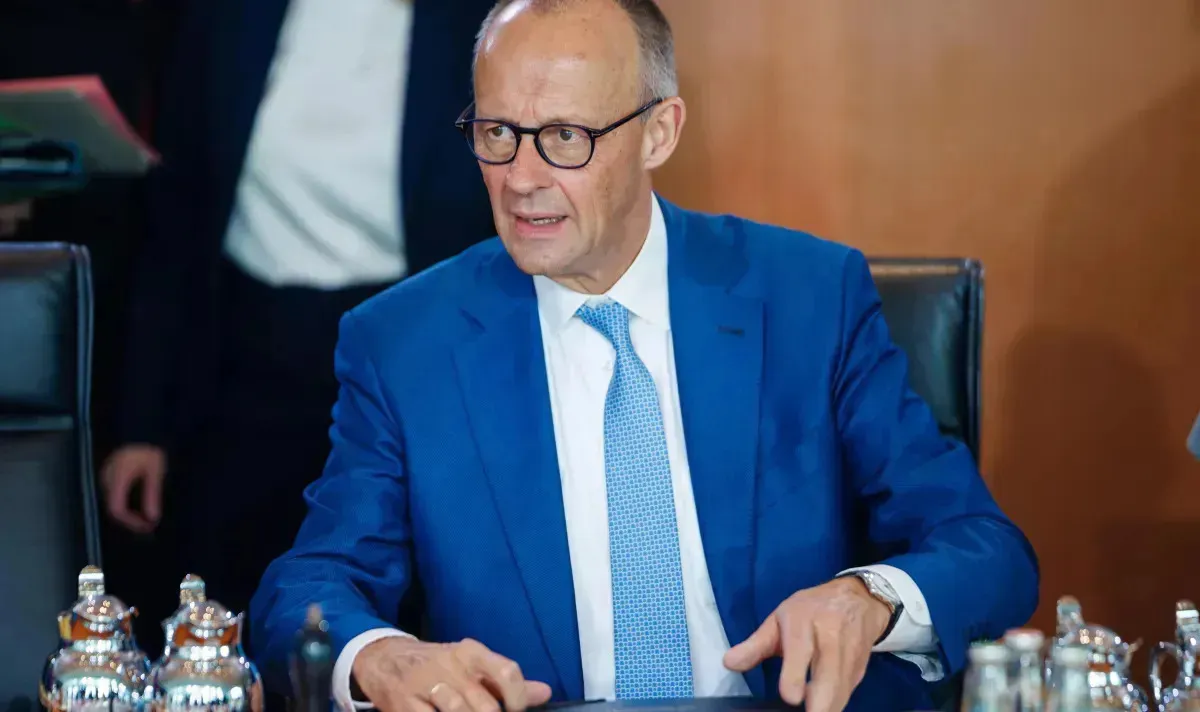

German Chancellor Friedrich Merz has linked Berlin’s support for the European Union’s seven-year budget for 2028–2034 to a commitment by all member states to participate in financing Ukraine. The demand has divided European leaders, with opposition coming not only from governments that have already refused to join the new financial scheme for Kyiv, but also from countries that support Ukraine, the Brussels-based Rapporteur portal reports.
In a letter to European Council President António Costa, Merz warned that Germany would not approve the budget unless a common solution was found for long-term financial support for Ukraine. „Support for Ukraine is a matter of our indivisible European security, which is why the burden must also be shared,“ the German chancellor wrote, as quoted by Le Monde.
Berlin insists that everyone must bear part of the costs
Ukraine needs around €70 billion to cover its budgetary needs in 2027. Around €45 billion of this sum is expected to be provided by the European Union. So far, the member states have agreed on a €90 billion loan for Kyiv for 2026 and 2027, with several countries receiving exemptions from the financial obligations.
Hungary, Slovakia, the Czech Republic and Bulgaria have stated that they do not wish to participate in the next mechanism for financing Ukraine. All four countries are major recipients of funds from the EU’s cohesion policy. According to Rapporteur, countries such as Slovenia and Ireland, which currently holds the presidency of the Council of the EU, are also opposing the linking of the two issues.
Slovenia is among the countries insisting that funding for agriculture and economic convergence be preserved in the next budget. In October, 17 countries, including Bulgaria, the Czech Republic, Hungary, Portugal, Romania, Slovakia and Slovenia, called for funding for poorer regions and farmers not to be reduced. The Irish presidency presented a new version of the negotiating text on 10 October.
The budget dispute becomes intertwined with aid for Kyiv
The European Commission’s proposal for the 2028–2034 budget is worth nearly €2 trillion. It includes the possibility of mobilising up to €100 billion for Ukraine over the seven-year period. The Commission says that member states will be able to receive the same levels of funding as under the current budget, while a safeguard clause is envisaged for less developed regions. This means that the claim that payments to poorer countries will be automatically reduced is not an agreed fact, but part of the political dispute over the distribution of funds.
Slovak Prime Minister Robert Fico described Merz’s position as „typical blackmail“ and said he would not back down. Czech Prime Minister Andrej Babiš also opposed the condition, pointing out that the draft budget itself already provides for €100 billion in funding for Ukraine.
The budget must be adopted unanimously by the member states, after which the consent of the European Parliament will be required. The European Council aims to reach a political agreement by the end of 2026, so that the necessary legislative texts can be adopted in 2027 and the new financial period can begin without interruption on 1 January 2028. António Costa is expected to present a new compromise proposal on 21 November.
Sources: rapporteur.com, lemonde.fr