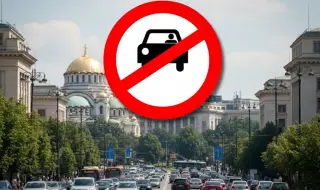
Sofia, the city that often breathes heavily under the haze of fine dust particles, is taking a decisive step in the battle for cleaner air. From December 1, 2025. significantly stricter restrictions come into effect in the city's low-emission zones, which will undoubtedly shake up the daily lives of thousands of motorists.
“The Small Ring“ - no longer accessible to the oldest
If your car falls into the First (I) or Second (II) environmental group, you have reason to worry if you often travel in the heart of the capital. In the period from December 1, 2025 to February 28, 2026 - the three darkest and coldest months - these cars will be completely banned from entering the so-called first city ring road.
We are talking about the area closed between „Opalchenska“ Blvd., „Vasil Levski“ Blvd., „Skobelev“ and Blvd. „Patriarch Evtimii“. The truth is that it is precisely these "veterans" of the road, whose catalytic converters or lack thereof are often only formally checked during the annual technical inspection (GTP), that are among the main pollutants, especially in winter. It is time for the state to tighten control over technical serviceability, because at the moment we are witnessing too many obviously faulty vehicles that somehow manage to pass the GTP.
Extension of the ban: First group leaves the wide center
In parallel with the „Small Ring“, First Eco Group is also banned from entering the Second City Ring – the wider center.
This expanded zone includes the boulevards „Konstantin Velichkov“, „Slivnitsa“ and “Sitnyakovo“ (with the border extending to “Srebarna“ Street). The restriction applies again for the same three-month period – December 1, 2025 to February 28, 2026.
If you are wondering how these bans will be controlled – the answer is with automated video surveillance. Cameras now monitor every entry and there will be no room for circumventing the rules.
Are there any exceptions?
Yes, reason has prevailed at least for some groups of citizens. The following are exempt from the rule:
Owners of cars with a permanent address in the zone itself, who have a valid paid parking sticker.
People with disabilities, who have a preferential parking card issued by any Bulgarian municipality.
Does the measure work? The statistics speak for themselves
The actions of the Sofia Municipality are not just a whim, but part of a European trend. Low-emission zones are recognized throughout Europe as one of the most effective tools for dealing with pollution. They directly affect the emissions of fine dust particles (PM 2.5, PM 10) and nitrogen dioxide (NO2), which are among the main causes of respiratory and cardiovascular diseases.
Is there a result? Absolutely yes! After introducing the small zone last winter, the Sofia Municipality reported a 25% improvement in air quality in the first month and a 10% overall improvement for the entire three-month period.
Looking to the Future: What's Next?
Sofia won't stop there. While Europe already has nearly 400 such zones and is expected to exceed 500 by the end of 2025, Bulgaria is catching up. The next big change is scheduled for December 1, 2027, when the ban on entering the “big ring“ (the Second) will be joined by the Second Eco Group – then the restrictions will become even more serious.
How to check your eco group? To avoid unpleasant surprises and fines, immediately check which environmental group your car belongs to HERE