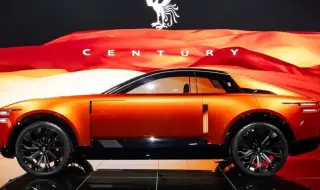
Despite the global fever for electrification and the categorical turn of the automotive giants towards batteries and hydrogen, Toyota is giving a clear signal: in the ultra-premium segment, classics have a future. The Japanese concern confirmed that its luxury brand Century - positioned even above Lexus and a direct competitor to Rolls-Royce - will remain an island of tradition, retaining internal combustion engines and will not switch to a fully electric drive.
This principled decision is completely in the spirit of the philosophy of Century, a brand that for more than half a century has been a benchmark for unsurpassed silence, refinement and an exceptional level of smoothness, achieved precisely through large atmospheric engines. The president of Toyota's powertrain division, Takashi Uehara, officially confirmed to the Australian publication CarExpert that future Century models will necessarily have an engine. While the specific powertrain is still being discussed, the basic vector is set: the internal combustion engine remains.
Toyota has several new technological goats that could form the heart of the future Century. One possibility is a promising four-cylinder hybrid system, combining a 2.0-liter turbocharged engine with powerful electric support. Engineers have set a goal of 400 hp, but Toyota experts believe that this power can easily be increased to an impressive 600 hp without any technical obstacles. It epitomizes the company's new approach to "compact performance," where an advanced hybrid architecture delivers a level of traction that was previously reserved for much larger engines.
However, the more likely and luxurious choice for the Century seems to be a next-generation hybrid V8
The development of this unit is closely linked to the creation of the GR GT supercar and its premium counterpart for Lexus. Toyota has already made it clear that this engine will not be exclusive to sports models and will find a place in future pickup trucks, SUVs and, most logically, the Century family. Preliminary estimates point to a potential of over 900 horsepower, which sounds like pure fantasy even for the ultra-luxury segment. Such a powertrain would transform the Century from a status symbol into one of the most powerful and technologically advanced models in its class.
There have also been rumors in the press about the possible return of the legendary V12, which powered the second-generation Century sedan from 1997 to 2017. This unique engine for a Japanese mass-produced car has become part of the brand's mythology. Despite the sentiment, Motor1 sources emphasize that these talks are currently unconfirmed. Toyota's main focus is on high-performance hybrids, not a revival of the twelve-cylinder engine.
The first Century models that adopt this evolutionary approach are expected to hit the road in the next two years. While other manufacturers in the ultra-luxury segment are betting entirely on electric vehicles, Toyota is choosing the path of improving traditional powertrains, reinforced by cutting-edge hybrid technologies. This step could prove to be key to building a unique identity for Century – a combination of classic luxury and engineering solutions of the future.